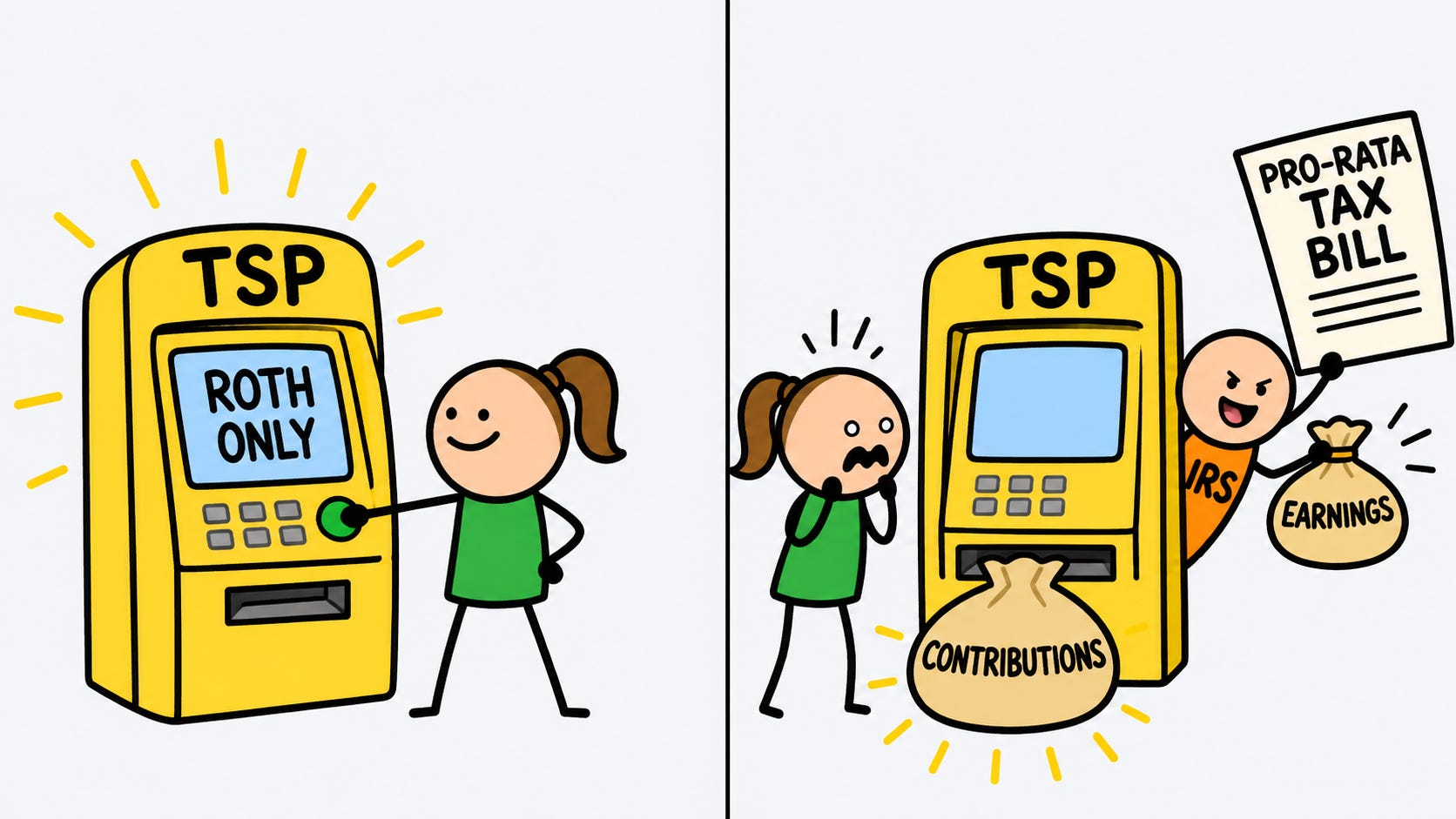
A TSP account with both traditional and Roth money holds two separate pots, and the TSP keeps them apart because the IRS taxes them differently. Most of the time that separation is invisible. Contributions go in, the balances grow, and the statement shows a single number at the top.
It stops being invisible the day a separated participant asks for money. The withdrawal screen asks where the money comes from, and the answer can change the tax bill on the same dollar amount by thousands.
A separated participant who is leaving some money in the account can direct a withdrawal to come only from the traditional balance, only from the Roth balance, or pro rata. Pro rata means the withdrawal carries the same percentages of traditional and Roth as the account. Installments work the same way: they can be set to draw from traditional first or Roth first, and when the chosen source runs dry, payments continue from the other one. A total distribution takes everything, so there is nothing left to choose.
The traditional side is generally simple. Pretax contributions and their earnings are taxable income in the year they come out. The one exception is traditional money that uniformed services members contributed from tax-exempt combat zone pay: those contributions stay tax free when withdrawn, though their earnings are taxable.
The Roth side has a wrinkle that surprises people who are used to Roth IRAs. Any money taken from the Roth balance carries a proportional mix of Roth contributions and the earnings on them, and the TSP does not let anyone withdraw only the contributions. The contribution portion is never taxed. The earnings portion is tax free only when the withdrawal is qualified, which takes two things: five years since January 1 of the year of the first Roth TSP contribution, and age 59.5, permanent disability, or death. Miss either one and the earnings portion is taxable. Roth IRAs work differently, paying out contributions first, which is why the TSP rule catches people off guard.
Withholding follows the taxable dollars. When a partial withdrawal eligible for rollover is paid directly to the participant, the TSP generally must withhold 20% of the taxable portion for federal income tax. On the Roth side, that means 20% of any nonqualified earnings. Required minimum distributions and certain installment payments follow different withholding rules. The source preference also has a limit on installments based on life expectancy: the TSP figures those payments from the entire account balance, traditional and Roth together, even when the payments are set to draw from one side first.
What happens if the withdrawal comes earlier than that? For someone under 59.5, the taxable portion of any withdrawal, traditional dollars and nonqualified Roth earnings alike, can also face the 10% early withdrawal penalty unless an exception applies, such as separating from service in or after the year of turning 55.
Two other rules follow from the source choice. For someone at required distribution age, only withdrawals from the traditional balance count toward the yearly requirement, so a Roth withdrawal leaves the requirement untouched. And if Roth money is rolled into a Roth IRA, the TSP’s five-year clock does not come along. The Roth IRA’s own clock applies instead, starting from the first year the person contributed to any Roth IRA.
So the timing questions are these. The five-year Roth clock runs from January 1 of the first Roth TSP contribution year. Age 59.5 is the other half of qualification. The tax year of the withdrawal is where the income lands. The source choice is made on each withdrawal request and can be different every time.
Karen separated from federal service at 58 and is now 60. Her TSP holds $320,000 traditional and $80,000 Roth, and the Roth balance is $60,000 of contributions and $20,000 of earnings. She made her first Roth TSP contribution three years ago, so her Roth earnings are not yet qualified even though she is past 59.5. She needs $20,000.
If she takes it pro rata, the withdrawal mirrors her account: $16,000 traditional and $4,000 Roth. The Roth piece is $3,000 of contributions and $1,000 of earnings. Taxable income: $17,000.
If she takes it all from traditional, all $20,000 is taxable.
If she takes it all from Roth, the $20,000 is $15,000 of contributions and $5,000 of earnings. Because the five-year requirement is not met, the $5,000 is taxable. Taxable income: $5,000. Since she is over 59.5, no 10% penalty applies to any of these options.
Two years later, when her five-year clock is complete, the same Roth-only withdrawal would be entirely tax free.
The source choice is one of the more useful levers in the TSP, and it resets every time money comes out. The same withdrawal can produce very different taxable income depending on which box gets checked.
What matters is where each balance stands on its own clock: the five-year Roth requirement, age 59.5, and any required distribution due from the traditional side. For how a TSP balance compares once it leaves for an IRA, including how Roth IRA ordering differs, our rollover IRA guide covers the move.
I write one of these every day, one retirement rule, explained in plain language and verified against the source. The daily email is free: subscribe here.
Full archive, worksheets, and search live at RetirementNewsRundown.com.
Disclaimer
This article is for educational and informational purposes only. It is not tax, legal, or financial advice and does not create an advisor-client relationship. Always consult appropriate professionals regarding your specific situation.