Social Security, in plain English: the rules that decide your benefit
A plain-English map of how Social Security decides your benefit, then a link to the full breakdown of each specific rule.
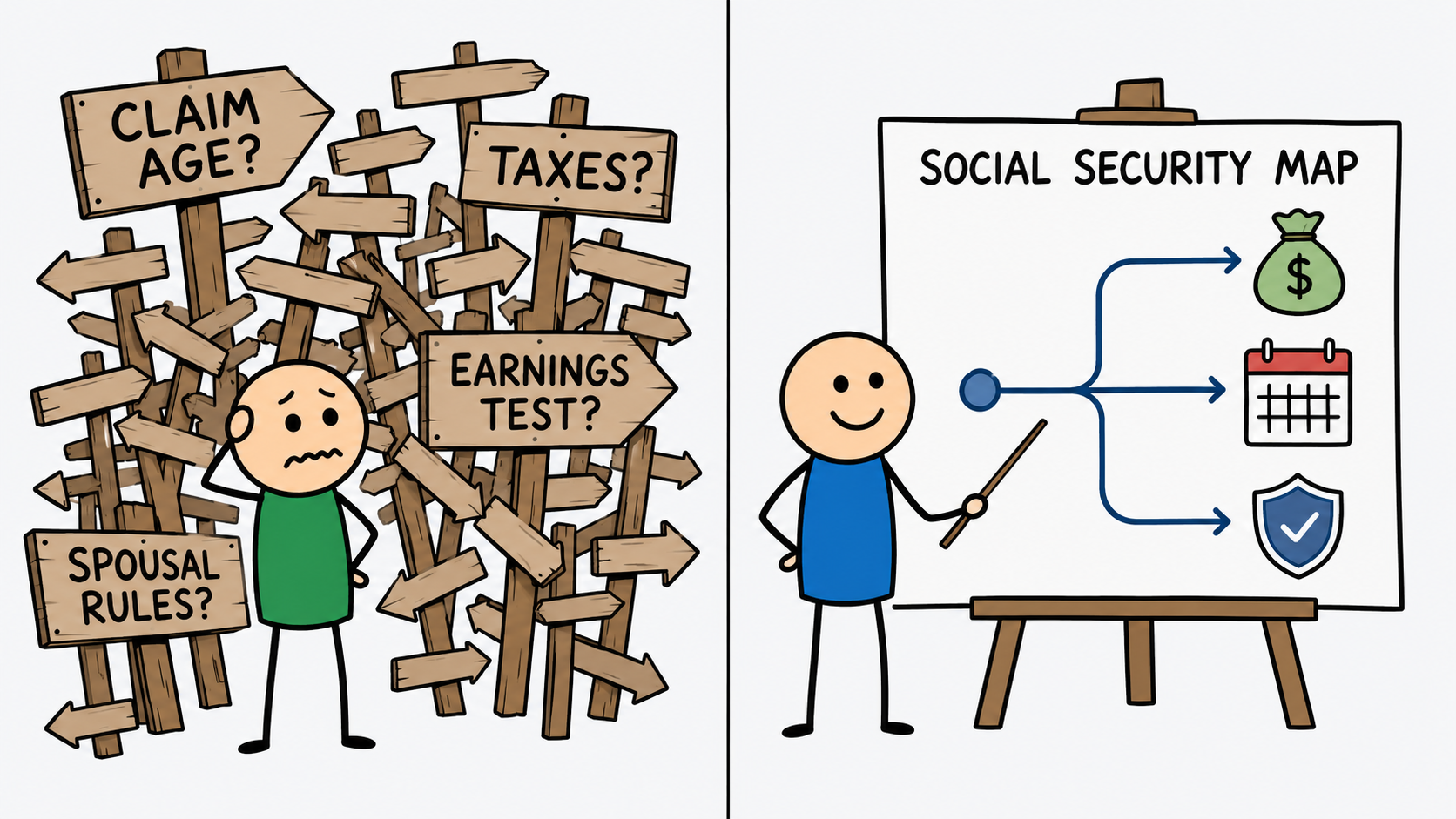
Social Security looks simple from the outside. You worked, you paid in, you collect a check. The rules that decide how big that check is, and when you should turn it on, are where the real money lives, and most of those rules are working quietly in the background whether you understand them or not. This page is the map. It walks through how the system decides your benefit, then points you to the full breakdown of each specific rule.
Key Concepts
Full Retirement Age (FRA)
For anyone born in 1960 or later, your full retirement age is 67. This is the benchmark Social Security uses to size every reduction and every increase to your monthly benefit.
Early Claiming Reduction
Filing for your own benefit before your full retirement age permanently reduces your monthly amount. The reduction is calculated month by month back to age 62 and does not go away once you reach full retirement age.
Delayed Retirement Credits
Filing after your full retirement age increases your monthly benefit through age 70 via delayed retirement credits. There is no additional benefit to waiting past 70.
Spousal Benefit Ceiling
A spouse can receive up to half of the higher earner's full retirement benefit. Unlike your own benefit, a spousal benefit does not grow past full retirement age.
Survivor Benefit
A surviving spouse can receive up to the full amount the deceased was receiving. Survivor benefits have more claiming-age flexibility than any other Social Security decision.
Taxability Depends on Other Income
Whether your Social Security benefits are taxable depends on your combined income under a formula whose thresholds have not been adjusted for inflation. More retirees fall into taxation every year as a result.
Full Retirement Age and Claiming Timing
The center of everything is your full retirement age. For anyone born in 1960 or later, that age is 67. It is the benchmark Social Security uses to calculate every reduction and every increase. Claim before it and your monthly benefit is permanently reduced. Claim after it and your benefit grows through delayed credits until age 70. The single decision of when to claim, measured against your full retirement age, shapes your income for the rest of your life. The full breakdown of how claiming at 62, 67, and 70 compare is in the claiming age guide.
The Earnings Test
If you claim early and keep working, a second rule kicks in. Before your full retirement age, earning above an annual limit causes Social Security to withhold part of your benefit, then recalculate it upward once you reach full retirement age. It feels like a penalty, but the mechanics are more forgiving than they look. How the earnings test actually works, and what happens to the withheld money, is covered in the earnings test guide.
Spousal and Survivor Benefits
Married, divorced, and widowed retirees have their own set of rules, and they are where the biggest planning decisions hide. A spouse can receive up to half of the higher earner's full retirement benefit, and unlike your own benefit, a spousal benefit does not grow past full retirement age. The specifics are in the spousal benefit guide. Survivor benefits work differently and more generously, a surviving spouse can receive up to the full amount the deceased was receiving, with more flexibility in timing than any other Social Security decision offers. That mechanism is broken down in the survivor benefit guide.
Taxability
Social Security benefits can be taxable, depending on your other income, and the thresholds that trigger that tax have not moved in decades, which pulls more retirees into taxation every year. How that calculation works is in the taxability guide.
WEP and GPO Repeal
For retirees who spent part of their careers in jobs not covered by Social Security, the old rules that reduced their benefits, known as WEP and GPO, were repealed under the Social Security Fairness Act. What that repeal changed is covered in the WEP/GPO guide.
Roth Conversion Coordination
If you are doing Roth conversions in your early retirement years, the timing of when you file for Social Security and when you convert interact in ways that can raise your tax bill or your Medicare premiums. How to think about the sequence is in the Social Security and Roth conversion timing guide.
Social Security is a system of specific, knowable rules, not a mystery. Each one above has a full plain-language breakdown, and understanding where you stand on each is what turns a permanent, largely irreversible decision into an informed one.
Frequently Asked Questions
At what age can I start collecting Social Security?
You can file as early as age 62. Your full retirement age depends on your birth year, and for anyone born in 1960 or later, it is 67. Filing at 62 permanently reduces your benefit; filing after your full retirement age grows it through age 70. Full breakdown: the claiming age guide.
How much does claiming early reduce my benefit?
Claiming before your full retirement age permanently reduces your monthly benefit by a fixed percentage for every month you file early. The reduction compounds, so the gap between claiming at 62 and waiting until 70 is significant across a full retirement. See the claiming age guide for the exact percentages.
Are Social Security benefits taxable?
It depends on your other income. Because the thresholds that trigger the tax have not moved in decades, more retirees fall into taxation every year. The plain-English breakdown of the calculation is in the taxability guide.
Did the repeal of WEP and GPO change my benefit?
Only if you spent part of your career in a job not covered by Social Security. Before the Social Security Fairness Act, WEP and GPO reduced benefits for people who earned pensions from non-covered work. Both rules were repealed. See the WEP/GPO guide for what actually changed.
Can I work while collecting Social Security before full retirement age?
Yes, but the earnings test applies. Before your full retirement age, earnings above an annual limit cause Social Security to withhold part of your benefit, and the withheld amount is recalculated back into your benefit once you reach full retirement age. See the earnings test guide.
How do spousal and survivor benefits differ?
A spousal benefit can be up to half of the higher earner's full retirement benefit and does not grow past full retirement age. A survivor benefit can be up to the full amount the deceased was receiving and has more timing flexibility. See the spousal benefit guide and the survivor benefit guide for the specifics.
Education-only disclaimer
This guide is for general education and information only. It does not provide individualized investment, tax, or legal advice, and does not establish a client relationship. Always consult your own tax professional, financial advisor, or legal counsel before making decisions about your accounts or retirement strategy.