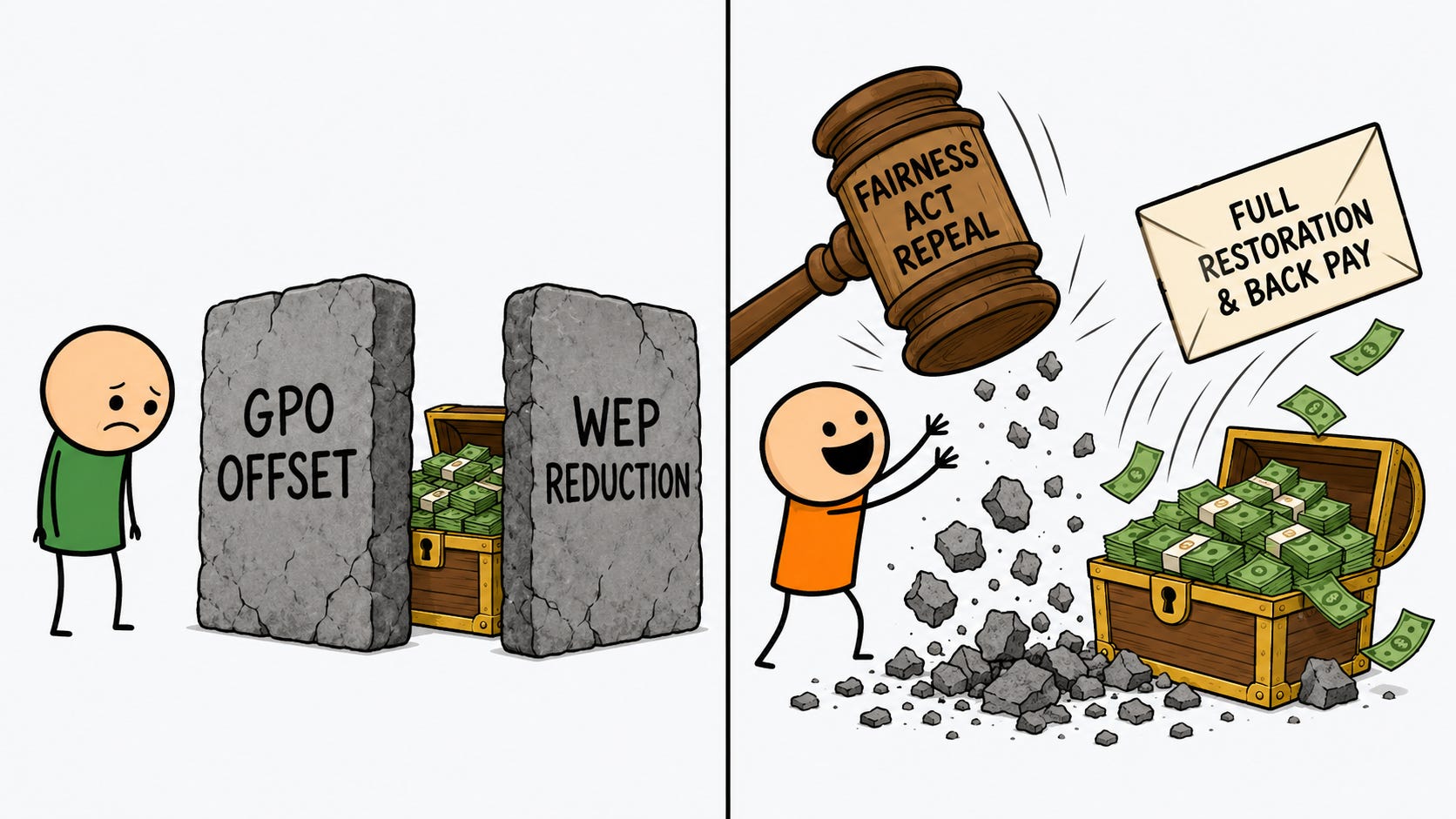
For decades, two provisions quietly reduced or erased the Social Security benefits of people who had spent part of their careers in public-sector jobs that did not pay into Social Security. Teachers, police officers, firefighters, and certain federal workers often discovered that the Social Security they had earned from other jobs, or the spousal benefit they expected from a husband or wife, arrived far smaller than the standard formula would suggest, or did not arrive at all. Those two provisions were the Windfall Elimination Provision and the Government Pension Offset. They have now been repealed, and understanding what they did explains why millions of beneficiaries saw their benefits increase. The key is not the job title by itself. The key is whether the pension came from work where Social Security taxes were not paid.
The two provisions worked differently and hit different benefits, which is the first thing to get straight. The Windfall Elimination Provision applied to a person’s own Social Security benefit. When someone earned a pension from work not covered by Social Security, and also qualified for Social Security through other covered work, this provision modified the standard benefit formula to produce a smaller benefit than the normal calculation would. It reduced the first and most generous factor in the formula that converts a person’s earnings history into a benefit. There were limits on the damage. A worker with enough years of substantial covered earnings was exempt entirely, and the reduction could never exceed half of the non-covered pension. But for many affected workers, the provision meaningfully shrank the Social Security benefit they had earned through their covered jobs.
The Government Pension Offset was the harsher of the two, and it applied to spousal and survivor benefits rather than to a person’s own. When someone was entitled to a Social Security benefit as a spouse, widow, or widower, and also received a pension from non-covered government work, this provision reduced that spousal or survivor benefit by two-thirds of the non-covered pension. Because two-thirds of a typical government pension is often a large number, this frequently eliminated the spousal or survivor benefit completely. A surviving spouse who expected to step into a meaningful survivor benefit could find it offset all the way down to nothing, purely because they also held a government pension of their own.
The Social Security Fairness Act repealed both provisions. The repeal is permanent, with no expiration built into it. Its effective reach applies to benefits payable for months after December 2023, which is why the recalculations and back payments trace to January 2024 rather than to the date the law was signed. Those two dates get confused constantly. The law was signed in early 2025, but it reached backward, restoring the full benefit for the period beginning in January 2024 and going forward from there.
For the vast majority of people already receiving reduced benefits, the fix required no action at all. Social Security recalculated the affected benefits and issued the higher monthly amounts, along with one-time retroactive payments covering the difference for the months the old provisions had still been applied. SSA began adjusting benefits in 2025 and reported that it had sent more than 3.1 million payments totaling 17 billion dollars by early July 2025. Most already-entitled beneficiaries were handled automatically, while people who never filed because WEP or GPO would have reduced the benefit may still need to apply.
Picture a retired teacher who spent thirty years in a state school system whose employees do not pay into Social Security, and who also worked enough years in private-sector jobs to qualify for a modest Social Security benefit of her own. Under the old rules, the Windfall Elimination Provision modified her benefit formula and reduced that Social Security check below what her covered earnings alone would have produced. With the repeal, that reduction is gone. Her own Social Security benefit is now calculated under the standard formula, and it stepped up to the full amount, with back payments covering the period since the effective date.
Now consider the same teacher’s spouse situation. Her husband paid into Social Security his whole career and has since passed away, and she expected a survivor benefit on his record. Under the old rules, the Government Pension Offset reduced that survivor benefit by two-thirds of her teacher’s pension, which was large enough to wipe the survivor benefit out entirely. She had been receiving nothing on her husband’s record. With the repeal of the offset, that survivor benefit is restored in full, which for many people in her position is the larger and more life-changing of the two fixes.
The resolution is understanding that this was a restoration rather than a new benefit, and that it landed automatically for most people but not for everyone. Anyone who was already collecting a reduced benefit generally did not need to do anything, since Social Security handled the recalculation and the back pay on its own. The group that does need to act is different. Some people affected by the Government Pension Offset never filed for a spousal or survivor benefit in the first place, because the offset would have reduced it to zero and there was no point. For those people, the benefit will not appear on its own, because there is no existing claim to recalculate. They generally need to file an application. The Social Security Fairness Act did not change the ordinary retroactivity rules for new applications, so the date someone applies can still affect how many months they receive.
There is also a tax consequence worth naming, since it catches people off guard. Restored benefits are still subject to the normal rules on the taxability of Social Security. A retroactive payment can create a larger tax-year event than a steady monthly increase would have, although special lump-sum reporting rules may reduce the taxable amount in some cases. The repeal fixed the benefit reduction. It did not create a special tax-free category for the restored money. The clean way to think about it is that these workers are now treated like any other Social Security recipient, for better in the size of the benefit and for the ordinary tax treatment that comes with it.
I write one of these every day, one retirement rule, explained in plain language and verified against the source. The daily email is free: subscribe here.
Full archive, worksheets, and search live at RetirementNewsRundown.com.
Disclaimer
This article is for educational and informational purposes only. It is not tax, legal, or financial advice and does not create an advisor–client relationship. Always consult appropriate professionals regarding your specific situation.