Two retirement decisions that people usually think about separately turn out to be tightly linked. One is when to start Social Security. The other is whether and when to convert traditional retirement money to Roth. Each is complicated on its own, but the place where they meet creates consequences that neither decision shows when examined alone. A Roth conversion done in a year when Social Security is already flowing behaves very differently from the same conversion done before benefits begin, and understanding why is the difference between a conversion that works as intended and one that quietly triggers costs the person never saw coming.
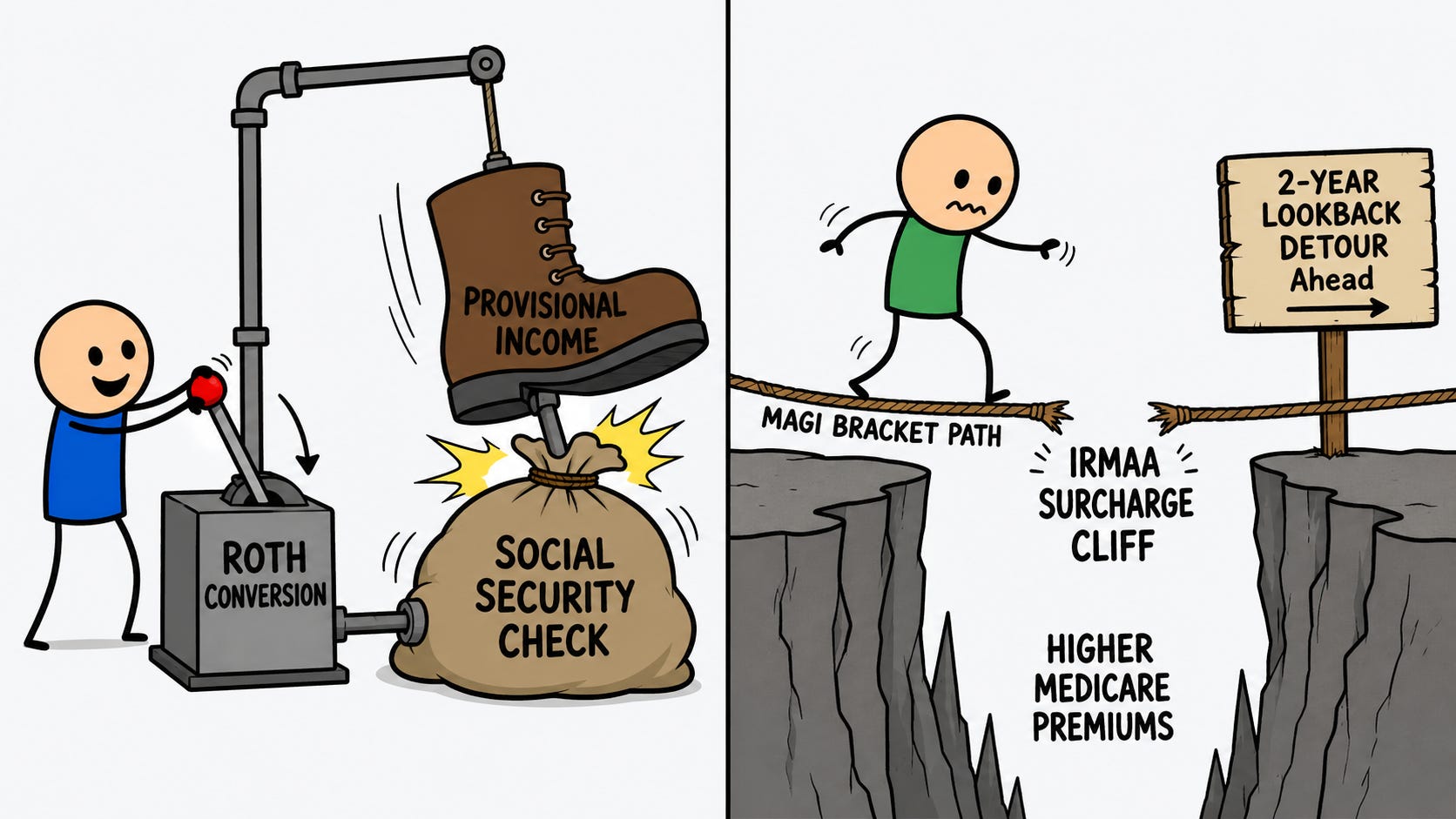
A Roth conversion is treated as ordinary taxable income in the year it happens. The converted amount gets added to the person’s income for that year and taxed accordingly. That much most people expect. What they do not always see is that the same converted amount also lands in provisional income, the measure that decides how much of a person’s Social Security benefit is subject to tax.
This is the hinge. If a person is already collecting Social Security when they convert, the conversion income does two things at once. It gets taxed on its own, and it can push more of the Social Security benefit into taxable territory, because it raised the provisional income figure that governs benefit taxation. A single conversion can therefore generate a tax bill larger than the conversion amount alone would suggest, since it drags a portion of the previously untaxed or lightly taxed benefit along with it. This is the interaction that makes conversion timing and filing timing inseparable.
The same conversion done in a year before Social Security has started avoids that particular collision. With no benefit being received, there is no benefit to pull into the taxable column. The conversion income is taxed on its own terms without the added drag on a Social Security check. This is why the years between leaving work and starting benefits often carry a structural feature worth recognizing. Income is frequently lower in that gap, the tax brackets sit relatively empty, and no Social Security benefit is yet exposed to the provisional income math. It is a window where the conversion may avoid one specific collision, pulling an active Social Security benefit into the provisional income formula. Avoiding the Social Security collision does not mean the conversion is automatically cheap. It only means there is no current Social Security benefit being pulled into the taxable-benefit formula.
There is a second cost that binds independently of the tax brackets, and it operates on a delay. Medicare premiums are keyed to income through IRMAA, a surcharge system based on MAGI that generally looks back two years. A conversion done in one year can raise the income figure that determines Medicare premiums two years later, and the surcharge tiers work as cliffs rather than gradual slopes, so crossing a threshold by a small amount can lift premiums for a full year. Because the lookback is two years, conversions done at certain ages set the premium a person pays once Medicare begins, which adds another layer of timing to think through that has nothing to do with the Social Security filing date itself but everything to do with the overall sequence.
A third consideration currently sits on top of these for taxpayers old enough to qualify, a temporary additional deduction for older taxpayers that phases out as income rises. A large conversion can push income into the range where that deduction shrinks, which raises the effective cost of the conversion during the years the deduction exists. Because it is temporary, it is a feature of the current landscape rather than a permanent part of the calculation.
Consider two people with identical traditional IRA balances, each wanting to convert a meaningful amount to Roth, and each around the age when Social Security becomes a live option.
The first person has already filed for Social Security and is collecting a monthly benefit. When they convert, the conversion income stacks on top of the benefit. It raises their provisional income, which pulls a larger share of their Social Security into the taxable column, and it counts toward the income figure that will set their Medicare surcharge two years later. The conversion still moves money into a Roth, but it does so at a higher combined cost than the raw conversion amount implied, because the benefit taxation and the premium surcharge both responded to the same income.
The second person has not yet filed. They are living on other resources in the gap between work and benefits. When they convert the same amount, there is no Social Security benefit in the picture to be dragged into taxation. The conversion is taxed on its own, in brackets that may be relatively empty because no benefit and no required distributions are filling them yet. The identical conversion produces a cleaner result on the Social Security side, not because the conversion was different, but because of what else was or was not happening in the same tax year.
The resolution is recognizing that the filing decision and the conversion decision share a single tax year and therefore cannot be optimized in isolation. The variable that links them is provisional income, the same measure that governs Social Security taxation, and conversions feed it directly. A conversion made while benefits are flowing interacts with the taxation of those benefits, while a conversion made before benefits begin does not, and the years before both Social Security and required distributions start tend to be the ones with the most open bracket space.
None of this dictates a single correct sequence, because the right ordering depends on a person’s other income, the size of their traditional balance, how close they are to Medicare and to required distributions, and how the surcharge cliffs and the temporary deduction fall in their particular case. What the mechanics make clear is that these two decisions are one decision viewed from two angles. Filing turns on a benefit that conversions can make more taxable, and converting turns on brackets and income thresholds that the timing of filing helps set. Seeing the interaction is what lets a person weigh the sequence deliberately, rather than making each choice as though the other were not sitting in the same tax return.
I write one of these every day, one retirement rule, explained in plain language and verified against the source. The daily email is free: subscribe here.
Full archive, worksheets, and search live at RetirementNewsRundown.com.
Disclaimer
This article is for educational and informational purposes only. It is not tax, legal, or financial advice and does not create an advisor–client relationship. Always consult appropriate professionals regarding your specific situation.