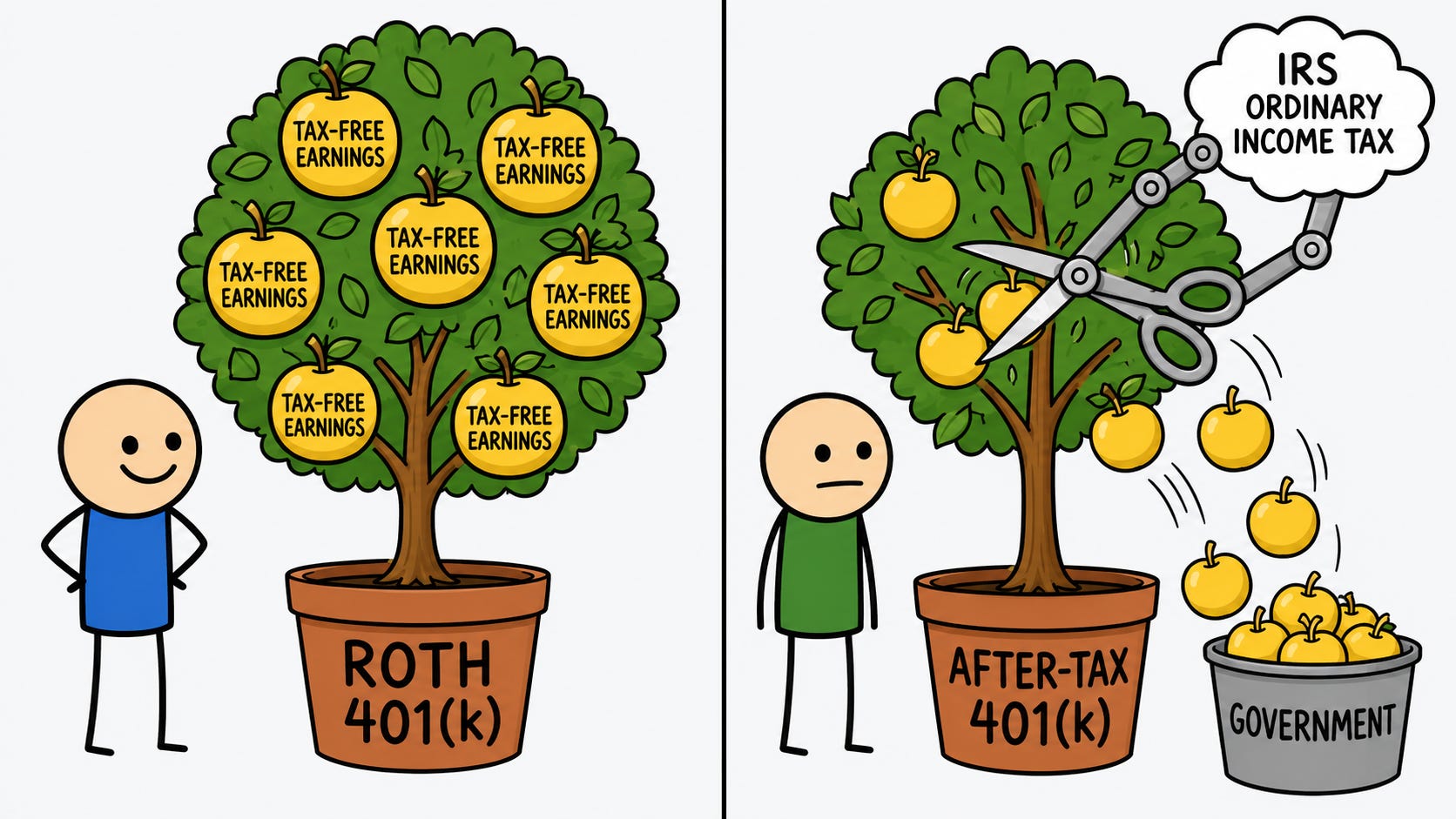
Most people know their 401(k) offers a traditional option and, increasingly, a Roth option. Fewer know there is a third category hiding in some plans, one with a name so similar to Roth that people assume it is the same thing. After-tax contributions are not Roth contributions, even though both go into the account with money that has already been taxed. The resemblance is real on the way in and disappears on the way out, and mistaking one for the other can lead someone to expect tax-free growth they are not actually getting.
A 401(k) can hold three distinct types of employee money, and keeping them separate is the whole point. Pre-tax contributions go in before tax, lower this year’s taxable income, and are fully taxed when withdrawn. Roth contributions go in after tax, do nothing for this year’s taxable income, and can come out completely tax-free in retirement, both the original contributions and the growth, if the qualified-distribution rules are satisfied. After-tax contributions are the third type. Like Roth, they go in with already-taxed dollars and do nothing for this year’s taxable income. Unlike Roth, their growth does not come out tax-free.
That last distinction is the one that matters most and the one people miss. When after-tax money is eventually distributed, the original contributions come back out tax-free, because tax was already paid on them and they created what is called basis in the account. But the earnings those contributions generated are taxed as ordinary income when they come out. The after-tax bucket grows tax-deferred, not tax-free. A Roth dollar and its lifetime of growth all escape tax at the end, provided the distribution is qualified. An after-tax dollar escapes tax on the way out, but its growth does not. Same after-tax entry, very different exit.
There is a second thing that makes after-tax contributions worth understanding, and it involves the two separate limits that govern a 401(k). The first limit is the one most people know, the cap on employee elective deferrals. That cap covers pre-tax and Roth contributions combined. Once a person has contributed up to it, they cannot put another dollar of pre-tax or Roth money in for the year. After-tax contributions live outside that elective deferral cap, if the plan permits them and the plan’s rules and testing allow room. They are not elective deferrals, so the deferral limit does not apply to them, which means a person who has already maxed their pre-tax and Roth contributions can potentially keep contributing on an after-tax basis.
But there is a second, larger limit that after-tax contributions do count against. This is the overall annual additions limit, the ceiling on everything that goes into the account in a year combined, including employee deferrals, all employer contributions like matching and profit sharing, and after-tax contributions. After-tax money fills the space between the elective deferral limit and this larger overall limit, minus whatever the employer has already put in. The room available for after-tax contributions is therefore whatever is left under the big limit after the deferrals and the employer money are accounted for.
One practical point sits underneath all of this. Not every plan allows after-tax contributions. It is an optional feature the employer chooses whether to offer, distinct from whether the plan offers a Roth option. A person cannot assume the ability to make after-tax contributions exists simply because their plan has a Roth feature, because those are two separate plan provisions.
Picture someone who has already contributed the maximum in Roth deferrals for the year, using up the entire elective deferral limit. They want to save more inside the 401(k) and their plan happens to offer an after-tax feature. They begin making after-tax contributions on top of the maxed Roth deferrals, which is allowed precisely because after-tax dollars do not count against the deferral limit they already exhausted.
Those after-tax contributions go in, and they begin generating investment earnings. Years later, when the money comes out, the split appears. Every dollar this person contributed on an after-tax basis comes back to them tax-free, because they already paid tax on it going in. But the earnings that accumulated on those dollars are taxed as ordinary income when distributed. Had those same earnings occurred inside the Roth portion of the account, they would have come out tax-free. The difference in outcome traces entirely to which bucket the growth happened in, not to how the money was taxed on the way in.
This is why the confusion between after-tax and Roth is more than a labeling problem. A person who believes their after-tax contributions will grow tax-free like Roth is planning around a benefit they do not have, and the gap shows up as a tax bill on the earnings at the worst possible time, in retirement when the money is needed.
The resolution is understanding after-tax contributions for what they are, a way to get more money into the plan after the elective deferral limit is used up, with tax-deferred rather than tax-free growth. That tax-deferred growth is the reason after-tax contributions rarely sit as a permanent home for the money. Many plans that allow after-tax contributions also allow that money to be moved into Roth treatment, which is the mechanism that turns the after-tax bucket into something more valuable by converting its future growth from taxable to tax-free. This is the doorway to what people often call a mega backdoor Roth, usually through an in-plan Roth conversion or an after-tax rollover to a Roth IRA, if the plan allows it. That movement is its own topic with its own rules, but it is the reason many people care about the after-tax feature in the first place.
The variables that decide whether after-tax contributions are even available and useful are whether the plan offers the feature at all, how much room remains under the overall annual additions limit after deferrals and employer contributions, and what the plan permits a person to do with the after-tax money once it is in. Understanding the category correctly is the necessary first step, because the entire value of after-tax contributions depends on not mistaking them for the Roth dollars they superficially resemble.
I write one of these every day, one retirement rule, explained in plain language and verified against the source. The daily email is free: subscribe here.
Full archive, worksheets, and search live at RetirementNewsRundown.com.
Disclaimer
This article is for educational and informational purposes only. It is not tax, legal, or financial advice and does not create an advisor–client relationship. Always consult appropriate professionals regarding your specific situation.