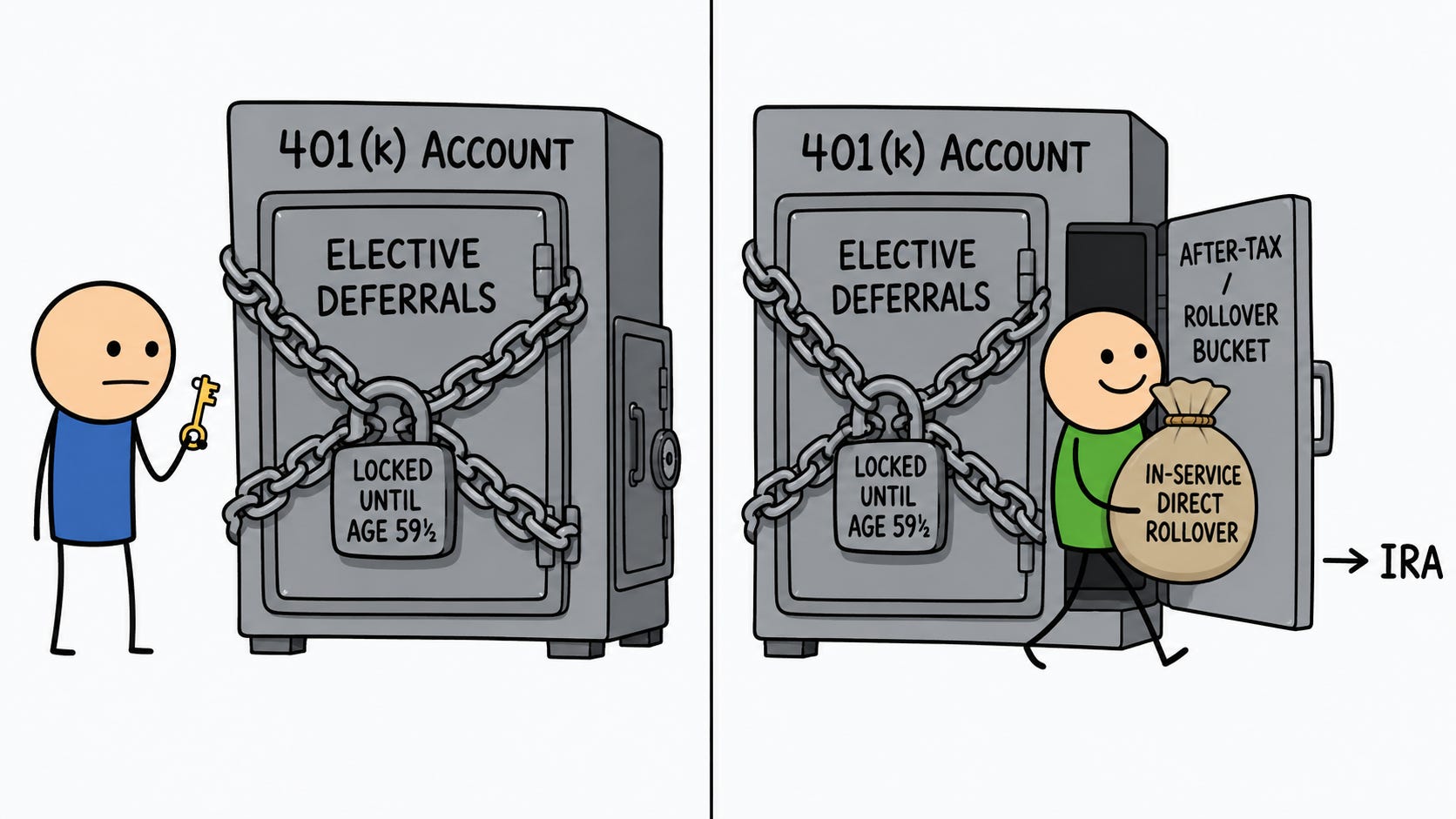
Most people believe their 401(k) is completely locked until they leave the job or reach retirement. Money goes in, it stays in, and the only way to touch it while still employed is a hardship or a loan. That belief is mostly true, but it misses a category that exists in many plans and surprises people when they discover it. An in-service distribution lets a person take money out of their 401(k) while still working for the employer that sponsors the plan, under specific conditions that depend heavily on the type of money and the person’s age. Understanding when it is possible, and how the different pieces of a 401(k) follow different rules, is the difference between accessing money cleanly and triggering an avoidable tax bill.
The starting point is that an in-service distribution is a plan feature, not a legal right. Federal law permits plans to offer them, but does not require it. Whether a person can take one, which types of money they can take, and under what conditions all live in the plan document, specifically the Summary Plan Description. Two people at two different employers can have completely different in-service options, because their plans made different choices. The first move for anyone curious about this is to read the Summary Plan Description or ask the plan administrator, because filling out paperwork for a distribution the plan does not allow is wasted effort.
The most important concept is that a 401(k) is not one uniform pot of money. It holds several distinct sources, and each source can follow its own in-service rules within the same plan. This is the piece that confuses people, because they assume access to one part means access to all of it.
Elective deferrals, the money a person contributes from their own paycheck whether pre-tax or Roth, are the most tightly restricted. Federal rules generally lock these until the person reaches age 59.5, separates from the employer, or meets another specific trigger like disability or hardship. This is why age 59.5 is the single most common in-service threshold. Once a person crosses it, plans are permitted to let them distribute their elective deferrals even while still working, which opens up the bulk of a typical 401(k) balance.
Other sources may move more freely if the plan allows it. After-tax contributions, the third category distinct from pre-tax and Roth, are often the source people see used for in-service access, especially in plans built to support after-tax rollover or Roth-conversion strategies. Rollover money, dollars a person brought into the plan from a prior employer plan or IRA, may also have its own in-service access rules. Neither should be assumed. The plan document decides. Employer money, the matching and profit-sharing contributions, follows its own schedule. The plan may allow distribution of vested employer money at an age specified in the plan, after severance from employment, because of hardship, or after another event written into the plan. The result is that a person under 59.5 may be locked out of their own deferrals while still having access to other sources, depending entirely on what the plan permits for each one.
Age 59.5 carries a second meaning beyond availability, and it is the tax consequence. A taxable in-service distribution taken before 59.5 generally carries the ten percent early distribution penalty on top of ordinary income tax, the same penalty that applies to any early retirement withdrawal. Reaching 59.5 generally removes the ten percent early distribution penalty on taxable amounts, but it does not make pre-tax money tax-free. Ordinary income tax still applies unless the money is moved by a valid rollover. So the age threshold does two things at once, it unlocks the elective deferrals and it ends the early withdrawal penalty on taxable amounts.
Picture someone in their late fifties, still working, who has just reached age 59.5 and wants to move a large portion of their 401(k) into an IRA for reasons of their own while continuing to work and contribute. Because they have crossed 59.5 and their plan permits in-service distributions at that age, their elective deferrals are now eligible to move. They request a direct rollover, the money travels straight from the plan to the IRA custodian without passing through their hands, and nothing is taxed or penalized. They keep working, keep contributing to the 401(k) going forward, and the money that moved is now in the IRA.
Now change the age. Suppose this person is only fifty five. Their elective deferrals are still locked, because they have not reached 59.5 and no other trigger applies. But their plan accepts after-tax contributions and allows those to be withdrawn while still employed. They can access the after-tax money through an in-service distribution even though the rest of their deferrals remain off limits, because the after-tax source follows a more permissive rule under their plan than the deferral source does. Same account, same person, different answer depending entirely on which money they are reaching for and what the plan permits for it.
The costly mistake in either case is taking a taxable distribution as cash rather than as a direct rollover. Cash in hand from a pre-tax source is taxable income, and before 59.5 it is penalized as well. The same dollars moved by direct rollover to an IRA are neither. The difference is entirely in the method, not the eligibility.
The resolution is recognizing that an in-service distribution is governed by two questions asked together. First, does the plan allow it, and for which money sources, which only the plan document answers. Second, what is the person’s age, which determines whether elective deferrals are even reachable and whether a taxable amount carries the early penalty. A person who understands that their 401(k) is a collection of separately governed money sources, rather than one locked box, can see which parts they can actually reach while still employed.
The variables that decide the outcome are the plan’s specific provisions, the person’s age relative to 59.5, the particular source of money they want to access, and the method they use to take it. The reason this matters is that in-service access, where it exists, opens up choices that most people assume are impossible until they leave the job, from consolidating money into an IRA at 59.5 to reaching after-tax dollars earlier. But every one of those choices sits on top of the plan’s permission and the tax mechanics of how the money comes out, and neither of those should be assumed rather than confirmed.
I write one of these every day, one retirement rule, explained in plain language and verified against the source. The daily email is free: subscribe here.
Full archive, worksheets, and search live at RetirementNewsRundown.com.
Disclaimer
This article is for educational and informational purposes only. It is not tax, legal, or financial advice and does not create an advisor–client relationship. Always consult appropriate professionals regarding your specific situation.