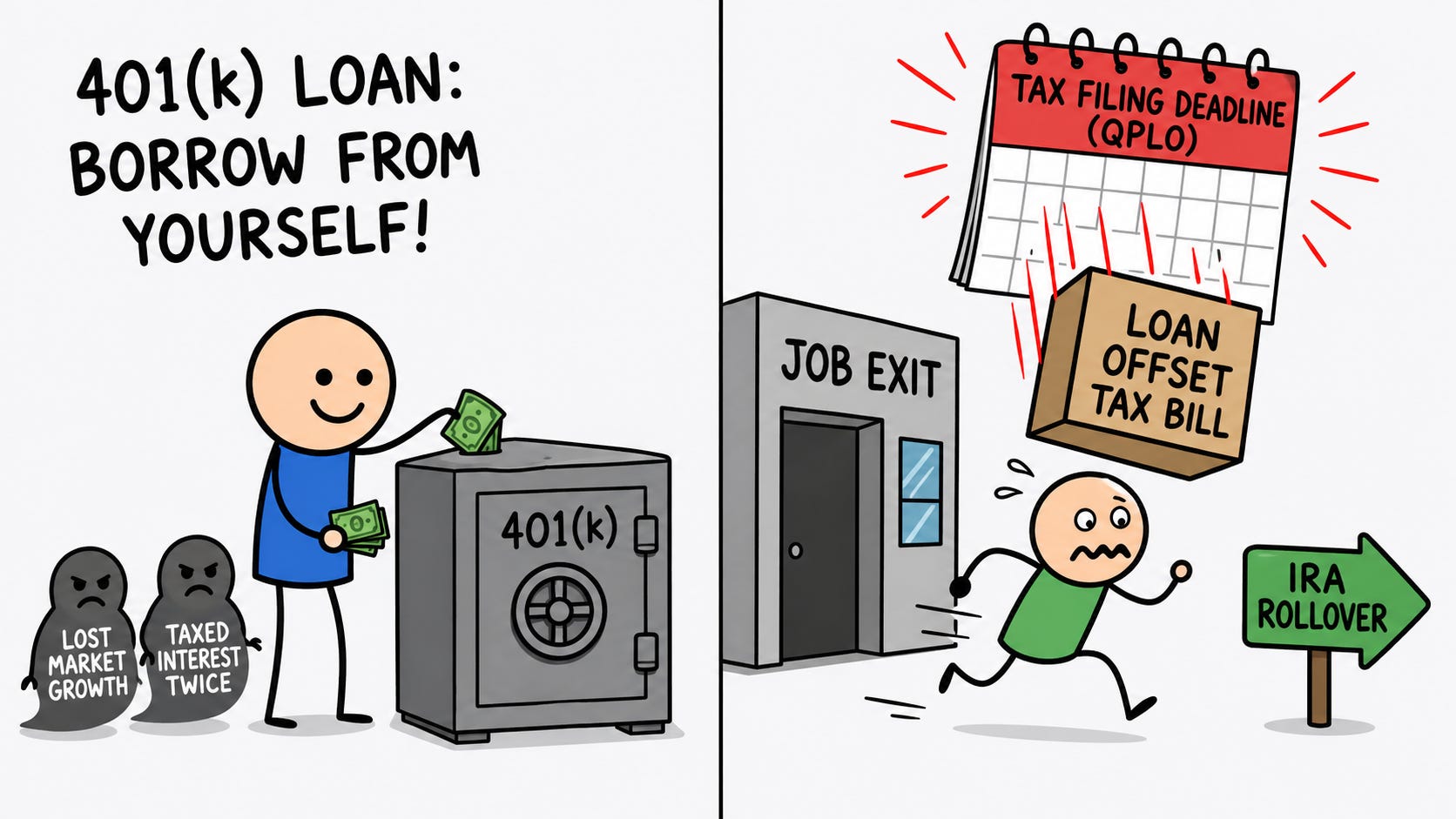
Borrowing from a 401(k) sounds almost too good to be true. The money is already yours, there is no credit check, no bank, and the interest you pay goes back into your own account instead of to a lender. For a lot of people that framing makes it feel like borrowing from yourself is nearly free, a clever way to access money without the cost of real borrowing. The mechanics are real, but so are the costs and the traps hiding inside them, and the single most expensive one has nothing to do with interest at all. It shows up when a person leaves the job.
A 401(k) loan is a plan feature, not a guarantee, so the first thing to know is that the plan has to offer loans at all. When it does, federal rules set the outer boundaries. A person can generally borrow the lesser of fifty thousand dollars or half of their vested account balance. Someone with a vested balance of eighty thousand can borrow up to forty thousand, half the balance. Someone with a balance of several hundred thousand hits the fifty thousand dollar ceiling instead, because that cap is a fixed statutory number that does not rise with the account. A small-balance rule may allow a plan to permit more than half of the vested balance, up to the statutory ten thousand dollar floor, but only if the plan is written that way. There is also a wrinkle that catches repeat borrowers, because the fifty thousand ceiling is reduced by the highest outstanding loan balance a person had in the prior twelve months, measured at its peak rather than its current level.
Repayment generally has to happen within five years, through level payments made at least quarterly, and in practice almost always through automatic payroll deduction. The one exception to the five year term is a loan used to buy a primary residence, which a plan may allow to stretch over a much longer period, often ten to fifteen years depending on the plan. As long as the payments are made on schedule, the loan is not a taxable event. This is the important line that separates a loan from a withdrawal. A withdrawal is taxed and possibly penalized immediately. A loan repaid on time is neither. The loan avoids tax only because it remains a loan. Once it fails the loan rules, the tax system stops treating it like borrowed money and starts treating it like a distribution.
The phrase paying yourself back conceals two real costs. The first is opportunity cost. Money pulled out as a loan is money no longer invested, so it misses whatever the market did while it was out. The interest paid back into the account does not replace that lost growth, it simply is not the same thing as the returns the money would have earned if it had stayed invested. Over a multi year loan during a strong market, the growth given up can dwarf the interest paid in.
The second hidden cost is a quiet form of double taxation on the interest in a traditional 401(k). The interest portion is paid back with after-tax dollars, and when it later comes out of the traditional account in retirement, it is taxed again as ordinary income. The interest dollars therefore pass through taxation twice, once when earned to make the payment and again when finally distributed. This does not make a loan catastrophic, but it does puncture the idea that paying interest to yourself is free.
The trap that does the most damage appears when a person leaves the job with a loan still outstanding, whether they quit or are let go. While employed, the loan is repaid quietly through payroll. Once the paychecks stop, the plan can call the remaining balance due, and this is where people get hurt.
Picture someone who borrowed a substantial amount and is a couple of years into repaying it when they change jobs. The outstanding balance does not simply continue on the old schedule. It becomes what is called a loan offset. When the job change creates a qualified plan loan offset, the person generally has until the due date of their federal tax return for the year of the offset, including extensions, to roll the offset amount into an IRA or another eligible plan. If they manage that rollover in time, they owe no tax and no penalty, and the retirement money stays intact. Under older rules the window was a brutal sixty days, and the change in the law that extended it is what gives people a real chance to save the money now.
If they miss that window, the outstanding balance is treated as a distribution. It becomes taxable income for the year, and if the person is under 59.5, the ten percent early distribution penalty can stack on top unless another exception applies. Someone who borrowed heavily and then lost their job can face a tax bill on tens of thousands of dollars at the worst possible moment, precisely when they are between paychecks and least able to absorb it. The loan that felt nearly free while employed becomes very expensive the moment employment ends.
The resolution is treating a 401(k) loan as a real loan with real conditions rather than a costless withdrawal from yourself. The mechanics that govern it are the borrowing limit tied to the vested balance, the five year repayment term with its primary-residence exception, and the requirement that payments stay on schedule to avoid a deemed distribution. The cost that people underweight is the combination of missed market growth and the double taxation on interest, and the risk that people fail to see coming is the loan offset that follows leaving the job.
The variables that decide how costly a given loan turns out to be are the size of the loan against the account, how long the money stays out of the market, and above all whether the person’s employment stays stable for the full repayment term. A loan repaid on schedule from a steady job is a manageable tool. The same loan interrupted by a job change becomes a race against a tax deadline. Anyone weighing a 401(k) loan is really weighing not just the terms on paper but the stability of the paycheck that is quietly repaying it, because that paycheck ending is what turns a routine loan into a taxable event.
I write one of these every day, one retirement rule, explained in plain language and verified against the source. The daily email is free: subscribe here.
Full archive, worksheets, and search live at RetirementNewsRundown.com.
Disclaimer
This article is for educational and informational purposes only. It is not tax, legal, or financial advice and does not create an advisor–client relationship. Always consult appropriate professionals regarding your specific situation.