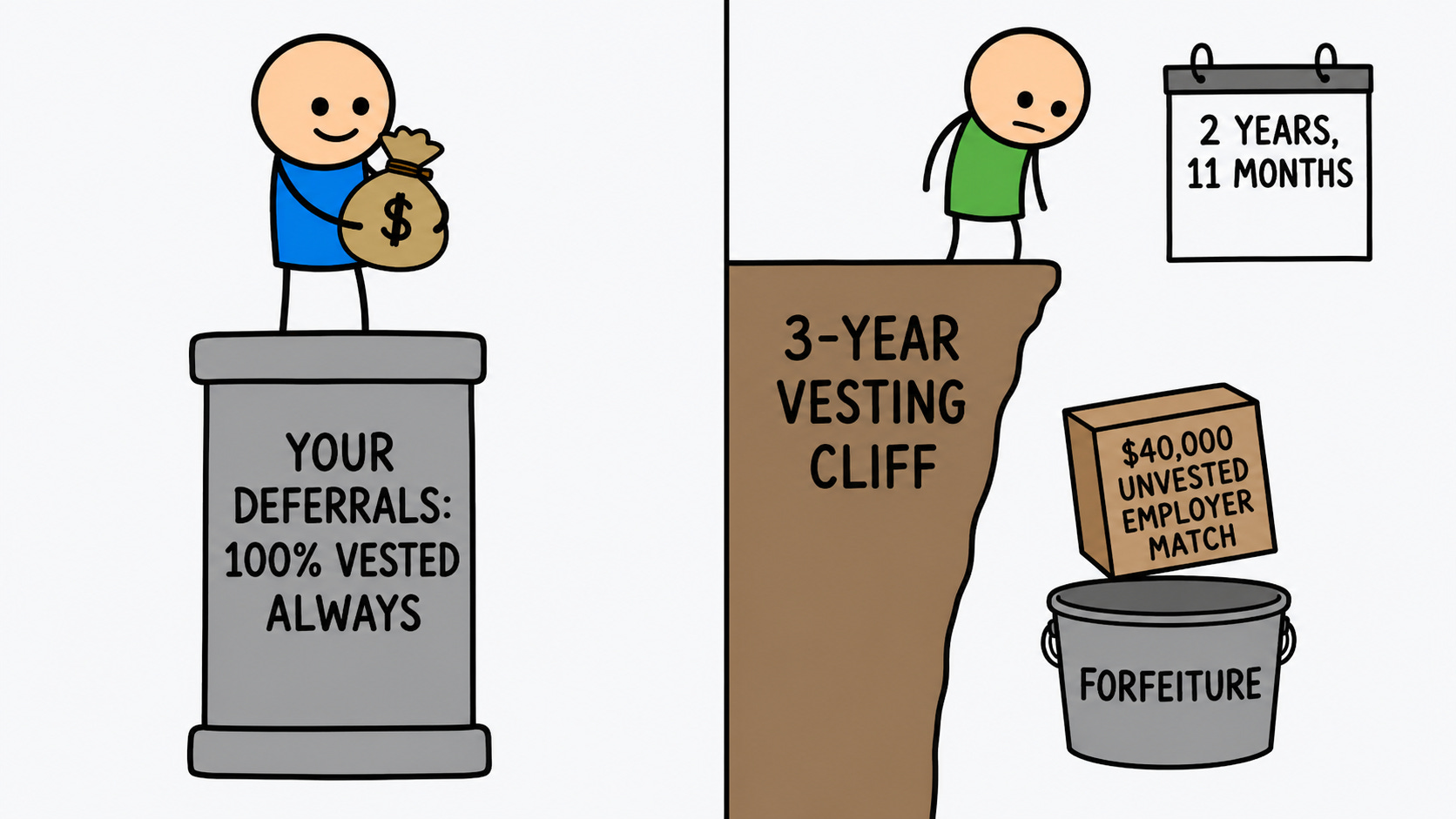
A person logs into their 401(k) and sees a balance. That number feels like their money, because it is sitting in an account with their name on it. But for anyone whose employer contributes to the plan, that balance can contain two very different kinds of dollars. Some of it cannot be taken away under any circumstances. Some of it can be forfeited when they leave the job. The line between the two is vesting, and people who do not know where that line falls in their own plan sometimes discover it at the worst possible moment, in the middle of a job change.
The first rule is the one that should reassure everyone. Money a person puts in themselves, and the earnings on that money, is theirs immediately and permanently. Elective deferrals from a paycheck, whether pre-tax or Roth, are one hundred percent vested the moment they go in. The same is true of after-tax contributions and of any money rolled in from a previous employer’s plan or an IRA. None of that can ever be forfeited, no matter how briefly someone works somewhere. Vesting schedules do not touch employee money at all.
Vesting applies only to what the employer puts in, and not even to all of that. Traditional safe harbor contributions, whether the safe harbor match or the safe harbor nonelective contribution, must be fully vested the moment they are made. Some corrective employer contributions, such as QNECs and QMACs used to fix testing failures, also have to be fully vested. What can carry a vesting schedule is ordinary employer money in a plan that is not safe harbor, meaning discretionary matching contributions and profit sharing contributions.
When a schedule does apply, federal law sets the outer limits and gives plans two shapes to choose from. The first is cliff vesting, where a person owns nothing of the employer money until they hit the threshold, and then owns all of it at once. The maximum permitted cliff is three years, so a plan cannot make someone wait longer than that before flipping them to fully vested. The second is graded vesting, where ownership builds in steps. The longest permitted graded schedule runs six years, with twenty percent vesting after two years of service and another twenty percent each year until reaching one hundred percent at six.
Both of those are maximums rather than defaults. A plan is free to be more generous, and many are. Immediate vesting, a two-year cliff, or a four-year graded schedule are all perfectly allowed because they get the employee to full ownership faster than the law requires. One special case sits in between, a QACA safe harbor plan, where required safe harbor contributions may use a vesting schedule, but the employee must be fully vested after no more than two years of service.
The detail that catches the most people is how the years get counted. Vesting is measured in years of service, and a year of service is usually not the same thing as a year on the calendar. Many plans use an hours-based method where a person earns a year of vesting service by completing at least a thousand hours of work in a plan year. Someone working part time, or someone who joined partway through a year, may not accumulate years of service at the pace their tenure would suggest. Two people hired the same week can sit at different vesting percentages if one worked substantially fewer hours.
Certain events override the schedule entirely and vest a person immediately regardless of how long they have been there. Reaching the plan’s normal retirement age does it. So does termination of the plan itself, or a partial termination affecting a group of participants, which is why layoffs and plan shutdowns often trigger full vesting for the people involved. Many plans also provide for full vesting on death or disability, though that particular provision is a plan choice rather than a universal rule.
Picture someone at a company using the six-year graded schedule, who has accumulated forty thousand dollars in employer matching contributions on top of their own deferrals. At the end of their third year of service they are forty percent vested in that employer money. If they left at that point, sixteen thousand of the employer contributions would go with them and the other twenty four thousand, plus any earnings tied to the unvested portion, would be forfeited back to the plan. Their own contributions and the earnings on those contributions leave with them in full, untouched, because employee money was never subject to the schedule.
Now change the plan to a three-year cliff and put the same person at two years and eleven months of service. Their vested percentage in the employer money is zero. Not forty percent, not partial credit for nearly three years of work. Zero. A few weeks later, at three full years of service, that same person would be one hundred percent vested in the entire forty thousand. The cliff structure means the difference between owning none of it and owning all of it can come down to a matter of weeks, which is precisely why the shape of the schedule matters as much as its length.
The resolution starts with reading the Summary Plan Description, because that document names the plan’s specific schedule, its method for counting years of service, and the events that trigger immediate vesting. A 401(k) statement usually shows both the total balance and the vested balance, and the gap between those two numbers is the amount currently at risk if employment ended.
The variables that determine what a person actually owns are which type of money the contributions are, what schedule the plan uses and whether it is more generous than the statutory maximum, how the plan counts a year of service against the hours actually worked, and whether any event has occurred that vests the account regardless. Knowing where a person sits on that schedule turns a vague sense that some of the balance might not be theirs into a specific number and a specific date. For anyone weighing a job change, that date is a real piece of information, because the mechanics do not care about intentions or near misses. Vesting credit is earned by completing the service the plan defines, and everything short of that threshold is forfeited when the employment ends.
I write one of these every day, one retirement rule, explained in plain language and verified against the source. The daily email is free: subscribe here.
Full archive, worksheets, and search live at RetirementNewsRundown.com.
Disclaimer
This article is for educational and informational purposes only. It is not tax, legal, or financial advice and does not create an advisor–client relationship. Always consult appropriate professionals regarding your specific situation./*