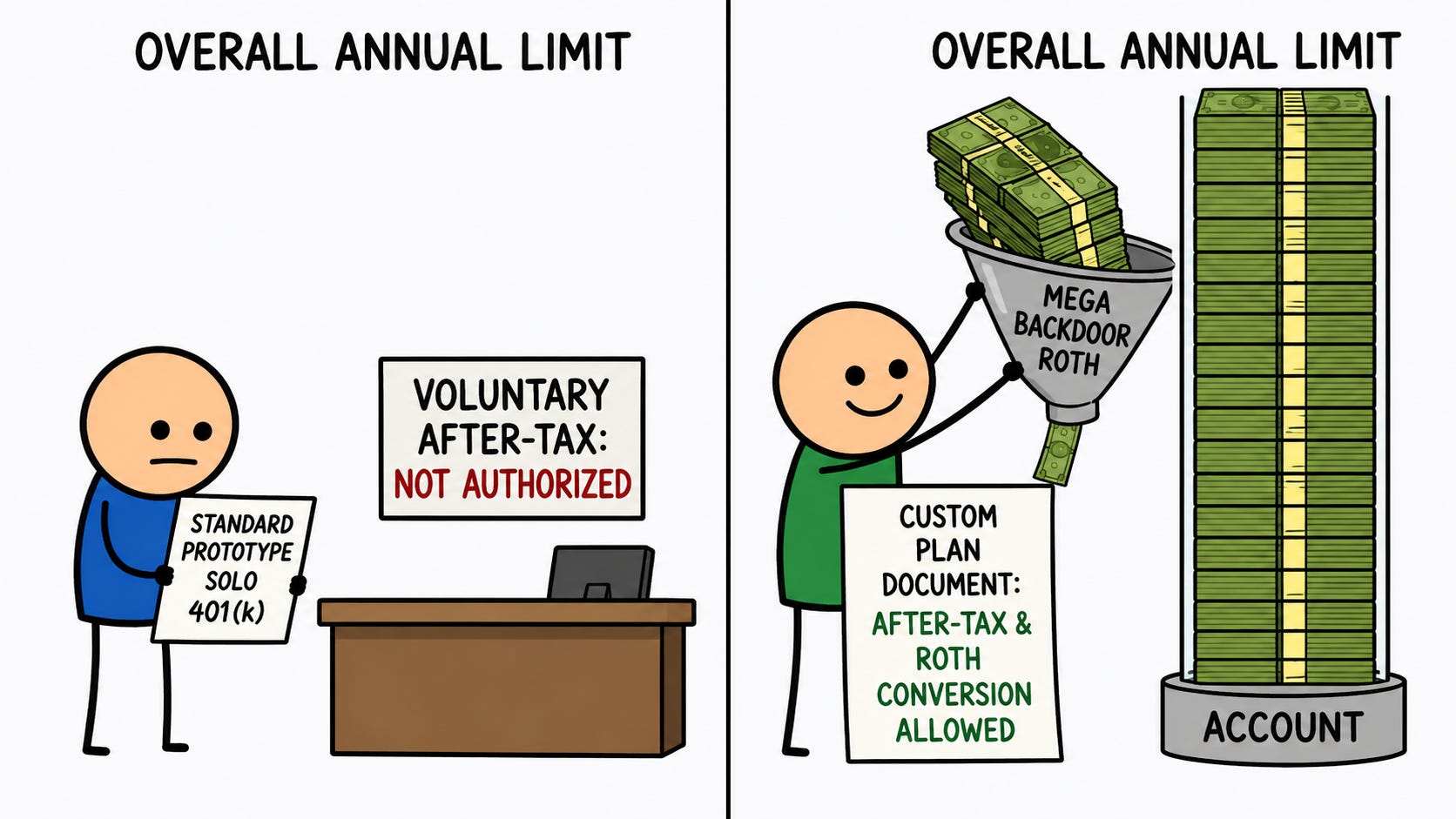
When a self-employed person opens a solo 401(k) at a major brokerage and sees a Roth option on the application, they might conclude they have access to the mega backdoor Roth. Later, when they go to use it, they find out it is not available to them. The plan document behind that account never authorized voluntary after-tax contributions, and it does not permit the in-plan Roth conversion or in-service distribution that would turn those dollars into Roth money. Understanding which Roth options are actually allowed inside a solo 401(k), and what determines whether a given plan offers them, is the difference between using a strategy like the mega backdoor Roth and having to adopt a custom plan document that allows it.
A solo 401(k) holds three different buckets of money, and the Roth rules differ for each one. Keeping them separate is what makes the rest of this make sense.
The first is employee elective deferrals, the contributions a person makes wearing their employee hat. These can go in pre-tax or as Roth, and the choice is straightforward. Roth deferrals are taxed now and grow tax-free, subject to the qualified distribution rules. They count against the same annual deferral limit that applies to every 401(k) a person participates in, across all employers combined.
The second is employer contributions, made by the person wearing their business owner hat. Historically these had to be pre-tax, with no Roth option at all. A change in the law now permits employer matching and nonelective contributions to be designated as Roth if the plan allows it, which is a meaningful expansion, and the same qualified distribution rules govern whether the eventual earnings come out tax-free. In practice, adoption has been uneven. A Roth employer contribution does not receive the same tax treatment as a pre-tax employer contribution, which is excluded from income when made. Under current reporting guidance, designated Roth employer contributions are reported for the year they are allocated, and that added reporting burden is one reason implementation has been slower and messier than the headline suggests. Many providers still do not offer the feature, so the fact that the law permits something does not mean a given plan has implemented it. Employer contributions are also calculated as a percentage of compensation, which means generating substantial room this way requires substantial income.
The third is voluntary after-tax contributions, and this is the one most people have never heard of. After-tax is not the same thing as Roth, even though both use dollars that have already been taxed. After-tax contributions do not count against the employee deferral limit at all. They occupy the space between what a person has already put in through deferrals and employer contributions and the much larger overall limit on everything that can go into the account in a year. That gap is often substantial, and after-tax contributions are what fill it.
The mega backdoor path is what happens when that third bucket gets converted. After-tax dollars are moved into Roth treatment, either through an in-plan Roth conversion inside the solo 401(k) or by rolling them out to a Roth IRA. The result is Roth money far in excess of what the deferral limit alone would allow. Unlike direct Roth IRA contributions, which phase out for higher earners, after-tax contributions to a plan carry no income limit. The overall annual additions limit is the main ceiling, but the actual room still depends on compensation, employer contributions already made, and the provisions written into the plan document.
Here is the gate that decides all of it. The plan document controls whether any of this is possible. Many standard prototype solo 401(k) documents offered by large brokerages do not authorize voluntary after-tax contributions, and many do not provide the in-plan Roth conversion or in-service distribution language needed to turn those contributions into Roth money. Without both of those provisions written into the document, the mega backdoor path does not exist inside that plan. The constraint is not the brokerage or the investments. It is the legal document governing the plan, and opening the path requires adopting a plan document that includes those features.
Picture a sole proprietor with meaningful self-employment income who wants as much Roth money as possible. They contribute the full employee deferral as Roth, then make an employer profit sharing contribution based on their compensation. Adding those two together still leaves a sizable gap beneath the overall annual limit.
With a plan document that permits it, they contribute that remaining gap as voluntary after-tax dollars, then convert those dollars to Roth. The Roth balance they build in that single year is dramatically larger than the deferral limit alone would have produced, and none of it was blocked by an income phaseout.
Now put the identical person, with identical income, in a standard prototype plan at a large brokerage. The Roth deferral works. The employer contribution works. But the after-tax step is simply unavailable, because the document does not authorize it, so the gap beneath the overall limit stays empty. Same income, same limits, same intentions, and a very different result driven entirely by paperwork.
The resolution begins with reading the actual plan document rather than assuming the account supports what the strategy requires. The two provisions to look for are authorization of voluntary after-tax contributions and permission for in-plan Roth conversions or in-service distributions of those after-tax amounts. Both have to be present.
A timing mechanic matters as well. Earnings that accumulate on after-tax dollars before conversion are taxable in the year of the conversion, while the contributions themselves are not, since tax was already paid on them. Converting promptly after contributing keeps those taxable earnings small. Letting after-tax money sit and grow before conversion creates a taxable event that a prompt conversion would have largely avoided.
One structural warning belongs here too. A solo 401(k) depends on the business having no employees other than the owner and a spouse. Adding a non-spouse employee who meets the plan’s eligibility requirements ends the plan’s one-participant status and pulls it into testing requirements that most solo plans are not built to handle. The variables that determine what a self-employed person can actually do are the provisions in their specific plan document, the type of entity and how compensation is calculated, the room remaining beneath the overall annual limit, and whether the business still has no eligible non-spouse employees.
I write one of these every day, one retirement rule, explained in plain language and verified against the source. The daily email is free: subscribe here.
Full archive, worksheets, and search live at RetirementNewsRundown.com.
Disclaimer
This article is for educational and informational purposes only. It is not tax, legal, or financial advice and does not create an advisor–client relationship. Always consult appropriate professionals regarding your specific situation.