People who know their way around retirement accounts tend to assume the HSA catch-up works like the others they have used. The 401(k) and IRA both let a person contribute extra once they reach a certain age, and the HSA does too, so the instinct is to treat it as the same rule with a different account attached. That instinct leads a married couple straight into a mistake that can waste a thousand dollars of tax-advantaged space every year. The HSA catch-up follows its own rules, and the one that you need to know has to do with whose account the money goes into.
The catch-up itself is simple enough. Starting in the year a person turns 55, the annual catch-up amount is one thousand dollars on top of their regular HSA limit, but the ability to contribute it still depends on being HSA-eligible for the relevant months. This is worth noting on its own, because the age is 55, not the 50 that governs 401(k) and IRA catch-ups. Someone who assumes the HSA catch-up starts at 50 like their other accounts will try to make it too early, and someone who waits for a later age will start too late. The trigger is the year they turn 55, and eligibility to make it depends on still being an eligible HSA contributor, which above all means being enrolled in a qualifying high deductible health plan and not being enrolled in Medicare.
Now the part that trips up couples. An HSA is an individual account. There is no such thing as a joint HSA, even for a married couple with family coverage. The account belongs to one person, the way an IRA does. This is a big deal for the catch-up, because the catch-up is a personal addition tied to the individual who is old enough to make it, and it can only go into that specific individual’s own HSA.
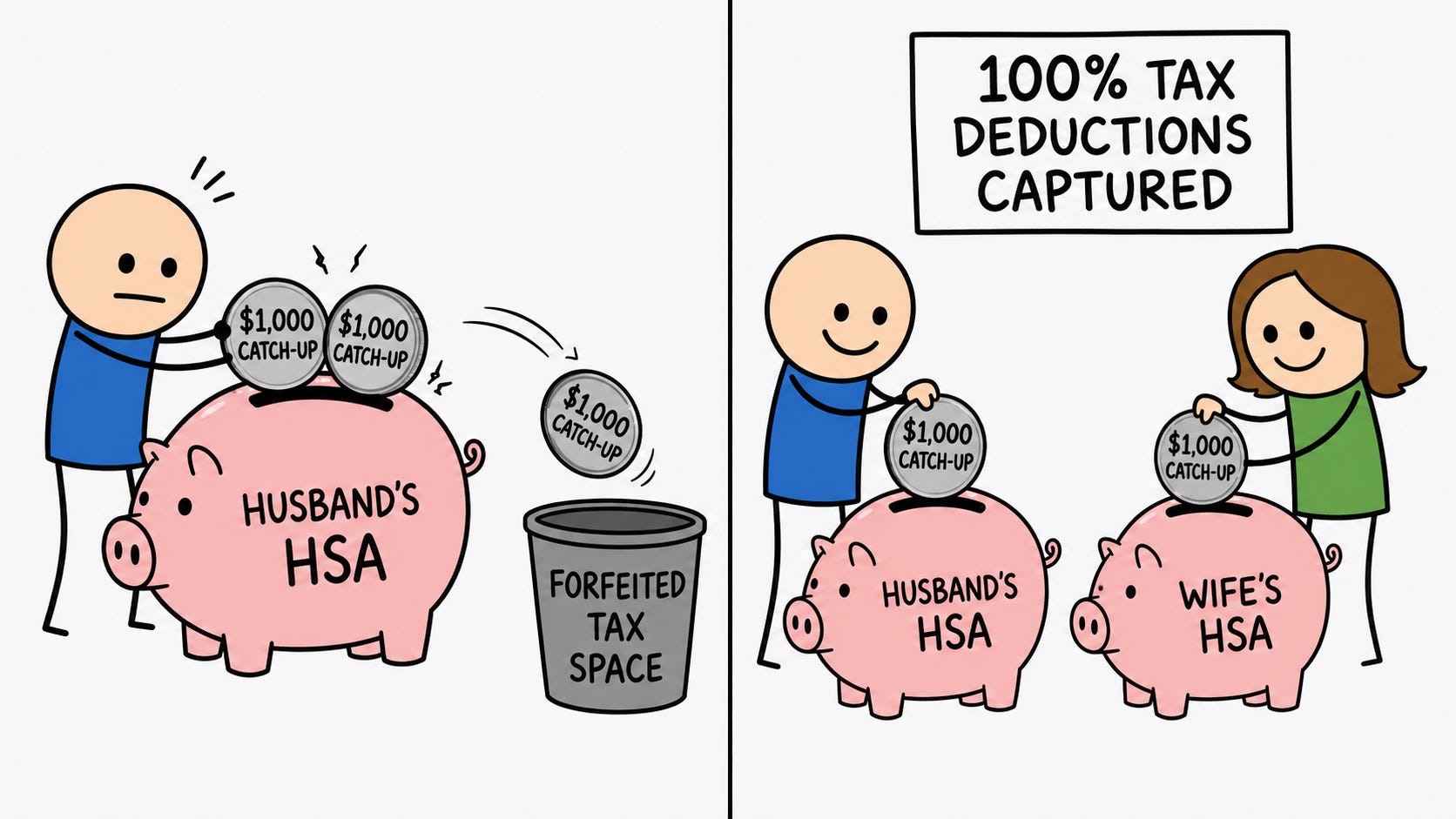
The regular family contribution limit does not work this way, which is exactly why the catch-up surprises people. A married couple with family coverage shares one family limit, and they are free to put that entire family limit into a single spouse’s HSA if they want. So a couple gets comfortable with the idea that one account can hold the household’s HSA money. Then they reach the catch-up years and assume the same flexibility applies. It does not. If both spouses are 55 or older, each of them has their own thousand dollar catch-up, and each catch-up can only be deposited into that spouse’s own account. Two catch-ups cannot both go into one spouse’s HSA. A single account cannot receive two catch-up contributions no matter how the couple would prefer to arrange it.
The consequence is direct. If both spouses are old enough but only one of them actually has an HSA, the other spouse’s thousand dollar catch-up has nowhere to go. It is not transferable to the spouse who has the account. It simply goes unused unless that second spouse opens an HSA in their own name to receive it. The fix is nothing more than opening a second account, but a couple who never realized they needed one loses that space every year they go without it.
Picture a married couple, both past 55, with family high deductible coverage. For years they have funneled all their HSA contributions into the husband’s account, because it was more convenient and the family limit allowed it. They deposit the full family limit and add his thousand dollar catch-up on top, and they think they have maxed the contribution.
Wrong. The wife is also 55 or older, which means she is entitled to her own thousand dollar catch-up. But she has no HSA of her own, so there is nowhere to put it, and it cannot be added to her husband’s account alongside his. That thousand dollars of tax-advantaged contribution is lost for the year. The moment she opens her own HSA, even with a small balance, she has a place to deposit her catch-up, and the household captures the full amount available to it. The only thing that stood between them and that extra deduction was creating the second account.
Now add a timing wrinkle. Suppose the husband is approaching 65 and about to enroll in Medicare. Medicare enrollment ends HSA eligibility completely, including the catch-up, because a person enrolled in Medicare is no longer an eligible individual who can contribute. Worse, enrollment can reach backward, since starting Social Security at or after 65 can trigger Medicare Part A coverage that applies retroactively for several months. A person who kept contributing during those retroactive months can end up with excess contributions to unwind. The catch-up years and the Medicare transition sit right next to each other, and the handoff between them has to be timed with care.
The resolution is treating the HSA catch-up as the individual, account-specific thing it is rather than a household pool. Each eligible spouse gets their own catch-up, each catch-up lives in that spouse’s own account, and a couple who wants both needs two accounts. The base family limit can be concentrated in one account, but the catch-ups cannot, and that asymmetry is the whole trap.
The variables that decide what a household actually captures are each spouse’s age relative to 55, whether each spouse who is eligible has an account of their own to receive a catch-up, and whether Medicare enrollment has ended eligibility for either of them. The contribution itself follows the same timing as the rest of the HSA, since a person generally has until the tax filing deadline for the year to make it. But the deadline does not help a spouse who has no account to contribute to, which is why the single most useful move for an older couple is confirming that both spouses hold their own HSA well before the year they want both of their catch-up contributions to count.
I write one of these every day, one retirement rule, explained in plain language and verified against the source. The daily email is free: subscribe here.
Full archive, worksheets, and search live at RetirementNewsRundown.com.
Disclaimer
This article is for educational and informational purposes only. It is not tax, legal, or financial advice and does not create an advisor–client relationship. Always consult appropriate professionals regarding your specific situation.