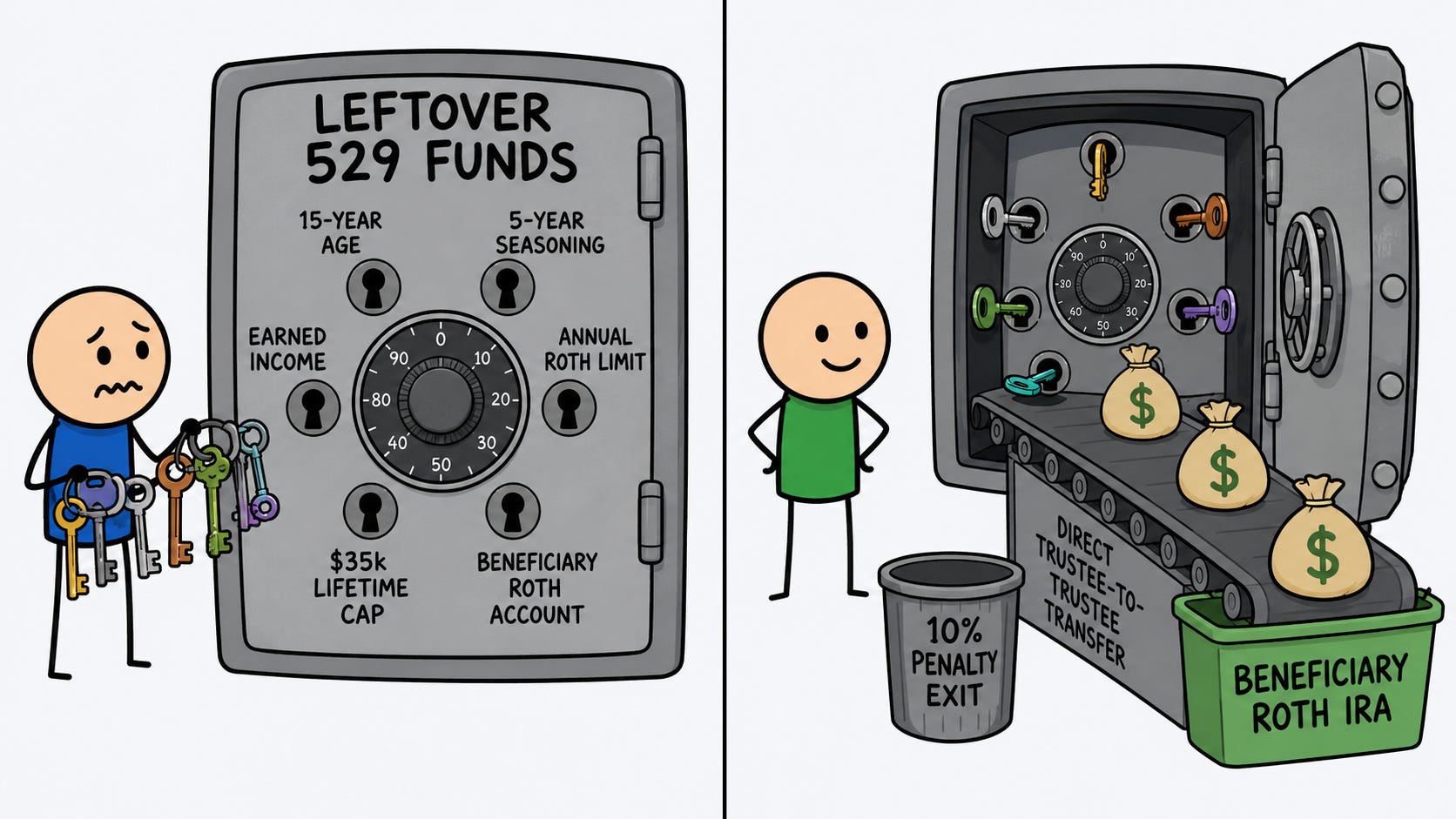
Parents who saved diligently in a 529 plan often end up with a good problem. The child earned scholarships, chose a cheaper school, or simply did not need all the money, and now there is a balance sitting in an education account with no education left to pay for. For years, one of the least attractive fallbacks for leftover money was a nonqualified withdrawal, which meant tax and a possible penalty on the earnings. Families had other ways to redirect the account, but no clean path from unused education savings into the beneficiary’s retirement account. A newer provision created exactly that, the ability to move leftover 529 money into the beneficiary’s Roth IRA. It is a genuinely useful escape hatch, but it comes wrapped in a stack of conditions that every single one must be satisfied, and missing any of them stops the rollover cold.
The provision lets money move from a 529 plan into a Roth IRA tax-free and penalty-free, which is what makes it attractive compared to simply pulling the money out. But it is fenced in by a series of guardrails designed to keep it from becoming an unlimited tax shelter, and understanding each one is the only way to know whether a given family qualifies.
The first guardrail is age. The 529 account must have been open for at least fifteen years. This clock runs from when the account was established, and it is the least forgiving part of the rule because there is no way to accelerate it. A family whose account is only twelve years old cannot open a new account to fix the problem, since a new account simply starts a new fifteen year clock. They wait.
The second is a lifetime cap. The total that can ever move from 529 to Roth for a given beneficiary is thirty five thousand dollars across their lifetime, counted across every 529 account that names them. This is not an annual figure. It is the ceiling on the entire strategy for that person, forever.
The third guardrail ties the rollover to the annual Roth contribution limit. Each year, the rollover is limited by the beneficiary’s remaining IRA contribution room. A regular contribution already made to a traditional or Roth IRA reduces how much can move from the 529 for that same tax year. This is why draining a large leftover balance is a multi year project rather than a single transfer. The lifetime cap and the annual limit together mean it takes several years of rollovers to move the full amount.
The fourth guardrail is compensation. The rollover is limited by the taxable compensation available to the beneficiary under the IRA contribution rules. For an unmarried beneficiary with no wages, self-employment income, or other qualifying compensation, there is generally no rollover room for that year, exactly the same requirement that governs an ordinary Roth contribution.
The fifth guardrail is a seasoning rule on recent contributions. Any money contributed to the 529 within the last five years, along with the earnings on those recent contributions, is excluded from the eligible pool. Only contributions and growth older than five years can move. A family that kept funding the account right up until the child finished school may find a large portion of the balance temporarily ineligible, even if the account itself easily clears the fifteen year age test.
The sixth guardrail is whose Roth IRA receives the money, and it is the one people get wrong most often. The rollover goes into a Roth IRA owned by the 529 beneficiary, the person the account was set up to benefit, not the parent who owns the 529. A parent cannot sweep leftover college money into their own Roth IRA on the strength of this provision. If the parent is the designated beneficiary and the account satisfies every other requirement, the receiving Roth IRA can be the parent’s. Changing the beneficiary shortly before the rollover creates a separate uncertainty, because current guidance has not clearly resolved whether a beneficiary change restarts the fifteen year period.
Two more mechanics round it out. The transfer has to be done directly between the 529 plan and the Roth IRA custodian, trustee to trustee, rather than by taking a check. And unlike a normal Roth contribution, this rollover is not blocked by income. A beneficiary who earns too much to make a direct Roth contribution can still receive a 529-to-Roth rollover, because the usual income phaseout does not apply here. The deadline also works like an IRA contribution deadline rather than a strict year end cutoff. Under current guidance, a qualifying transfer completed by the tax-filing deadline, generally April 15 without extensions, may be designated for the prior tax year if the beneficiary still has unused contribution room for that year.
Picture a family whose 529 has been open for eighteen years and holds a leftover balance well above the lifetime cap after the child finished school. The account clears the fifteen year test comfortably. The child, now working, has taxable compensation from a real job.
Even in this favorable case, the money cannot move all at once. The lifetime cap limits the total to thirty five thousand across the child’s life, and the annual limit means each year’s rollover cannot exceed the year’s remaining IRA contribution room. So the family maps out a multi year sequence, moving an amount each year that fits within that year’s limit and the child’s compensation, until they either reach the lifetime cap or empty the eligible pool. If the parents had contributed heavily in the last five years, that recent money would sit on the sidelines until it seasons past the five year mark, shrinking what is eligible in the early years of the plan.
Now change one fact. Suppose the unmarried child has no taxable compensation this year while attending graduate school full time. This year nothing can roll, because the compensation requirement is not met, regardless of the account being old enough and the balance being available. The strategy simply pauses until a year when the child has compensation again.
The resolution is treating this as a checklist where every box has to be checked in the same year, not a single rule. The account must be old enough, the recent contributions must be set aside, the beneficiary must have taxable compensation, the annual amount must fit the remaining IRA contribution room, the running total must stay under the lifetime cap, and the money must land in the beneficiary’s own Roth. A family that satisfies all of it has a clean, tax-free way to convert leftover education savings into retirement savings for their child, which is a meaningfully better outcome than a penalized withdrawal.
One open question deserves a flag. It is not yet fully settled whether changing the beneficiary on a 529 restarts the fifteen year clock, and guidance on that point has not been finalized. A family considering a recent beneficiary change before attempting a rollover should treat the timing as uncertain and confirm current rules before relying on it. The variables that decide whether the strategy works in a given year are the account’s age, the five year seasoning on contributions, the beneficiary’s taxable compensation, the remaining annual IRA contribution room, the room left under the lifetime cap, and the ownership of the receiving Roth. When all of those line up, the leftover money that once had only a taxable exit gets a tax-free one instead.
I write one of these every day, one retirement rule, explained in plain language and verified against the source. The daily email is free: subscribe here.
Full archive, worksheets, and search live at RetirementNewsRundown.com.
Disclaimer
This article is for educational and informational purposes only. It is not tax, legal, or financial advice and does not create an advisor–client relationship. Always consult appropriate professionals regarding your specific situation.