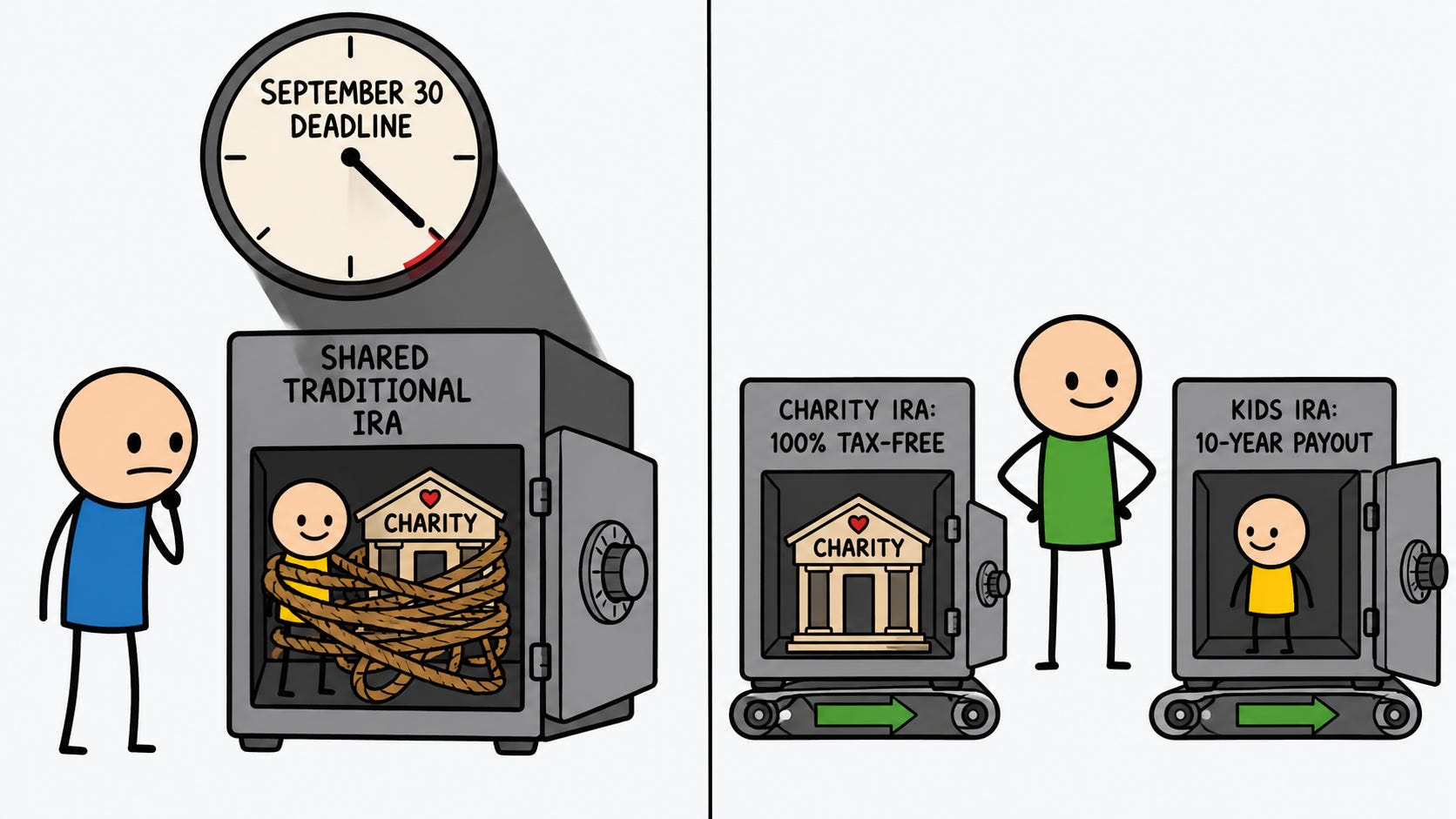
Someone charitably inclined looks at their traditional IRA and their desire to leave money to a favorite cause and connects the two, naming the charity as a beneficiary of the account. It is a genuinely smart move, better than most people realize, because of how the tax treatment works. But the same designation becomes a trap the moment that charity is listed alongside children or other individuals on the same IRA, because a charity and a person are treated as fundamentally different kinds of beneficiary, and mixing them can damage what the human beneficiaries receive. Understanding both halves, the reason a charity is an ideal IRA beneficiary and the reason it must usually stand alone, is what separates a clean legacy gift from an accidental tax problem for the family.
Start with why leaving a traditional IRA to charity is so effective. A fully pre-tax traditional IRA carries an embedded income-tax bill. When an individual inherits it, distributions are generally taxable to them as ordinary income, taxed at their rate in the years they withdraw. A qualified tax-exempt charity is different. Because it pays no income tax, it can generally receive its share of the IRA without that income tax applying, so the full pre-tax balance passes to the charity intact. This makes a traditional IRA often one of the most tax-efficient assets to leave to charity, precisely because it carries an embedded tax bill that disappears when the recipient is tax-exempt. Assets that would pass to a person tax-free, like a Roth IRA or a taxable brokerage account with a stepped-up basis, are often better left to human heirs, with the tax-heavy traditional IRA steered toward the charity that will not be taxed on it. One nuance worth noting is that a traditional IRA can contain nondeductible contributions, which create after-tax basis, so a human beneficiary generally owes tax only on the taxable portion rather than every dollar.
Now the trap, which lives in how the tax code classifies beneficiaries. An individual can be a designated beneficiary. Most adult children are non-eligible designated beneficiaries and generally receive the ten year payout rule, while certain eligible designated beneficiaries may qualify for life expectancy treatment. A charity has no life expectancy, so it is a non-designated beneficiary. On its own, that classification does not matter, because the charity just takes its money tax-free and the question of a payout period is irrelevant to it.
The problem appears when a charity and one or more individuals are named on the same IRA and the account is left undivided. The presence of the non-designated beneficiary can contaminate the treatment for everyone on the account. When a charity remains a beneficiary of one undivided account, the owner may be treated as having no designated beneficiary. If the owner died before their required beginning date, the account generally falls under the five year rule. If the owner died on or after their required beginning date, distributions generally continue over the deceased owner’s remaining life expectancy. Either result removes the account from the normal designated-beneficiary framework that would otherwise apply to the individuals, but it is not accurate to say the replacement schedule is always shorter. It is a different regime, and often a less desirable one, but whether it is more compressed depends on the specifics, including the owner’s age at death.
The fix is separation, and there are two post-death routes that may be available. The charity can receive its entire share by September 30 of the year following death, which causes it to be disregarded when the remaining beneficiaries are determined. Cash the charity out in time, and the human beneficiaries are left as the only beneficiaries, treated under the rules that apply to individuals. Alternatively, properly established separate beneficiary accounts may allow each beneficiary’s share to be treated separately, provided the separate-account requirements are satisfied on time, generally by the end of the calendar year following death. The custodian’s procedures matter for both routes, which is why waiting until either deadline is dangerous.
Picture a parent who names a favorite charity and two adult children as equal beneficiaries of one traditional IRA, intending to give a third to the cause and split the rest between the kids. The intention is generous and the structure looks reasonable on paper.
If the executor and custodian act in time, everything works. The charity’s third is paid out before the determination date in the year after death, tax-free to the charity. With the non-designated beneficiary removed, the two children are left as the only beneficiaries, both treated under the distribution rules that apply to individual designated beneficiaries, generally the ten year rule for adult children. The parent’s plan lands exactly as intended.
Now suppose the paperwork sits and the charity is still a co-beneficiary of the undivided account past that determination date, with no separate accounts established in time either. The account now contains a non-designated beneficiary at the moment the beneficiaries are finalized. The children can be pushed off the designated-beneficiary framework and onto the no-designated-beneficiary schedule, which, depending on when the parent died relative to their required beginning date, is a different and usually worse regime than the one they should have had. The charity still gets its money, but the children pay for the delay with a distribution schedule they did not choose and, in many cases, a heavier stack of taxable income squeezed into fewer years.
The resolution, for anyone planning the gift rather than cleaning up after it, is usually to keep the charity on its own dedicated IRA. The cleanest possible structure is one IRA with the charity as the sole beneficiary and a separate IRA, or separate beneficiary designations, for the human heirs. That way the charity’s tax-free treatment and the individuals’ payout never interfere with each other, because they were never on the same account to begin with. A person with one large IRA who wants to benefit both a charity and their children can often split it into two accounts during their lifetime, or work with the custodian to structure the designations so the charity’s portion is cleanly segregated.
For a family inheriting an account that already mixes the two, the resolution is speed and correct paperwork. Either the charity’s share is paid out before the determination date in the year following death, or valid separate accounts are established by the applicable deadline, so the individuals are not held hostage to the non-designated beneficiary sharing their account. The variables that decide the outcome are whether the charity shares an account with individuals, whether that account is separated correctly and in time, and when the original owner died relative to their required beginning date. Handled correctly, a charitable IRA beneficiary is one of the most tax-efficient gifts available. Handled carelessly, it turns a generous gesture into a smaller or more awkwardly taxed inheritance for the people the owner also wanted to provide for.
I write one of these every day, one retirement rule, explained in plain language and verified against the source. The daily email is free: subscribe here.
Full archive, worksheets, and search live at RetirementNewsRundown.com.
Disclaimer
This article is for educational and informational purposes only. It is not tax, legal, or financial advice and does not create an advisor–client relationship. Always consult appropriate professionals regarding your specific situation.