People name a trust as their IRA beneficiary for reasons that have nothing to do with taxes. They want control over how a young or financially inexperienced heir receives the money, protection from a beneficiary’s creditors or divorce, or a structure that can provide for a disabled family member. A trust can do all of that. But an IRA left to a trust follows a more demanding set of rules than an IRA left to a person, and whether the trust preserves the payout treatment the family expects depends entirely on how the trust is written. Get the structure wrong and the retirement account can be forced out far faster, and taxed far harder, than anyone intended.
This discussion primarily concerns traditional and other pretax IRAs. Roth IRAs follow many of the same beneficiary payout rules, but qualified Roth distributions generally are not taxable, so the tax consequences described below apply mainly to pretax money.
The starting question is whether the trust qualifies as what the rules call a see-through trust, sometimes called a look-through trust. When it qualifies, the IRS looks through the trust to the people who benefit from it and treats them as the account’s beneficiaries, which is what allows the favorable payout periods available to individuals. When it does not qualify, the trust is treated as a non-designated beneficiary, the same general category as an estate. The account then follows the five year rule or the deceased owner’s remaining life expectancy rather than a payout period based on the trust beneficiaries.
The regulations describe four requirements for see-through treatment. The trust must be valid under state law, become irrevocable no later than the owner’s death, have identifiable beneficiaries, and satisfy the applicable documentation rules. For IRAs, however, the 2024 final regulations say that the trust documentation does not have to be furnished to the IRA custodian. That eliminated the old October 31 delivery deadline for IRA beneficiaries, although the September 30 beneficiary determination date still matters for disclaimers, beneficiary removals, and certain trust changes.
If a trust fails those conditions, the consequence depends on timing. If the owner died before their required beginning date, the account falls under a five year payout. If the owner died on or after that date, distributions run over the deceased owner’s own remaining life expectancy. Neither uses the beneficiary’s life expectancy.
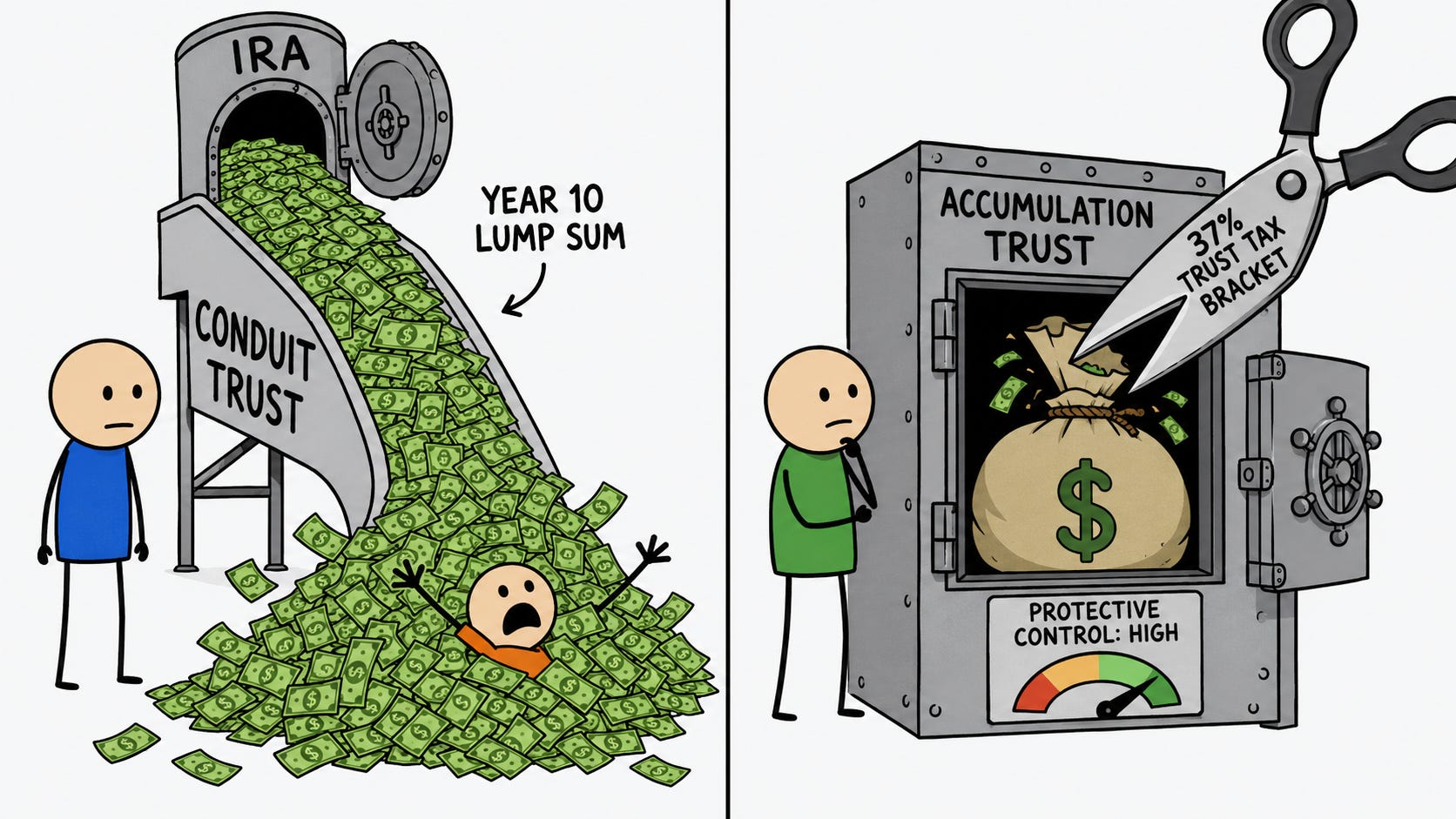
Then comes the distinction that decides most trust outcomes, whether the trust is a conduit trust or an accumulation trust. A conduit trust requires the trustee to pass every dollar it receives from the IRA straight through to the beneficiary, keeping nothing. Because nothing stays behind, only that current beneficiary counts, and later or backup beneficiaries are disregarded. The beneficiary’s own status flows through, so if that person qualifies for a longer payout the trust gets it, and the money is taxed at the beneficiary’s personal rate. The cost appears at the end of the payout period. If the owner died before the required beginning date, no annual distribution is required during the first nine years, so a conduit trust could pass out nothing during that period if the trustee takes nothing from the IRA. Any balance still inside the IRA must come out by the end of year ten, and the conduit terms require that distribution to pass through to the beneficiary. The control the trust was meant to provide ends at exactly that moment.
An accumulation trust lets the trustee keep distributions inside the trust instead of passing them through. That retained money stays under the trustee’s control, which is the protection many families want, and it carries two costs. First, because money can accumulate for later beneficiaries, more people count when determining the payout, including remainder beneficiaries. If any counted beneficiary is not an individual, such as an estate or charity, the trust can lose see-through status. Some remote beneficiaries are disregarded under the regulations, and a limited charitable exception applies to certain trusts for disabled or chronically ill beneficiaries. Second, pretax IRA money retained inside a trust is taxed at trust income tax rates, which reach the highest federal bracket at a very low level of income, far below where an individual would reach that same bracket. Money kept in the trust for protection can therefore carry a much heavier tax cost than the same money paid out to a person.
The post-SECURE payout rules flow through the trust by the same logic. Most beneficiaries are now subject to the ten year rule. A narrow group can still use a life expectancy payout. That group includes a surviving spouse, the owner’s child who is under age 21, a disabled person, a chronically ill person, and someone who is not more than ten years younger than the owner. That longer payout survives inside a conduit trust, because the single beneficiary’s status passes straight through. Life expectancy treatment can also survive through an accumulation trust when every counted beneficiary is an eligible designated beneficiary, although that is uncommon and the oldest counted beneficiary may control the calculation. A separate set of rules applies to certain trusts for disabled or chronically ill beneficiaries. A properly drafted trust in that category can preserve life expectancy treatment for that beneficiary while allowing the trustee to retain distributions for protection, and it is the standard tool for leaving retirement money to a special needs beneficiary.
Consider a parent who set up a trust years ago, before the current rules, naming it as beneficiary of a large traditional IRA to protect a son who is poor with money. The trust required every IRA distribution it received to be passed directly to the son. Under the old lifetime payout rules, the trustee generally withdrew only the annual required distribution, producing the slow, controlled release the parent wanted.
Under the current rules the son is subject to the ten year rule, and because the parent died before their required beginning date, no annual distributions are required during those ten years. If the trustee leaves the account untouched during the first nine years, the entire remaining balance must come out by the end of year ten and pass directly to the son. The large lump sum lands directly in the hands of the person the trust was designed to shield from exactly that, all taxable to him in a single year. Had the trust been written as an accumulation trust, the trustee could have kept the money past year ten and preserved control, but the retained distributions would have been taxed at trust rates along the way. Neither result matches what the parent pictured when the trust was drafted, which is why these older documents need review.
The resolution is matching the trust structure to the beneficiary and the goal rather than assuming any trust will do. A see-through trust preserves the individual payout rules only if it is valid, irrevocable at death, and has identifiable beneficiaries. Within that, a conduit trust passes payout status and taxation through to the beneficiary but surrenders control at the end of the period, while an accumulation trust keeps control but counts more beneficiaries and taxes retained pretax money at trust rates. The variables that decide the outcome are whether the trust qualifies as see-through at all, whether it is conduit or accumulation, whether the beneficiary is one of the few who still qualify for a life expectancy payout, whether any non-individual sits in the chain of counted beneficiaries, and when the owner died relative to their required beginning date. Anyone who named a trust as an IRA beneficiary before the SECURE Act changed these rules should have the document reviewed, because a structure that made sense under the old lifetime payout can now produce the opposite of what it was built to achieve.
I write one of these every day, one retirement rule, explained in plain language and verified against the source. The daily email is free: subscribe here.
Full archive, worksheets, and search live at RetirementNewsRundown.com.
Disclaimer
This article is for educational and informational purposes only. It is not tax, legal, or financial advice and does not create an advisor–client relationship. Always consult appropriate professionals regarding your specific situation.