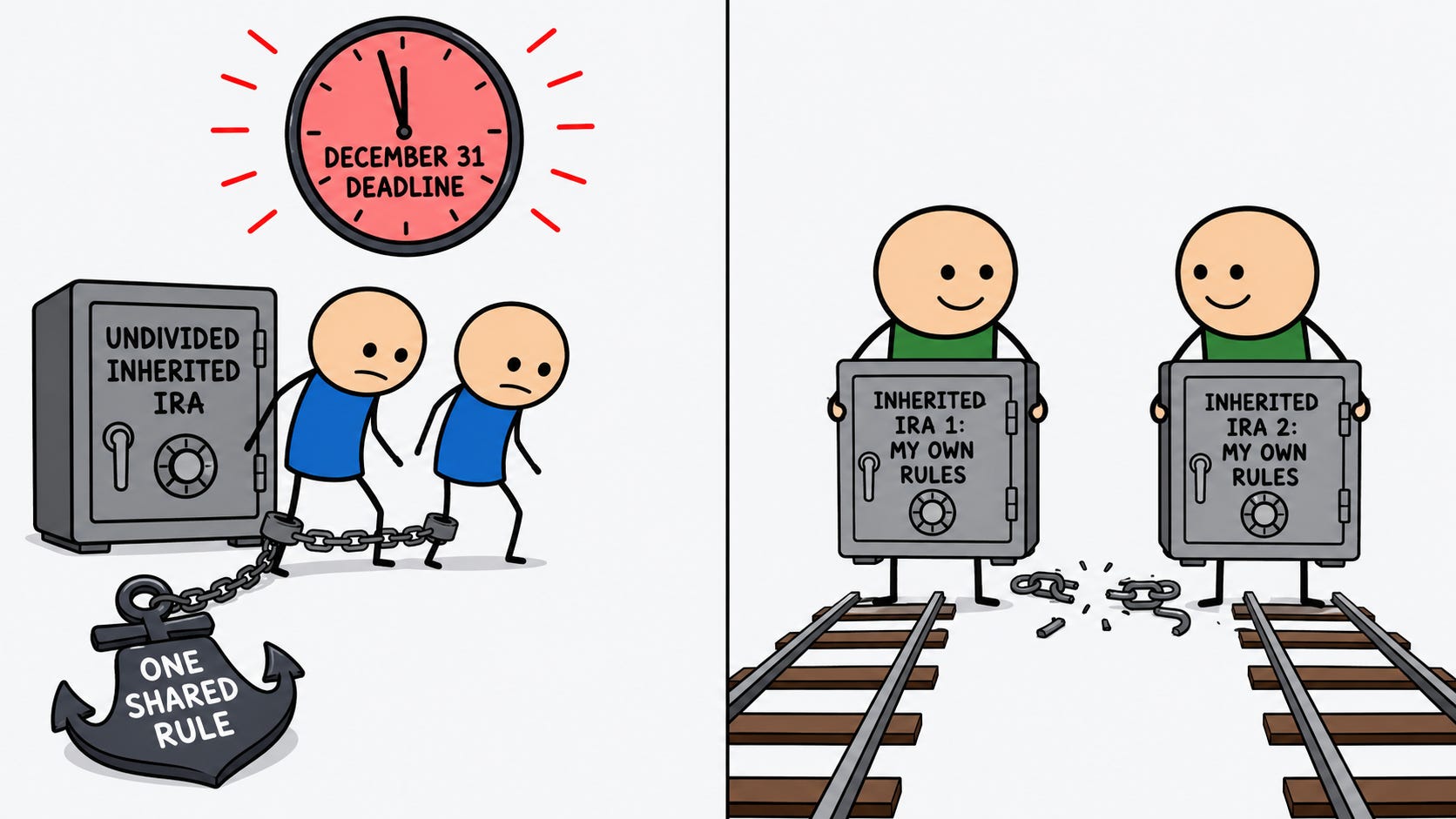
When more than one person inherits a single IRA, the instinct is to assume each heir simply takes their share and follows their own rules. That is what most people expect, and it is what happens only if the beneficiaries take a specific action by a specific deadline. Leave the inherited IRA as one undivided account past that deadline, and the tax code can treat the heirs as a group rather than as individuals with their own separate situations. Understanding how separate accounting works, and the two deadlines that govern it, is what lets beneficiaries in different circumstances avoid being forced into one shared result.
The reason separate accounting matters starts with what happens to an undivided account. When several people inherit one IRA and it stays whole, the beneficiaries can be treated as a group in ways that hurt some of them. Leaving the account undivided can force the entire account under the ten year rule, prevent an eligible designated beneficiary from using life expectancy treatment, or, when an annual distribution calculation is required, require that calculation to use the oldest beneficiary’s age. Timely separate accounts allow each beneficiary’s share to be tested separately instead.
The fix is separate accounting, which means splitting the one inherited IRA into a distinct inherited IRA for each beneficiary, with the post-death distributions, investment gains and losses, and expenses properly allocated among the shares. Simply opening several account numbers is not enough on its own. The transactions and investment results have to be allocated correctly for the division to count as genuine separate accounting. Once that is done properly, each separate account can be tested under the rules that fit its own beneficiary rather than a single shared result imposed on everyone.
Two deadlines govern whether this works, and they do different jobs. The first is September 30 of the year following the year of death, the date on which the beneficiaries are finalized. This is the date that matters when a non-individual, such as a charity or an estate, is among the beneficiaries. A charity or estate has no life expectancy and cannot be a designated beneficiary, and if one is still counted among the beneficiaries when they are determined, it can push the account into the least favorable no-designated-beneficiary treatment for the individuals. A beneficiary who has received their entire interest or disclaimed by that date is generally disregarded when the beneficiaries are determined.
The second deadline is December 31 of the year following the year of death, and this is the one that establishes the separate accounts for purposes of applying the distribution rules independently. To have each beneficiary’s share tested under its own rules rather than as part of a group, the separate accounts must be established by that date. This is the single most important deadline for a group of heirs who inherited one account, because missing it locks them into being tested as a group.
When a charity or estate is included, there may be more than one way to prevent it from affecting the individual beneficiaries. Its entire interest can be paid out or otherwise removed by September 30, or its interest may be isolated through timely separate-account treatment. The available procedure depends on the beneficiary designation and the custodian’s requirements, so this is a point to confirm with the custodian rather than assume.
The stakes are highest when the beneficiaries are not all in the same category. Since the SECURE Act, most beneficiaries are subject to the ten year rule, but a narrow group of eligible designated beneficiaries, including a surviving spouse, a disabled or chronically ill person, a minor child of the owner, and someone not more than ten years younger than the owner, can still use a life expectancy payout. If one of those eligible beneficiaries shares an undivided account with an ordinary ten year beneficiary, the presence of the non-eligible beneficiary generally causes the whole account to be treated as having no eligible designated beneficiary, which puts it under the ten year rule and costs the eligible beneficiary their longer payout. Separate accounting by the deadline is what protects that better treatment. A surviving spouse may also be unable to use certain sole-beneficiary elections while their share remains combined with other beneficiaries, so separating the spouse’s interest can preserve cleaner access to those rules, though the spouse’s rollover rights require their own separate analysis.
Picture a parent who leaves one traditional IRA equally to two adult children. One of them qualifies as disabled under the inherited IRA rules and is therefore an eligible designated beneficiary. The other is an ordinary adult child subject to the ten year rule.
If the IRA stays undivided, the presence of the non-eligible child generally causes the entire account to be treated as having no eligible designated beneficiary, which puts the whole thing under the ten year rule. The disabled child loses the life expectancy payout they would otherwise have been entitled to, simply because they share an account with a sibling in a different category.
If instead properly maintained separate accounts are established by December 31 of the year following the parent’s death, each share is tested on its own. The disabled child’s separate account can use life expectancy treatment, stretching distributions over their own life, while the other child’s separate account follows the ten year rule. The division is what lets two beneficiaries in genuinely different legal categories each get the treatment their own situation allows, rather than both being pulled onto the same schedule.
Now suppose the parent had also named a charity to receive a share of the same IRA. If that charity is still counted among the beneficiaries when they are determined, its presence as a non-individual can push the individuals onto the least favorable treatment. Removing the charity’s interest by the September date, or isolating it through timely separate accounts, keeps the individuals from being affected by it. The charity question and the category question answer to the two different deadlines.
The resolution is treating separate accounting as an active step the beneficiaries must take, not something that happens automatically. An undivided inherited IRA can force beneficiaries in different categories onto one shared result, and establishing properly maintained separate accounts by December 31 of the year following death is what lets each share be tested under its own rules. Where a non-individual beneficiary is involved, removing or isolating it in time is the separate step that keeps the individuals from being contaminated.
The variables that decide the outcome are whether the beneficiaries establish genuine separate accounts, whether they do it by the year-after-death deadline, whether any non-individual beneficiary was handled by the earlier determination date, and whether any beneficiary is an eligible designated beneficiary whose better treatment depends on separating out. Two points often surprise heirs. Splitting the account does not give ordinary ten year beneficiaries separate ten year clocks, because every one of those clocks runs from the original owner’s death and ends in the same tenth year regardless of the split. And the account can still be divided administratively after the December deadline, but a late division does not restore separate treatment for the distribution rules. The beneficiaries can hold different accounts while remaining tied together for calculating the required distribution. What timely separate accounting preserves is not a different deadline but a different classification, letting each beneficiary be measured under the rules that actually fit their situation.
I write one of these every day, one retirement rule, explained in plain language and verified against the source. The daily email is free: subscribe here.
Full archive, worksheets, and search live at RetirementNewsRundown.com.
Disclaimer
This article is for educational and informational purposes only. It is not tax, legal, or financial advice and does not create an advisor–client relationship. Always consult appropriate professionals regarding your specific situation.