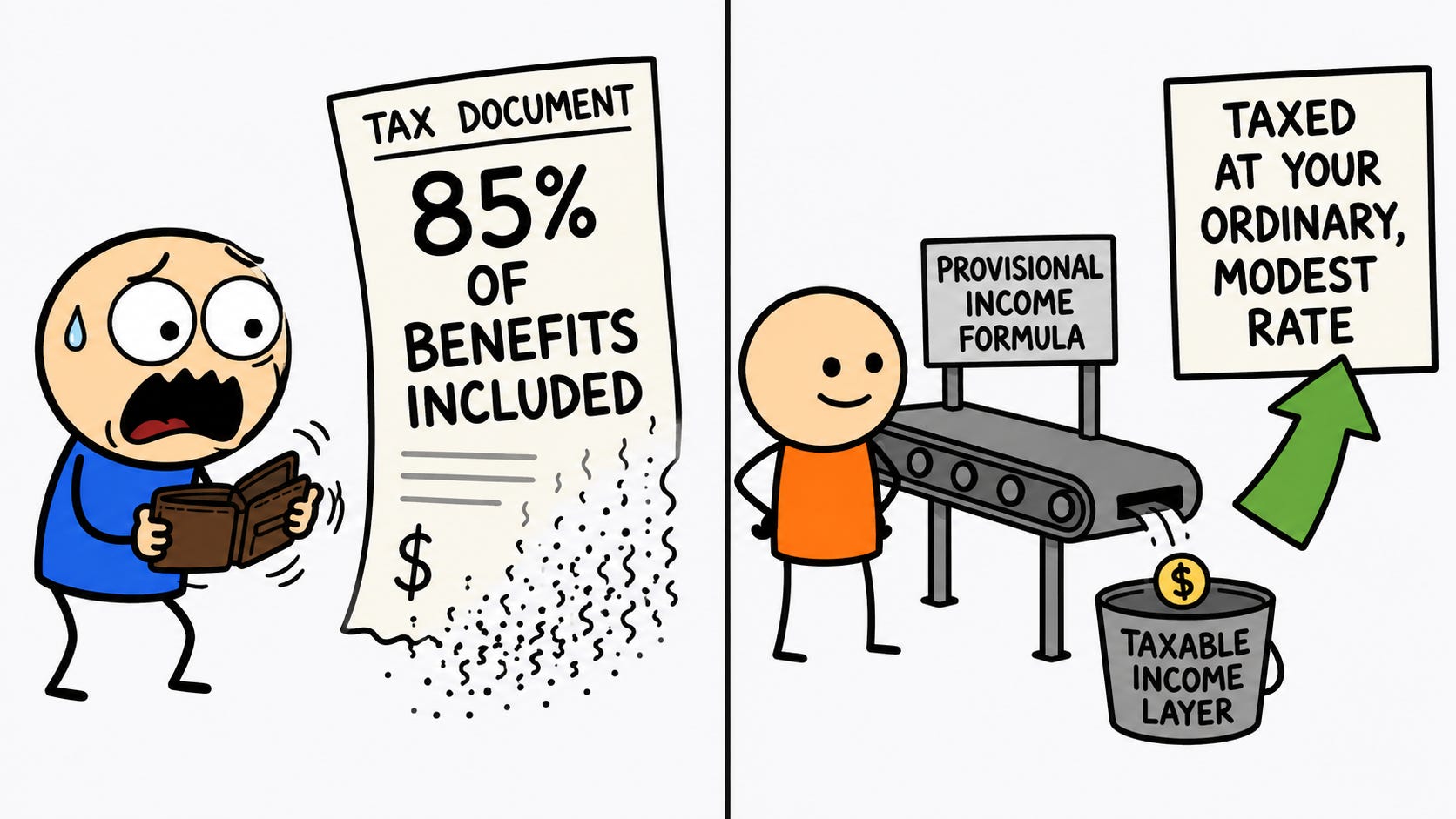
Plenty of people reach retirement believing Social Security is tax-free money, a benefit they already paid for during their working years and should now collect without the government taking another bite. For some retirees that belief happens to be true, but for many it is not, and the rule that decides which group a person falls into surprises them at tax time. Whether Social Security gets taxed, and how much of it does, comes down to a formula that most people have never seen and that behaves in ways that feel deeply counterintuitive once they do.
The tax on Social Security does not look at the benefit by itself. It looks at a broader measure of income, often called provisional income or combined income, and compares that figure against fixed thresholds. Provisional income is built by taking all of a person’s other taxable income, adding any tax-exempt interest they earned, and then adding one half of their Social Security benefits. That combined number is what the thresholds are measured against, not the benefit alone and not the person’s ordinary taxable income.
From there the structure runs in three tiers. If provisional income falls below the lower threshold for the person’s filing status, none of their Social Security is taxable. If it lands between the lower and upper thresholds, up to half of their benefits can be pulled into taxable income. If it climbs above the upper threshold, up to eighty five percent of their benefits can be pulled in. The lower threshold is twenty five thousand dollars for single filers and thirty two thousand dollars for married couples filing jointly. The upper threshold is thirty four thousand dollars for single filers and forty four thousand dollars for married couples filing jointly. Those numbers are not adjusted each year like ordinary tax brackets, which is why they matter so much.
Here is the point that causes more confusion than anything else in this entire area, and it is worth stating flatly. The eighty five percent figure is not a tax rate. It is the maximum portion of the benefits that gets added to taxable income. Someone in the top tier does not lose eighty five percent of their Social Security to taxes. They add up to eighty five percent of the benefit amount to their taxable income, and that added amount is then taxed at their ordinary income rate like any other dollar. A person hearing that eighty five percent of their Social Security is taxable often panics as though most of their check is being confiscated, when the reality is that a portion of the benefit joins their taxable income and gets taxed at whatever modest rate applies to them.
One structural feature explains why this tax reaches more people every year. The thresholds are not adjusted for inflation. They were set decades ago and have never moved, while benefits and other income have risen steadily with the cost of living. A dollar figure that once described a comfortably high income now describes a fairly ordinary retirement, so each passing year quietly pulls more retirees across thresholds that have stood frozen since they were written. This is not an accident a person can plan their way out of entirely, but it is the reason a retiree who escaped the tax years ago may find themselves subject to it now without their real spending power having changed at all.
There is a recent wrinkle worth understanding clearly, because it has been widely misdescribed. A tax law created a new temporary additional deduction for taxpayers age sixty five and older. It was often described in headlines as ending the tax on Social Security. That description is not accurate. The formula above was not changed. The thresholds, the provisional income calculation, and the tiers all remain in place. The new deduction works later in the tax return. It can reduce taxable income and lower the final tax bill for older taxpayers who qualify, but it does not remove Social Security from the taxation formula and it does not lower provisional income. The tax on Social Security still exists in the law. The deduction is a separate, temporary offset, not a repeal.
Consider a retiree whose only income is a modest Social Security benefit and nothing else. Their provisional income is just half their benefits plus no other income, which keeps them comfortably below the lower threshold. None of their Social Security is taxable, and their instinct that the benefit is tax-free turns out to be correct for their situation.
Now give that same person a meaningful stream of other income, say regular withdrawals from a traditional IRA on top of the Social Security. Those withdrawals are fully taxable on their own, and they also count toward provisional income, and they push the combined figure above the upper threshold. Suddenly up to eighty five percent of the Social Security benefit is being added to taxable income as well. The IRA withdrawal did not just get taxed itself. It dragged a large portion of the previously untaxed Social Security into taxable territory alongside it. This is the interaction that catches people, because the tax on the benefit is triggered not by the benefit growing but by other income rising around it.
The resolution is understanding that Social Security taxation is really a story about total income, not about the benefit in isolation. The lever that moves it is provisional income, and the sources that feed provisional income are the ordinary taxable income a retiree draws from other places, their tax-exempt interest, and half their benefits. A retiree whose other income is low may find their benefits entirely untaxed, while a retiree pulling significant income from pensions, retirement accounts, or work can find a large share of their benefits taxed no matter how the benefit itself is structured.
The variables that determine the outcome are the size of a person’s other taxable income, their filing status, and where their resulting provisional income lands against the frozen thresholds. Because those thresholds do not move with inflation, the direction over time favors more taxation rather than less, which is exactly why this catches retirees who felt safe in earlier years. Understanding the formula turns an unpleasant surprise into something a person can at least see coming, since the tax on the benefit rises and falls with the other income a retiree chooses to realize around it.
I write one of these every day, one retirement rule, explained in plain language and verified against the source. The daily email is free: subscribe here.
Full archive, worksheets, and search live at RetirementNewsRundown.com.
Disclaimer
This article is for educational and informational purposes only. It is not tax, legal, or financial advice and does not create an advisor–client relationship. Always consult appropriate professionals regarding your specific situation.