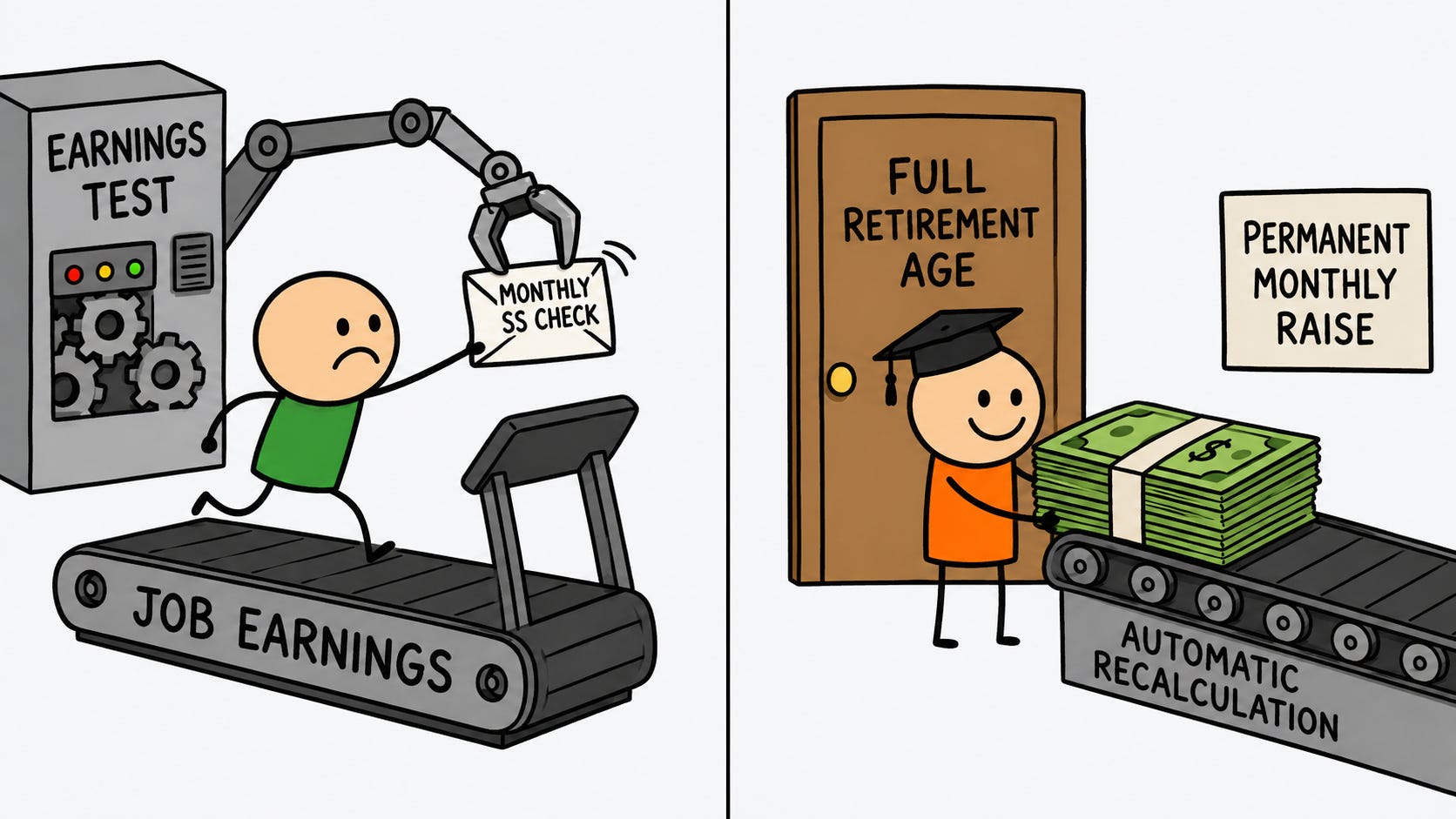
Someone claims Social Security early, keeps working, and then opens a benefit statement showing that entire monthly checks have vanished. The natural reaction is that the government is punishing them for working, clawing back benefits they earned and keeping the money. That reading is wrong on the most important point. The earnings test does reduce benefits for people who claim early and keep working, but the mechanics of how it works, what income triggers it, and where the withheld money actually goes are all different from what the panic suggests.
The earnings test applies only to people who have claimed Social Security and have not yet reached full retirement age. Once a person reaches full retirement age, the test disappears completely, and they can earn any amount with no effect on benefits at all. Everything about this rule lives in the window between an early claim and full retirement age.
Inside that window there are two different versions of the test. For any year a person is under full retirement age for the whole year, there is a lower earnings limit, and for every two dollars earned above it, one dollar of benefits is withheld. In the specific year a person reaches full retirement age, a more generous version applies to the months before the month they reach full retirement age. That year has a much higher limit, and the withholding softens to one dollar held back for every three dollars earned above it. Then, starting with the month the person actually reaches full retirement age, the test switches off entirely for the rest of that year and forever after.
The single most important thing to understand is what counts as earnings. The test looks only at money earned from work. Wages from a job and net earnings from self-employment are what trigger it. The kinds of income most retirees are actually living on do not count at all. Withdrawals from a 401(k) or an IRA do not count. Pension payments do not count. Interest, dividends, capital gains, and rental income do not count. A person could pull a large sum from retirement accounts and collect substantial investment income in the same year without any of it moving the earnings test, because none of it is money earned from working. Those income sources can still matter for income taxes, Medicare premiums, or the taxation of Social Security benefits, but they do not move the earnings test itself. This is why the test mostly affects people who claim early while still holding down a job or running a business.
The second most important thing is where the withheld money goes, because this is where the punishment story falls apart. The withheld benefits are not refunded as a lump sum. When the person reaches full retirement age, Social Security performs a recalculation that accounts for the months in which benefits were withheld, effectively treating the person as though they had claimed slightly later than they did. That recalculation can raise the monthly benefit going forward for the rest of their life. The withholding is closer to a deferral than a penalty. Money that would have arrived earlier as smaller checks comes back later as a higher monthly amount, though whether it fully catches up depends on how long the person lives to collect the raised benefit.
Picture someone who claimed early and is under full retirement age for the entire year, collecting a monthly benefit while also working a job that pays well above the lower earnings limit. Because their wages exceed that limit, Social Security withholds one dollar for every two they earned over it. Depending on how far over the limit their wages run, this can consume several entire monthly checks. Social Security does not shave a little off each payment. It typically withholds whole checks until the required reduction is covered, then resumes normal payments.
That same person, in the year they finally reach full retirement age, plays under kinder rules. The limit that year is dramatically higher, the withholding rate is gentler at one in three, and only the earnings in the months before they reach full retirement age count. The moment their full retirement age month arrives, the test is gone, and they can earn without limit while collecting the full benefit.
Then comes the part that reframes the whole thing. All those checks that were withheld during the early years were not lost. At full retirement age the benefit is recalculated upward to account for them, and the person collects that higher amount for the rest of their life.
The resolution is understanding that the earnings test is a timing rule, not a penalty, and that it keys entirely off earned income during a specific age window. A person deciding whether to claim early while still working can weigh the fact that a substantial portion of their benefit may be temporarily withheld, and that the withholding is later returned as a higher benefit rather than kept.
Someone whose income in retirement comes from investments, a pension, or retirement account withdrawals rather than from a paycheck may find the test never touches them at all, since those sources fall entirely outside it.
The most common expensive misunderstanding is treating the withheld benefits as gone and making decisions in a panic to avoid the test, when the reality is that the money resurfaces as a larger check later. The mechanics that determine how the test affects any particular person are their age relative to full retirement age, the size of their earned income against the applicable limit, and the number of years they will be working inside that pre full retirement age window. Knowing those three things turns an alarming line on a benefit statement into a predictable and temporary adjustment.
I write one of these every day, one retirement rule, explained in plain language and verified against the source. The daily email is free: subscribe here.
Full archive, worksheets, and search live at RetirementNewsRundown.com.
Disclaimer
This article is for educational and informational purposes only. It is not tax, legal, or financial advice and does not create an advisor–client relationship. Always consult appropriate professionals regarding your specific situation.