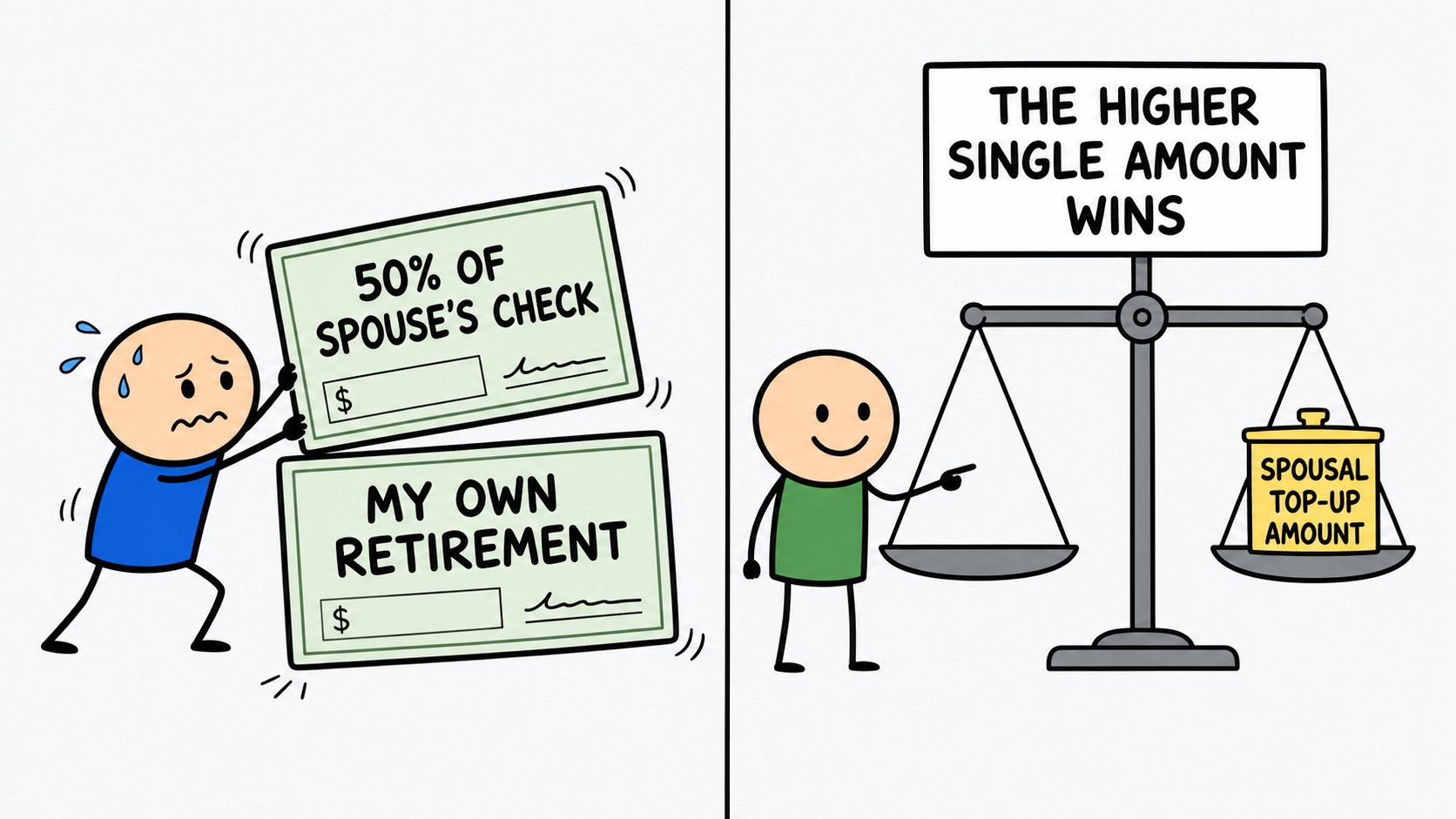
A person with little or no work record of their own, or a much smaller one than their spouse, can receive a Social Security amount based partly or entirely on their spouse’s earnings record. This is the spousal benefit, and it exists to support households where one person earned significantly less or stepped out of the workforce entirely. The trouble is that almost everything people believe about it is slightly off. They think they get half of their spouse’s check, on top of their own, whenever they want it. Every piece of that sentence is wrong, and the corrections are where the real mechanics live.
The spousal benefit is worth up to fifty percent of the worker’s primary insurance amount. That primary insurance amount is the benefit the worker would receive at their own full retirement age, and it is the anchor for the entire calculation. This is the first correction, and it is a big one. The spousal benefit is based on the worker’s full retirement age figure, not on the check the worker actually collects. If the worker claimed early and took a reduced benefit, the spousal benefit is still figured from the higher full retirement age amount. And if the worker delayed past full retirement age and grew their own check with delayed credits, the spousal benefit does not grow along with it. It stays pinned to the full retirement age baseline no matter what the worker’s actual payment turns out to be.
The second correction is that, for a current spouse, the worker generally has to have filed for their own benefit before the spouse can collect a spousal benefit. A spouse cannot start collecting on a worker’s record while that worker is still sitting on an unfiled claim, letting their own benefit grow untouched. The record has to be active. The spouse also generally has to be at least 62 to claim a spousal retirement benefit, unless they qualify under the child-in-care rules.
The third correction dismantles the most common fantasy, which is collecting a spousal benefit on top of one’s own. That is not how it works for anyone subject to the current rules. When a person files, they are treated as filing for everything they are eligible for at once, both their own retirement benefit and any spousal benefit. Social Security then pays the higher of the two, not the sum. Mechanically, Social Security may pay the person’s own benefit first and then add a spousal top-up to bring the total up to the higher spousal amount, but the result is still not both checks stacked together. A person does not receive their own full benefit plus half their spouse’s. They end up at whichever single amount is larger. If their own benefit already exceeds half the spouse’s primary insurance amount, the spousal benefit is simply irrelevant and never enters the picture. This rule also closed the old strategy of claiming only a spousal benefit while letting one’s own retirement benefit grow to seventy, which no longer works for anyone born after an early 1954 cutoff.
The fourth correction is about timing. The full fifty percent is only available if the spouse waits until their own full retirement age to claim. Claiming the spousal benefit earlier permanently reduces it, and the reduction is steep. A spouse who claims at the earliest possible age can see the benefit fall to roughly a third of the worker’s primary insurance amount rather than half. And on the other end, waiting past full retirement age earns nothing extra. Unlike a person’s own retirement benefit, which grows with delayed credits up to seventy, the spousal benefit hits its ceiling at full retirement age and stops. There is no reward for patience beyond that point.
One thing that is not a problem worth worrying about is any effect on the worker. A spouse collecting a spousal benefit takes nothing away from the worker’s own check. The worker receives their full benefit, and the spousal benefit is paid alongside it without reducing it.
Picture a couple where one spouse had a long career and the other worked part time for years. The higher earner has a primary insurance amount of a round three thousand dollars. The lower earner’s own benefit, based on their own record, would come to eight hundred.
The spousal benefit ceiling here is fifty percent of three thousand, which is fifteen hundred. Because that is far more than the lower earner’s own eight hundred, the spousal path is what matters for them. If they wait until their own full retirement age to claim, their combined retirement-plus-spousal amount can reach the full fifteen hundred, with their own eight hundred paid first and a spousal top-up of seven hundred bringing it up to the ceiling. If they claim at the earliest age instead, that fifteen hundred shrinks permanently to something closer to the low thousand range, and it stays there for life.
Now suppose the higher earner delays their own claim to seventy and grows their personal check well above three thousand through delayed credits. This does nothing for the spousal benefit. The lower earner’s fifteen hundred ceiling was set by the three thousand primary insurance amount and does not budge, because the spousal calculation never looked at the delayed number. The higher earner’s patience raised their own check and, importantly, the eventual survivor benefit, but it left the spousal benefit exactly where it was.
The resolution is understanding that the spousal benefit runs on a different engine than a person’s own retirement benefit. It is anchored to the worker’s full retirement age figure, it is capped at half of that, it requires the worker to have filed, it cannot be stacked on top of one’s own benefit, and it gains nothing from waiting past full retirement age. Those five mechanics together explain almost every surprise people run into.
The variables that determine what any particular spouse actually receives are the size of the worker’s primary insurance amount, the size of the spouse’s own benefit for comparison, and the age at which the spouse claims. A spouse whose own benefit is small relative to half the worker’s primary insurance amount is the one for whom the spousal benefit does real work, while a spouse whose own record is strong may find their own benefit is the higher number and the spousal calculation never comes into play. The whole system resolves to a single comparison at the moment of filing, paying the larger of two numbers rather than combining them, and knowing which number will be larger is what turns the decision from a guess into arithmetic.
I write one of these every day, one retirement rule, explained in plain language and verified against the source. The daily email is free: subscribe here.
Full archive, worksheets, and search live at RetirementNewsRundown.com.
Disclaimer
This article is for educational and informational purposes only. It is not tax, legal, or financial advice and does not create an advisor–client relationship. Always consult appropriate professionals regarding your specific situation.