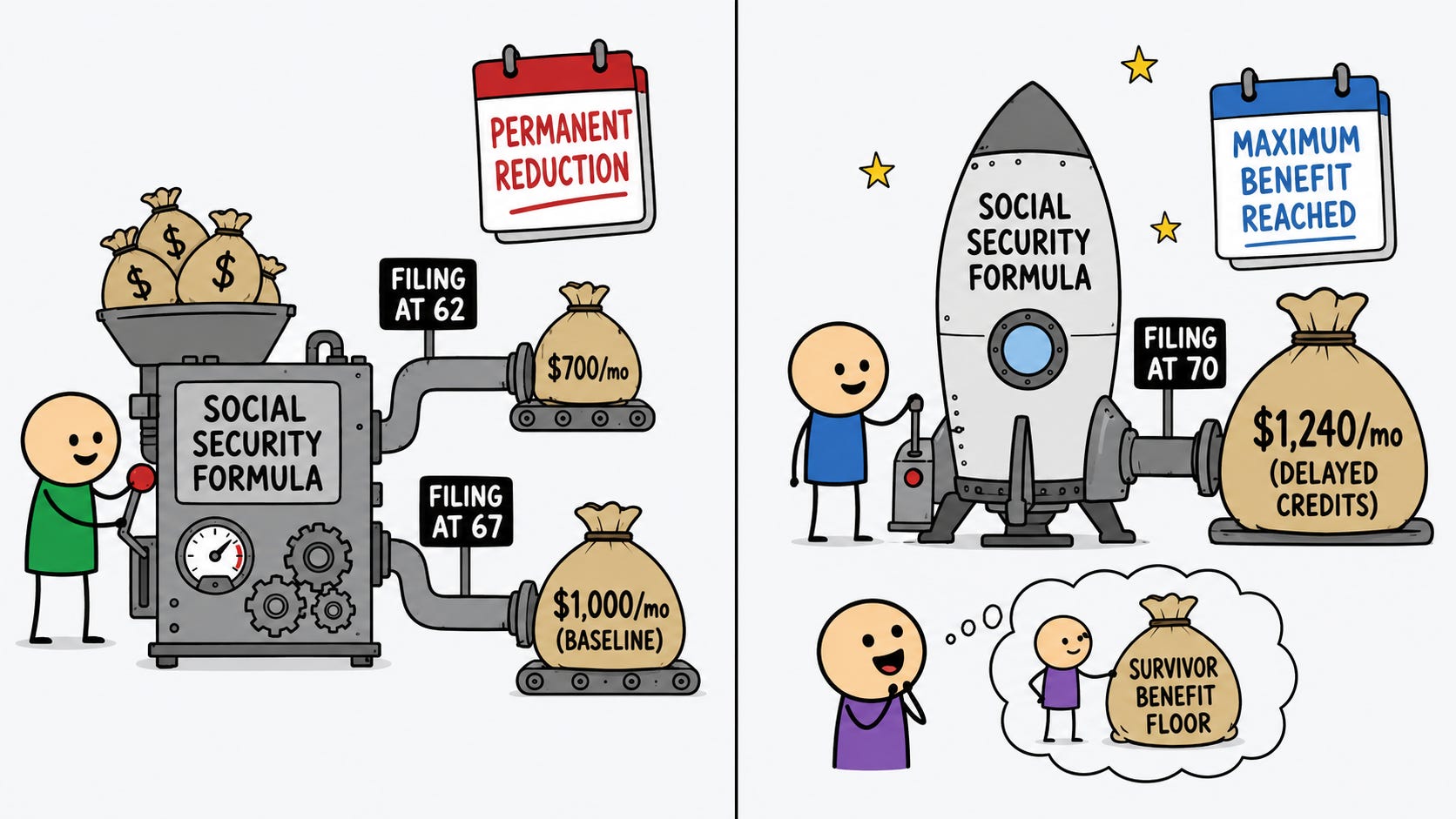
Social Security lets a person start their retirement benefit anywhere from age 62 through age 70. The monthly check that results is dramatically different depending on where in that window a person files, and the difference is permanent. People often treat this as a single question with a single right answer, but the system is really just running a formula. Understanding the formula, and the handful of variables that actually move the outcome, matters more than any rule of thumb about the best age to claim.
The entire system is built around one number, the benefit payable at full retirement age. For anyone born in 1960 or later, full retirement age is 67. That age is the anchor. Claiming earlier shrinks the monthly benefit below that baseline, and claiming later grows it above the baseline, according to fixed adjustment rates.
Claiming before full retirement age reduces the benefit on a tiered schedule. The reduction runs at roughly five ninths of one percent for each of the first thirty six months a person claims early, then slows to five twelfths of one percent for each additional month beyond that. Stacked all the way down to age 62, someone with a full retirement age of 67 lands at seventy percent of their baseline. That is a thirty percent permanent cut to the monthly amount. The reduction is not a temporary penalty that heals at full retirement age. Filing early sets a lower monthly number that stays low. Later cost of living adjustments apply to the benefit after claiming, so the early or delayed claiming decision changes the base that all future adjustments build on.
Claiming after full retirement age works in the opposite direction through delayed retirement credits. Each year of delay past 67 adds eight percent to the monthly benefit, accruing month by month. Wait the full three years to age 70 and the benefit reaches one hundred twenty four percent of the baseline, a twenty four percent raise over the full retirement age amount. These credits stop accruing at 70. There is no further increase for waiting beyond that age, which is why 70 functions as the practical ceiling of the claiming window. Delaying past it forfeits checks for no additional monthly gain.
So the three landmark ages describe a wide spread. At 62, seventy percent of the baseline. At 67, one hundred percent. At 70, one hundred twenty four percent. The same worker with the same earnings record can end up with a very different monthly benefit depending only on when they file.
Consider a worker whose full retirement age benefit would be a round one thousand dollars a month. This single earnings record produces three very different checks across the window.
Filing at 62 sets the benefit at seven hundred dollars a month, permanently. Filing at 67 sets it at the full one thousand. Filing at 70 sets it at one thousand two hundred forty. The person did nothing different in their career to produce these numbers. The only variable is the age they started, and the age seventy check is more than seventy percent larger than the age sixty two check.
The tradeoff hiding inside those numbers is time versus size. The person who files at 62 collects a smaller check but collects it for eight more years than the person who waits until 70. The person who waits collects nothing during those years but locks in a much larger check for however long they live after. Whether the larger check eventually outweighs the years of foregone smaller checks depends entirely on how long the person lives, which is the one variable nobody knows in advance. This is why the claiming decision resists a universal answer. It is a bet on longevity that each person can only make with their own information.
The mechanics above are fixed, but several personal variables determine which claiming age produces the most total benefit for a given person, and they pull in different directions. Longevity is the largest. A longer life favors the bigger delayed check, while a shorter life favors the years of early checks. Current cash need matters, since a person who stops working at 62 without other income may have no practical choice but to file early regardless of the math. Continued work matters too, because an earnings test can temporarily withhold benefits for someone who claims before full retirement age while still earning above a set limit. Those withheld months can increase the benefit calculation at full retirement age, but they are not simply refunded as a lump sum.
One variable reaches beyond the individual entirely. For a married couple, the higher earner’s claiming age sets the floor for the survivor benefit the surviving spouse will eventually receive. Filing early on the higher earner’s record permanently lowers not just that person’s check but the survivor benefit that outlives them. This turns claiming age into a household decision rather than an individual one, because the choice echoes into a widow or widower’s income years later.
None of these variables points to a single correct age. They are the inputs a person weighs against their own health, finances, and family situation. The value of understanding the formula is that it turns the claiming decision from a guess into a clear-eyed comparison, where a person can see exactly what each age costs and pays and decide which tradeoff fits their own circumstances.
I write one of these every day, one retirement rule, explained in plain language and verified against the source. The daily email is free: subscribe here.
Full archive, worksheets, and search live at RetirementNewsRundown.com.
Disclaimer
This article is for educational and informational purposes only. It is not tax, legal, or financial advice and does not create an advisor–client relationship. Always consult appropriate professionals regarding your specific situation.