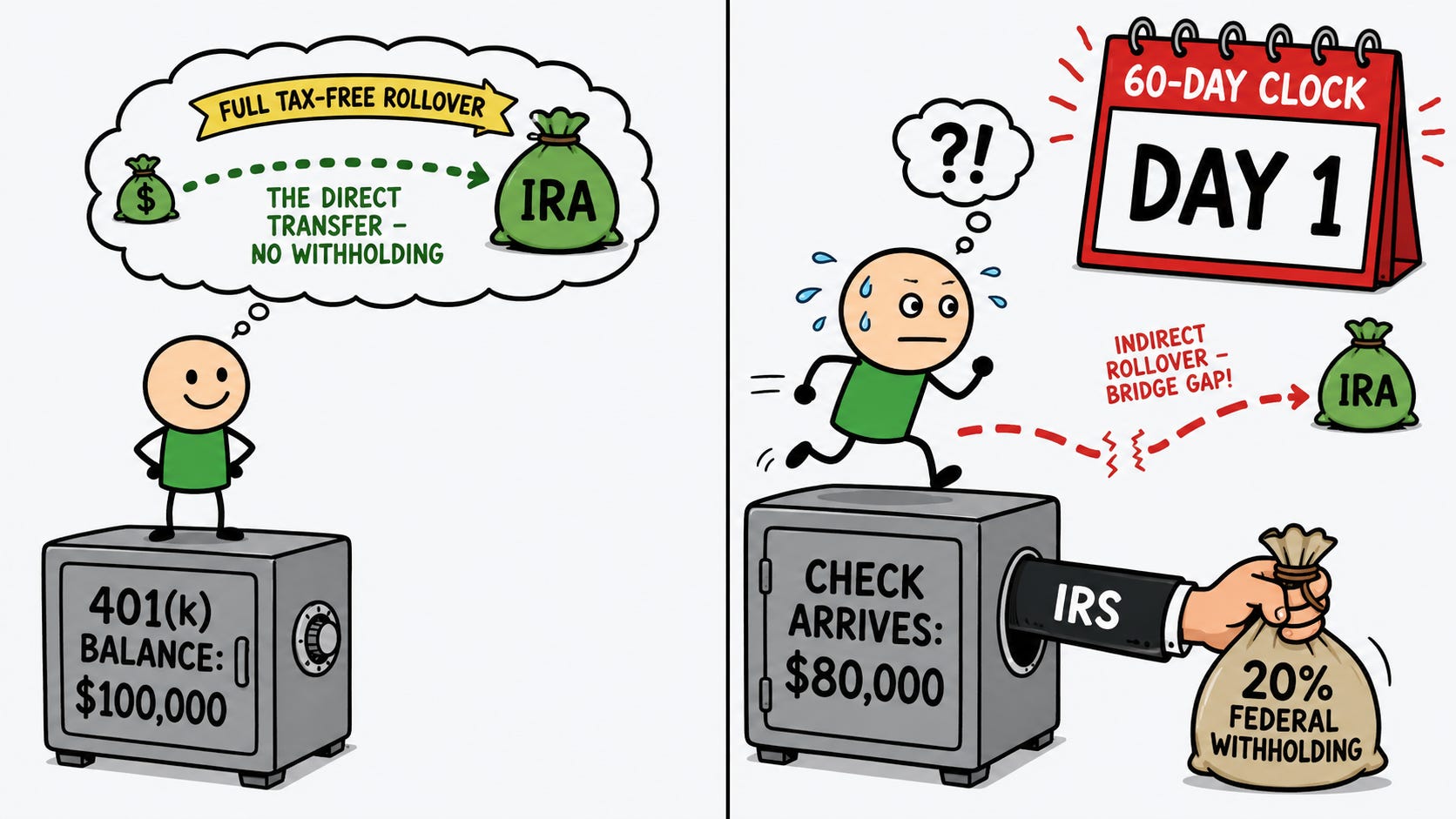
A person leaving a job decides to move their 401(k) somewhere better. They ask the plan to send them the money, planning to turn around and deposit it into an IRA within the sixty days the rules allow. The check arrives and it is smaller than expected, noticeably smaller, because a fifth of the balance is simply gone. That missing fifth is not a fee and it is not lost, but it sets a trap that can convert part of a perfectly good rollover into taxable income. The trap springs from a withholding rule that applies to one specific way of moving the money and not to the alternative sitting right next to it.
When an employer plan like a 401(k) sends a distribution directly to the participant, and that distribution is eligible to be rolled over, the plan is required by law to withhold twenty percent for federal taxes. This is not optional and the participant cannot waive it. It applies even when the person states plainly that they intend to roll the whole thing over within the sixty day window. The intent does not matter. The moment the money is paid to the person rather than sent straight to another retirement account, the twenty percent comes out.
Here is where the trap closes. To complete a full tax-free rollover, the person has to deposit the entire original distribution amount into the new account, not just the eighty percent that actually landed in their hands. The twenty percent that was withheld still counts as part of the distribution. If the person only redeposits what they received, the withheld portion is treated as money they kept, which makes it a taxable distribution for the year. If they are under the age at which early distribution penalties stop applying, a penalty attaches to that portion on top of the tax.
So someone who took a hundred thousand dollar distribution receives eighty thousand after withholding. To roll over the full hundred thousand and owe nothing, they must come up with the missing twenty thousand from their own separate savings and deposit the full hundred thousand into the IRA. Do that, and the entire distribution is a clean rollover. The twenty thousand that was withheld is not gone, it was a prepayment of tax, and it gets credited back when the person files their return, often coming back as a refund since a completed rollover means no tax was actually owed. But the person needs the cash to bridge that gap in the meantime, and anyone who cannot find the extra twenty thousand ends up rolling over only eighty and paying tax on the rest.
The way to avoid the entire problem is the direct rollover. Instead of having the money paid to the participant, the plan sends it straight to the receiving account, with the check made payable to the new custodian for the benefit of the person rather than to the person directly. Because the money never passes through the participant’s hands as a distribution to them, the mandatory twenty percent withholding does not apply. The full balance moves, nothing is withheld, and there is no gap to bridge.
Consider two people each moving the same hundred thousand dollar 401(k) into an IRA, one using each method.
The first asks for a check made out to themselves. The plan withholds twenty thousand and hands them eighty thousand. To keep the rollover whole, this person now has to find twenty thousand dollars of their own money and deposit a full hundred thousand into the IRA within sixty days. If they manage it, they eventually recover the twenty thousand at tax time, but they had to float it in the meantime. If they cannot, they roll over eighty thousand, and the remaining twenty thousand becomes taxable income, with a penalty if they are young enough to trigger one.
The second person requests a direct rollover, with the funds sent straight from the plan to the IRA custodian. No withholding applies. The entire hundred thousand moves intact, there is no missing twenty percent, no scramble to replace it, and nothing to reclaim later. Same starting balance, same destination, wildly different friction, decided entirely by which box was checked when the money left the plan.
There is a meaningful contrast worth carrying away, because it explains why this trap is so specific to workplace plans. A distribution from an IRA does not carry this mandatory twenty percent. IRA distributions follow different withholding rules, and the owner can generally elect out of federal withholding, which means the same indirect rollover mistake made from an IRA does not automatically create the same twenty percent cash gap. The harsh mandatory withholding is a feature of employer plan distributions in particular, which is exactly why moving 401(k) money is where people get caught.
The clean resolution is to move workplace retirement money by direct rollover whenever possible and to treat any check made payable to yourself as the path that starts the sixty day clock and triggers the withholding. When a plan offers to cut a check to the participant or to send it straight to the new account, those two options look almost identical on the surface and behave completely differently underneath. The one that keeps the money out of the participant’s hands is the one that keeps the full balance working and skips the trap entirely.
I write one of these every day, one retirement rule, explained in plain language and verified against the source. The daily email is free: subscribe here.
Full archive, worksheets, and search live at RetirementNewsRundown.com.
Disclaimer
This article is for educational and informational purposes only. It is not tax, legal, or financial advice and does not create an advisor–client relationship. Always consult appropriate professionals regarding your specific situation.