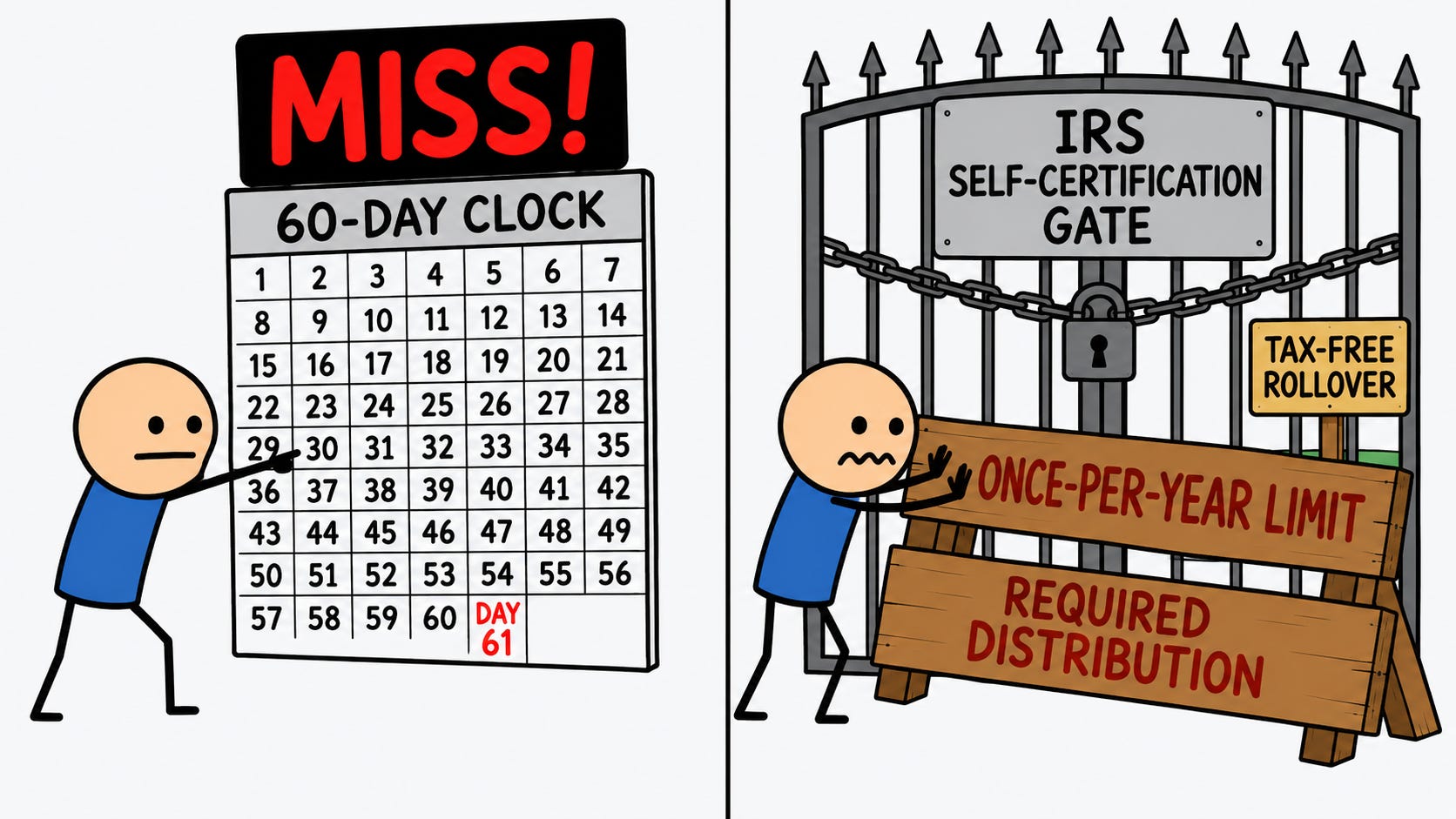
Someone takes money out of an IRA or a workplace plan meaning to move it to another retirement account. The check arrives, life happens, and the deadline to complete the move quietly passes. The rule attached to that deadline is unforgiving on its face, because a rollover that misses the window stops being a rollover and becomes a taxable distribution. But there is a repair path built specifically for honest misses, and knowing it exists is the difference between eating an unnecessary tax bill and fixing the mistake at no cost.
When money leaves a retirement account as a distribution paid to the account owner, the owner has sixty days to get it into another eligible retirement account for the move to count as a tax-free rollover. Miss those sixty days and the default outcome is harsh. The distribution becomes taxable income for the year, and if the person is under the age at which early distribution penalties stop applying, a penalty stacks on top. If taxes were withheld from the distribution, the withheld amount still has to be replaced from other funds for the full distribution to count as rolled over, since only what actually lands back in a retirement account gets the tax-free treatment.
The repair path is self-certification. Rather than the old route of asking the IRS for individual permission through an expensive private ruling, a person who missed the deadline for a qualifying reason can now sign a written certification, hand it to the receiving institution, and complete the late rollover. The receiving institution can generally accept the money and report it as a rollover based on that certification, as long as it does not have actual knowledge contradicting the certification. The reasons that qualify are specific and cover the kinds of things that genuinely derail people, a death or serious illness in the family, hospitalization, a financial institution error, a distribution check that was misplaced and never cashed, a postal error, severe damage to a residence, and a handful of others in the same spirit. The deposit has to be made as soon as practicable once the obstacle clears, with a general safe harbor of thirty days after the reason no longer prevents it.
Here is the part that gets misread constantly, and it is the whole reason to understand this rather than assume it. Self-certification is not IRS approval. Signing the letter does not mean the IRS has blessed the rollover. It means the person is asserting, under their own signature, that they meet a qualifying reason, and the institution can rely on that assertion to process the deposit. The IRS can still examine the return later and decide the reason did not actually qualify. If that happens, the rollover collapses into a taxable distribution after all, potentially with penalties and interest, and the money sitting in the receiving account can potentially turn into an excess contribution with its own separate problem. The certification is a permission to proceed, not a verdict in the person’s favor.
The second thing self-certification cannot do is rescue a rollover that was never allowed for some other reason. It waives the sixty-day timing requirement and nothing else. It cannot override the rule that limits a person to one IRA-to-IRA rollover in a twelve month period, so a second attempted rollover inside that window stays broken no matter how good the reason for lateness. It cannot make a required minimum distribution eligible to be rolled over, because required distributions can never be rolled over in the first place. Every other condition for a valid rollover still has to be independently satisfied.
Picture someone who took a distribution intending to move it to a new IRA, then landed in the hospital for an extended stay that ran past the sixty-day mark. The distribution technically failed the timing test. Without the repair path, that money would simply be taxable income for the year.
Because a serious illness and hospitalization sit squarely among the qualifying reasons, this person can complete the rollover once recovered, moving as soon as practicable after getting out and back on their feet. They sign the self-certification, hand it to the new IRA custodian, and the custodian accepts the deposit and reports it as a rollover. On its face the problem is solved.
Now change one detail. Suppose this same person had already done an IRA-to-IRA rollover a few months earlier, inside the same twelve month window. The hospitalization still explains the lateness, but lateness was never the only problem. The once-per-year limit independently blocks this second rollover, and self-certification does nothing for that. The person can sign all the letters they want and the rollover is still invalid, because the waiver only ever addressed the sixty days.
The cleaner lesson underneath all of this is that the sixty-day rollover is the fragile way to move retirement money, and self-certification is a repair for a mistake that was avoidable to begin with. Money moved directly from one institution to another, through a trustee-to-trustee IRA transfer or a direct rollover from a plan, does not put the funds in the owner’s hands, does not start the same sixty-day scramble, and is not limited by the once-per-year IRA rollover rule. The whole category of failure this waiver addresses simply does not arise when the money never becomes a distribution in the first place.
For a miss that has already happened, speed and honesty are what make the repair hold. The reason has to be real, the deposit has to happen promptly once the obstacle clears, and the person should keep a copy of the certification with their records in case the return is ever examined. Self-certification turns an honest, qualifying mistake into a fixable one, but it rewards the person who treats it as a genuine assertion of fact rather than a formality, because the IRS retains the last word.
I write one of these every day, one retirement rule, explained in plain language and verified against the source. The daily email is free: subscribe here.
Full archive, worksheets, and search live at RetirementNewsRundown.com.
Disclaimer
This article is for educational and informational purposes only. It is not tax, legal, or financial advice and does not create an advisor–client relationship. Always consult appropriate professionals regarding your specific situation.