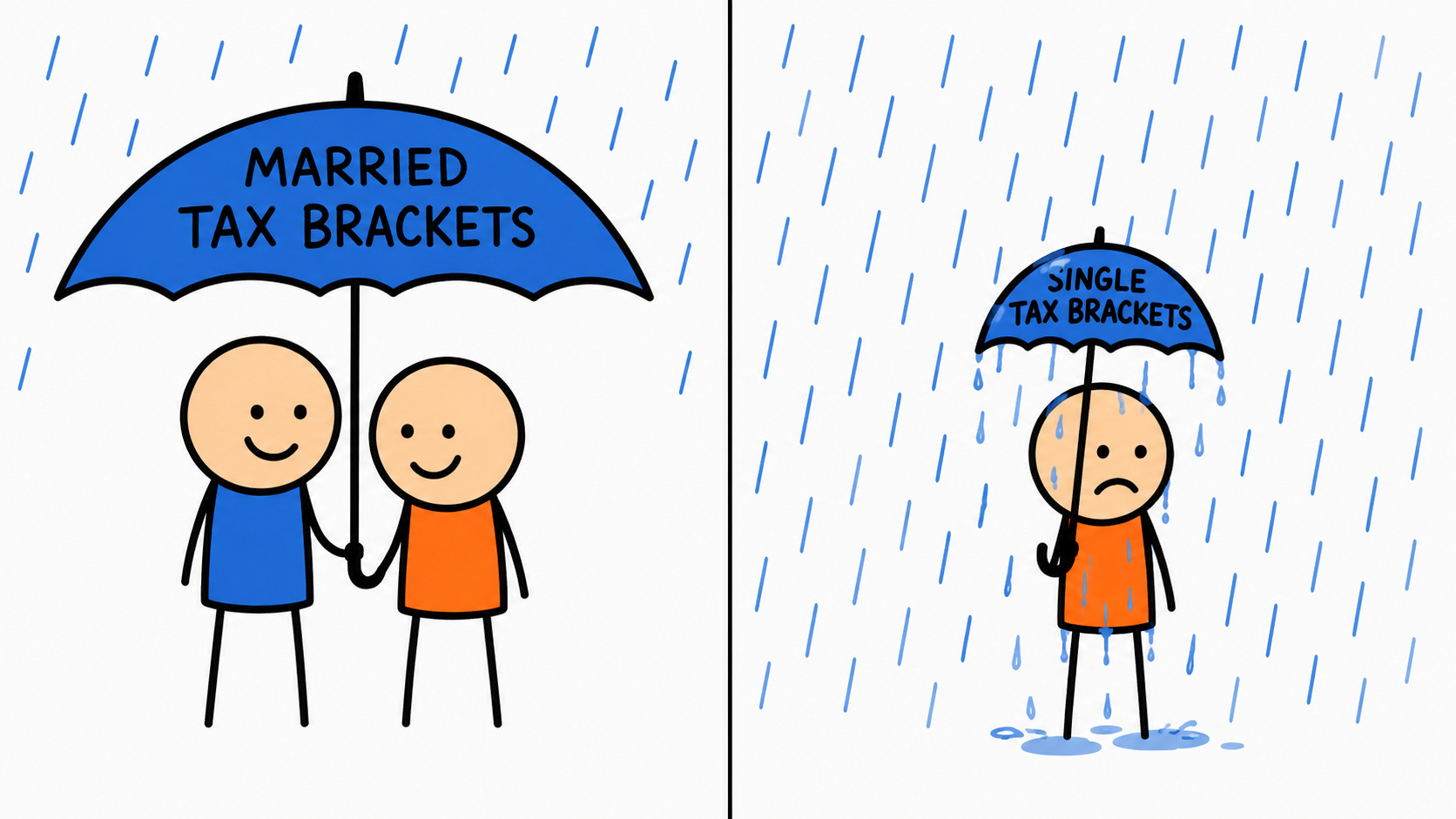
A married couple in retirement builds a rhythm around their income. Required distributions come out of their accounts, Social Security arrives, and the tax on all of it gets calculated under the wide brackets and large standard deduction that married couples enjoy. Then one spouse dies, and the survivor expects their tax picture to get simpler and lighter, since there is now one person instead of two. The opposite often happens. The income barely shrinks while the tax treatment of it turns sharply less favorable, and the survivor ends up paying more tax on roughly the same money. This is the trap, and it is driven almost entirely by a change in filing status colliding with distributions that do not shrink to match.
The rule sits in how filing status changes after a death. For the entire calendar year in which a spouse dies, the survivor can still file jointly, keeping the wide married brackets and the full married standard deduction for that final year. After that year, unless the survivor has a dependent child living at home, they file as a single taxpayer. There is a special status that extends the married brackets for up to two additional years, but it requires a dependent child in the household, which most retirees do not have. So for the typical retired widow or widower, the shift is simple and abrupt. Married filing jointly in the year of death, then single the very next year.
Single filing status is far less generous than married filing jointly in two specific ways that both push tax higher. The brackets are generally much narrower, meaning income climbs into higher rates faster. The standard deduction is substantially smaller, meaning more income is exposed to tax in the first place. Nothing about the survivor’s spending or lifestyle caused this. The tax code simply treats one person under tighter rules than it treated the couple.
Now bring in the required distributions, which are the reason this hits retirees so hard. When a spouse dies, the survivor often has options for the deceased spouse’s retirement accounts, including treating an inherited IRA as their own. If those dollars become part of the survivor’s own IRA picture, the future required distributions are tied to the survivor’s larger pre-tax balance. The forced income can hold steady or even rise in the exact stretch when the survivor’s filing status gets worse, and even when it stays flat, the same required distribution that felt manageable under joint brackets now lands under single brackets.
Picture a couple who each had retirement accounts producing required distributions, plus two Social Security checks, all taxed comfortably under married brackets. One spouse dies. The survivor treats the deceased spouse’s IRA as their own, so the future required distribution is figured on both balances combined. The household lost one Social Security check, which is a real income drop, but the required distribution income may stay stubbornly high, and in some cases may rise, depending on the account balances and how the inherited retirement money is handled.
The following year the survivor files as a single taxpayer. That required distribution now flows into much narrower brackets under a substantially smaller standard deduction. The same withdrawal that sat in a low bracket while married gets taxed at a higher rate while single. On top of that, the higher taxable income can push more of the survivor’s Social Security into the taxable range and can lift them into a higher Medicare premium tier, since both of those systems key off income thresholds that are lower for a single filer and easier to cross. The survivor is living on less total cash and paying a higher effective tax rate on it at the same time.
The resolution lives in planning that happens before the death rather than after, because once the survivor is filing single the main lever is already gone. The years when both spouses are alive are the years with the wide brackets, and that is the window when moving money out of pre-tax accounts is cheapest. That does not mean every couple should convert aggressively. It means the married years are the window where bracket space, future required distributions, Social Security taxation, and Medicare premium thresholds can all be compared before the survivor is forced into the tighter single-filer structure. Reducing the pre-tax balance during those wide-bracket years means smaller forced distributions later, when they would otherwise land under the harsher single brackets.
The mechanics that determine how hard the trap hits are the size of the surviving spouse’s pre-tax balance, the required distribution calculated on it, and the gap between joint and single brackets. Separate year-of-death distribution rules can also apply when the deceased spouse had already reached required distribution age, which is one more reason the year of death deserves its own careful tax review. A couple who understands that the survivor will eventually face single brackets can weigh how much income to compare across the married years, when each dollar is taxed more gently. This is a case where the timing of a tax decision matters as much as the decision itself, and the cheapest years to act are the ones that end the moment the first spouse dies.
I write one of these every day, one retirement rule, explained in plain language and verified against the source. The daily email is free: subscribe here.
Full archive, worksheets, and search live at RetirementNewsRundown.com.
Disclaimer
This article is for educational and informational purposes only. It is not tax, legal, or financial advice and does not create an advisor–client relationship. Always consult appropriate professionals regarding your specific situation.