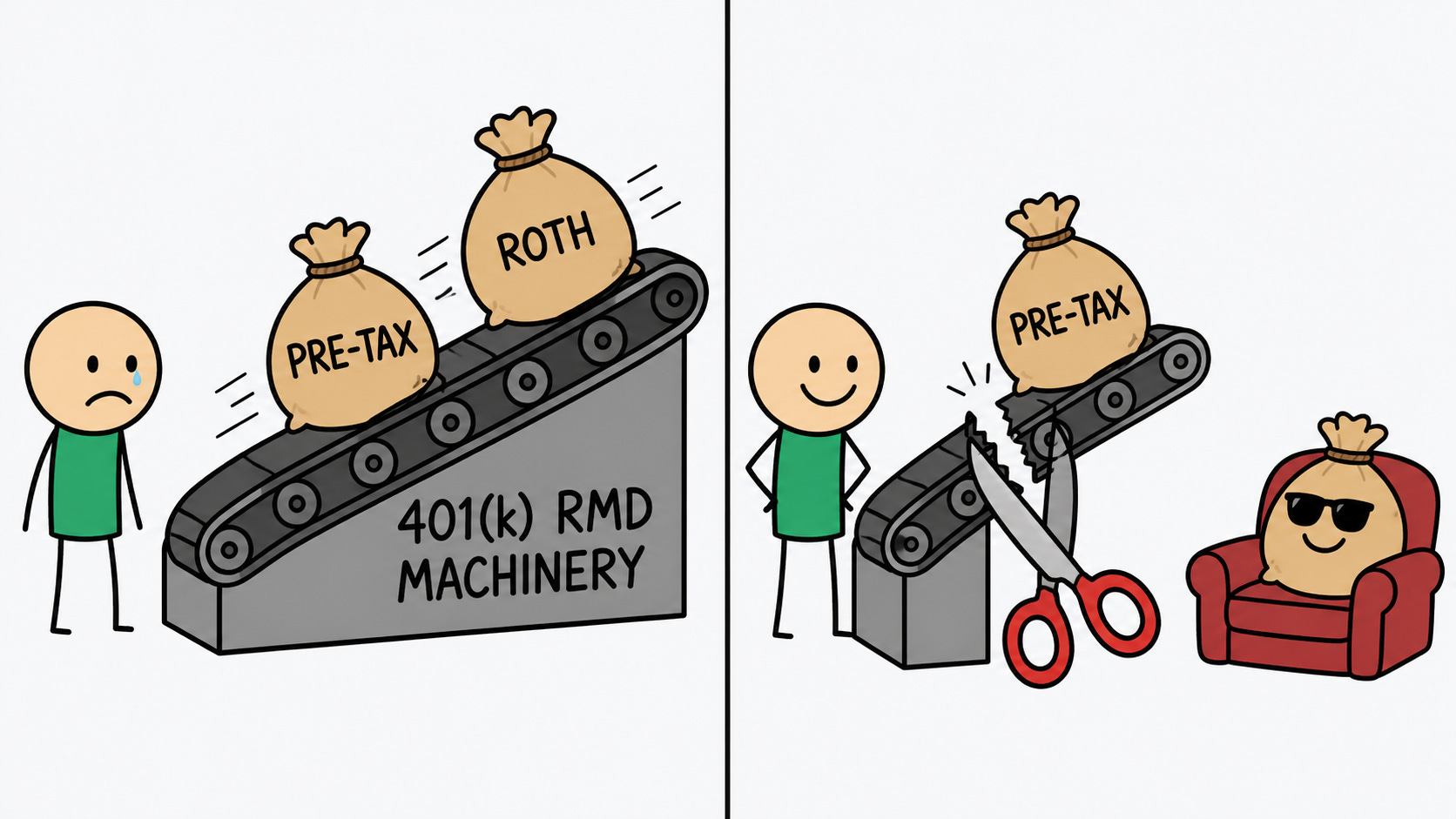
For years, a quiet inconsistency sat inside the retirement system. A Roth IRA never forced its owner to take a distribution during their lifetime, but a Roth 401(k) did. Same Roth tax treatment, same after-tax dollars going in, yet the workplace version dragged its owner into the required distribution machinery while the individual version did not. People who had carefully built a Roth balance inside their 401(k) were surprised to learn the government still made them pull money out of it every year. That inconsistency is now gone, and understanding what changed matters for anyone holding Roth money in an employer plan.
The rule is that designated Roth accounts inside employer plans no longer carry a lifetime required distribution. This covers designated Roth accounts inside employer plans, most commonly Roth 401(k) and Roth 403(b) accounts. The owner of that Roth workplace money is no longer forced to take annual distributions from it while alive, which finally lines the workplace Roth up with the Roth IRA it always resembled. Starting with 2024 required distributions, these designated Roth balances no longer generate a lifetime obligation going forward.
Before this change, the Roth balance inside a 401(k) was treated no differently from the pre-tax balance when the plan calculated a required distribution. The entire account, Roth dollars and pre-tax dollars together, went into the formula. Someone with a million dollar 401(k) split evenly between the two sides had their required amount calculated on the full million, and a slice of that forced withdrawal effectively came out of Roth money that a Roth IRA owner would never have been required to touch. The only way to escape it before the change was to roll the workplace Roth into a Roth IRA, moving the money into the one place the required distribution rules did not reach.
Two boundaries on this change matter, because both are places people overreach when they hear the headline.
The first is that this eliminates the lifetime requirement only. It does nothing to the rules that apply after death. A person who inherits a designated Roth account is still subject to distribution requirements as a beneficiary, the same way a Roth IRA passes its own distribution rules to whoever inherits it. The tax-free growth does not become a permanent, requirement-free inheritance. It empties on the beneficiary timeline like other inherited retirement money.
The second is that this touches only the Roth side of the account. The pre-tax portion of the same 401(k) keeps its full required distribution obligation, calculated and taken exactly as before. Removing the Roth dollars from the calculation shrinks the required amount, but it does not eliminate it for anyone still holding pre-tax money in the plan.
Picture someone at required distribution age with a workplace plan holding a large Roth balance alongside a pre-tax balance. Under the old approach, the plan looked at the combined total and produced a single required amount that reflected both sides. Part of what this person was forced to withdraw each year was Roth money, money that had already been taxed and was supposed to be growing tax free for as long as they wanted to leave it there.
Under the current rule, the designated Roth balance is excluded from the participant’s lifetime required distribution calculation. If the plan also holds pre-tax dollars, the required distribution still applies to that non-Roth portion. The Roth dollars can now sit untouched for the rest of the owner’s life, continuing to grow with no forced withdrawal, exactly as they would in a Roth IRA. If this person’s entire workplace balance were Roth, there would be no lifetime required distribution from that plan at all.
The practical resolution for many people is that a step they used to take may no longer be necessary. Rolling a workplace Roth into a Roth IRA was often done specifically to escape the old required distribution, and that particular reason has now disappeared. There can still be other good reasons to consolidate Roth money into an IRA, investment options and simplicity among them, but the forced distribution is no longer the thing pushing the decision.
The transition year is the only messy corner. Someone who delayed a first required distribution from the final old-rule year into the following spring may still have had that old-rule obligation to satisfy. That is a narrow timing issue, not the ongoing rule. Going forward the rule is settled. Roth money inside an employer plan carries no lifetime required distribution, the pre-tax side still does, and beneficiaries still face their own requirements once the account is inherited.
I write one of these every day, one retirement rule, explained in plain language and verified against the source. The daily email is free: subscribe here.
Full archive, worksheets, and search live at RetirementNewsRundown.com.
Disclaimer
This article is for educational and informational purposes only. It is not tax, legal, or financial advice and does not create an advisor–client relationship. Always consult appropriate professionals regarding your specific situation.