You can usually tell when someone learned a strategy before they learned the problem.
They’ll say something like, “I want to move my IRA into my 401(k),” and then immediately start talking about Roth contribution limits, income phaseouts, or how they “heard you’re supposed to do this every year.”
It’s not that they’re dumb. They’re usually trying to do the responsible thing. They’re just describing contribution rules while asking a rollover question, which is like reading the rules for baking a cake while you’re trying to change a tire.
The retirement system won’t stop you from doing that, by the way. It will politely allow you to proceed.
And later it will grade the outcome, not the intent.
A lot of popular retirement tactics exist for one reason: a constraint showed up.
High income that blocks direct Roth IRA contributions. Pre-tax IRA balances that trigger the pro-rata rule. Contribution limits that cap how much can be added. Employer plan rules that allow or block roll-ins. These tactics were built as workarounds. They are not achievements.
A good example is the backdoor Roth. It exists because some people make too much income to contribute directly to a Roth IRA, so they contribute to a traditional IRA instead, then convert to a Roth.
That basic idea is allowed. The part people miss is that it doesn’t live in a vacuum.
The conversion is governed by calendar-year tax rules. Specifically, conversions are taxed based on the year the conversion happens. Not your tax filing date. Not the year you meant. The actual calendar year.
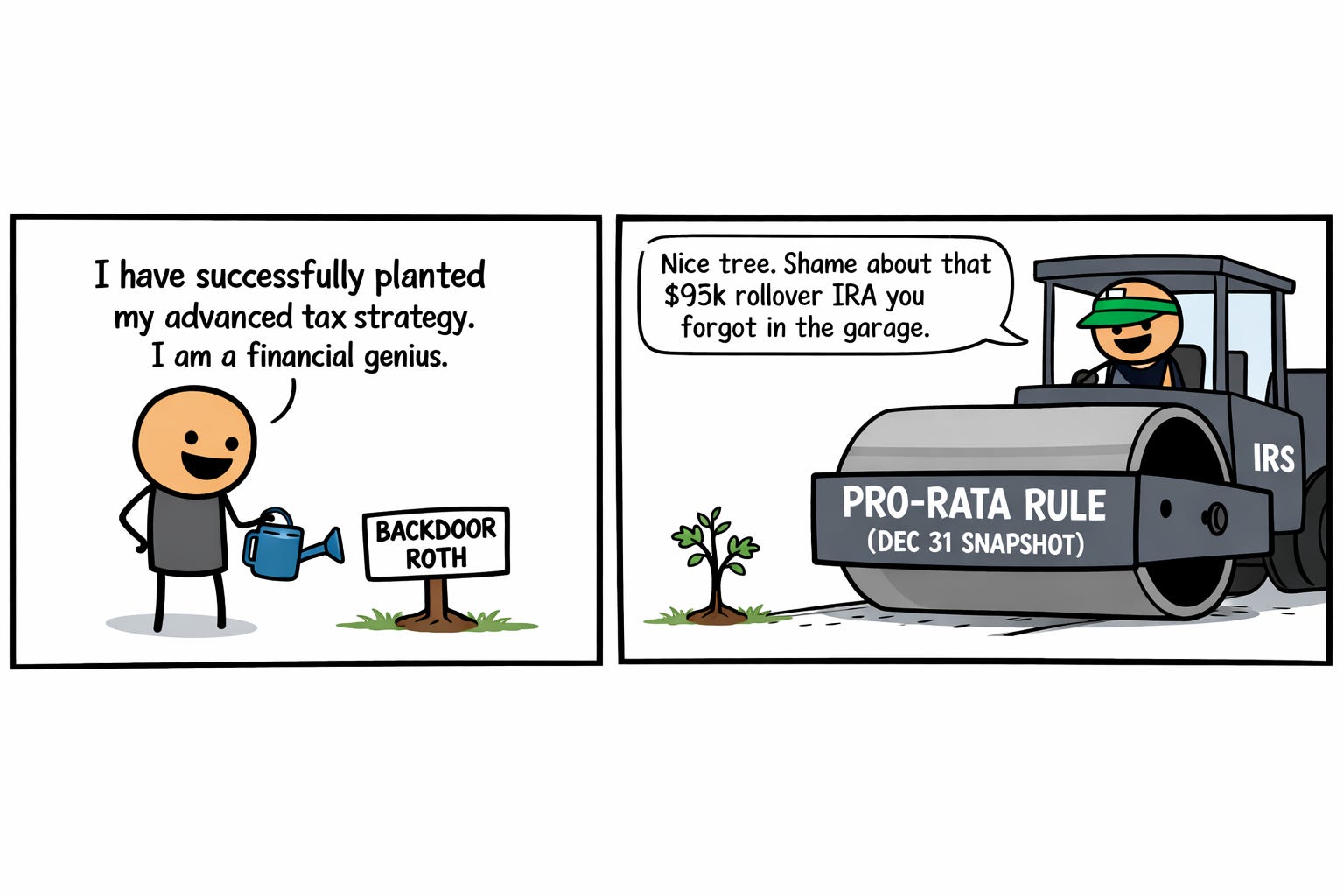
And the pro-rata rule uses a calendar-year snapshot. The IRS looks at the value of all your traditional, SEP, and SIMPLE IRAs as of December 31 of the year you convert. That includes accounts you forgot about, accounts you rolled over ten years ago, and the SEP IRA you used for your side hustle that you never think about until it ruins your day.
So when someone says, “I’m moving my IRA into my 401(k) so I can do a backdoor Roth,” what they’re often trying to solve is not a rollover problem. They’re trying to solve a pro-rata problem.
Those are different. That matters.
What happens if it’s done later instead is where this gets real. If you do the conversion in 2026, the IRS is going to care about what your IRA balances look like on December 31, 2026. If your IRA-to-401(k) rollover happens in January 2027, it’s too late for 2026. The system is not sentimental about your timeline.
Here’s a concrete scenario, with dates, because this is where people stop trusting vibes.
Say it’s February 2026. Someone contributes $7,000 to a traditional IRA for 2025 as a non-deductible contribution. That part is tied to the tax-filing deadline. IRA contributions for a given tax year are generally allowed up to the tax-filing deadline, typically April 15, not the extension date for most people’s IRA funding decision. It’s a tax-year rule.
Then, on March 10, 2026, they convert that $7,000 to a Roth IRA. That conversion is a 2026 event. Conversions don’t wait for your tax return. There is no “do it by April 15” conversion deadline. The calendar year you convert is the calendar year that matters.
Now here’s the twist. They also have $93,000 sitting in an old rollover IRA from a previous employer plan. They forgot it existed, because it’s been quietly behaving for years, like a well-trained liability.
On December 31, 2026, their total IRA balances are $100,000. That $7,000 non-deductible basis is now mixed into a bigger pool.
When they convert $7,000 in March, they may think they converted the non-deductible money. The IRS does not care what they think. Under the pro-rata rule, the conversion is treated as coming proportionally from pre-tax and after-tax amounts across all their IRAs. Roughly 7 percent after-tax, 93 percent pre-tax.
So even though they “did the backdoor Roth,” most of that conversion becomes taxable income in 2026.
Nothing illegal happened. Nothing “failed.” It was allowed.
It just solved the wrong problem.
Now, what if they move the $93,000 IRA into their 401(k) later instead? If that rollover into the employer plan happens before December 31, 2026, and the plan accepts roll-ins and the assets are eligible to be rolled in, then their year-end IRA balance might be close to zero. That can change how the pro-rata rule applies for that year.
If it happens after December 31, 2026, then for the 2026 conversion the year-end snapshot is already locked. The rollover might help future years, but it will not rewrite 2026. The system doesn’t do “retroactive clarity.”
Also, if they decide they hate this and want to undo the conversion later, that door is largely closed. Roth conversions used to be recharacterizable. That changed. Once you convert, the conversion is generally permanent for tax purposes. That’s not a penalty, it’s just the reality of the rule.
And if they contributed to a Roth IRA directly when they were ineligible, that’s a different mess with its own correction window. Excess IRA contributions carry a 6 percent excise tax for each year they remain uncorrected. The fix typically involves removing the excess and associated earnings by the due date of the return, and that due date can include extensions depending on the situation. Wait too long and it becomes an annual problem, not a one-time cleanup.
Again, later is not the same as now.
The point of all this is not to scare people away from strategies.
The point is to remove the magical thinking that comes with strategy talk.
A strategy is not a badge. It’s a tool designed for a specific constraint. If the constraint doesn’t exist, the tool often adds nothing except moving parts, paperwork, and a new way to be surprised next spring.
If you’re under Roth IRA income limits, a backdoor Roth isn’t “more advanced.” It’s just more steps. If you have access to a Roth option inside your employer plan and you’re not using it, you don’t have a shortage of strategies. You have a misunderstanding of what problem you’re trying to solve.
And if you’re mixing up contribution rules with rollover rules, you’re not alone. The system is full of similar-sounding terms that operate on totally different clocks. Tax-year contributions have tax-filing deadlines. Conversions live on the calendar year. Pro-rata cares about December 31. Corrections have windows that close whether you looked at them or not.
Once you start asking one simple question, the fog clears.
What problem is this strategy designed to solve?
If you can answer that, you’ll usually know where you stand now, and you’ll also know what changes if you do it later instead.
That’s the real win. Not the tactic.
I write one of these every day, one retirement rule, explained in plain language and verified against the source. The daily email is free: subscribe here.
Disclaimer
This article is for educational and informational purposes only. It is not tax, legal, or financial advice and does not create an advisor–client relationship. Always consult appropriate professionals regarding your specific situation.