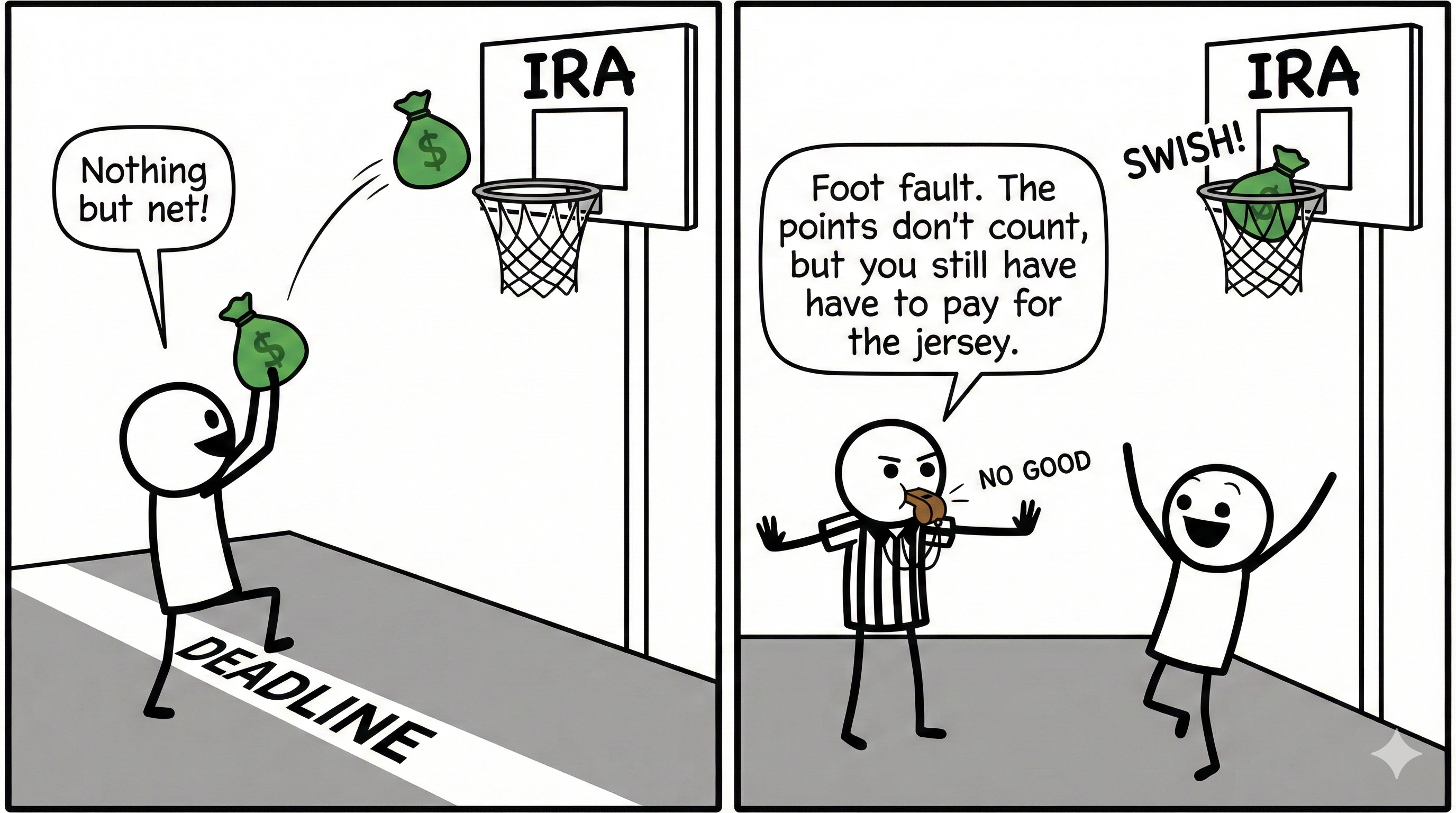
There’s a moment people feel proud of themselves in retirement paperwork.
The money moved.
The account balance looks correct.
Everything ended up where it was supposed to go.
That moment is usually followed by the sentence that causes the most damage later:
“At least it ended up in the right place.”
That sentence feels logical. It feels fair. It feels like how the real world should work.
It is also completely irrelevant to how retirement rules actually operate.
The retirement system does not judge outcomes. It judges sequences.
It does not ask where the money landed. It asks how it got there, when it moved, and what rules were in effect at each step along the way.
If those steps do not line up exactly with the rulebook, the fact that the money eventually landed in the correct account does not rescue the transaction. The system does not retroactively bless a process just because the ending looks tidy.
This is where people feel blindsided years later.
The core misunderstanding is assuming retirement rules work like logistics.
If a package starts at your house and ends up at the correct destination, most systems consider that a success. Maybe it took a weird route. Maybe it was late. But it arrived.
Retirement rules do not work that way.
They work like accounting. Every movement is recorded when it happens. Each step belongs to a specific year and a specific category. Once a step is recorded, it does not get rewritten just because the next step happened to fix the optics.
This matters because most retirement problems are not about fraud or recklessness.
They are about timing and classification.
Money left an account.
Money went into another account.
The intent was reasonable.
But intent does not define the event. Timing does.
A distribution is recorded the moment money leaves a retirement account. That recording happens immediately, even if no one notices. The system does not wait to see what you do next.
If the rules allow that distribution to be reclassified later, such as through a rollover, that reclassification only happens if every condition is met on time.
If those conditions are not met, the original classification stands forever.
It does not matter that the money eventually arrived where you wanted it to go.
This is where people confuse tax filing deadlines with transaction deadlines.
Tax filing deadlines determine when you report what already happened. They do not determine whether something was done correctly.
Calendar year deadlines determine when an action belongs.
Correction windows determine whether certain mistakes can still be fixed.
Filing deadlines simply document the result.
If a transaction failed in November and the return is filed perfectly in April, the failure still belongs to November.
If something is done later instead, it becomes a new event. It does not heal the old one.
Rollovers are the cleanest example of this confusion.
People think of a rollover as moving money from one account to another. The system thinks of it as a distribution that is forgiven only if very specific conditions are met.
The money leaves as a distribution. That is not optional. That is how the system records it.
Only after the money is redeposited within the allowed window, in the proper way, does the system agree to relabel that distribution.
If the window closes before that happens, the system does not reconsider. It does not care that the money eventually landed in an IRA. The distribution already happened. The classification already locked.
Putting the money into the account later instead creates a different event, usually a contribution.
If that contribution is not allowed, you now have a second problem layered on top of the first.
From the outside, everything looks fine.
From the inside, the system recorded two separate failures.
Here is how this plays out in real life.
Someone leaves a job in October 2024. They receive a check made payable to them personally. They plan to roll it into an IRA.
The check arrives on October 15. They deposit it into an IRA on January 10, 2025.
From their perspective, the money left and then went back where it belonged.
From the system’s perspective, the sequence looks like this:
October 2024: taxable distribution
January 2025: contribution
The rollover window closed before the deposit happened. The fact that the money eventually ended up in the IRA does not change the classification of the October distribution.
If the contribution exceeds limits or violates eligibility rules, that creates an excess. Fixing that excess later creates another distribution.
All of this came from one assumption: that ending in the right place meant it was done right.
Required minimum distributions create a similar illusion.
People miss an RMD and take money later to catch up. They assume the system will match the later distribution to the earlier requirement.
It does not.
An RMD is a specific type of distribution tied to a specific year. If it is missed, it remains missed. A later distribution is simply a later distribution.
The account balance goes down, which feels productive. But the missed requirement does not disappear.
If this is addressed later instead of within the correction window, the system records both events separately.
Again, the ending looks fine. The path does not.
Even fixes can fall into this trap.
Removing an excess contribution is the correct move. But the act of removing it is a distribution. That distribution has its own tax and penalty rules.
People assume fixing a problem returns them to neutral. Sometimes it does. Sometimes it creates a new issue that only exists because the fix happened too late or in the wrong year.
The system is not confused. It is simply evaluating each step as it occurs.
This is why so many retirement problems feel delayed.
Nothing exploded when the money moved. Nothing broke when the account balance updated. Nothing looked wrong at filing time.
The cost appears later, when the system reconciles years of recorded events against current rules.
By then, the ability to change the sequence is gone.
The reassuring part is that this is not about being perfect.
It is about understanding that retirement rules care about order, timing, and classification far more than outcomes.
The system does not reward effort. It does not punish intent. It records events.
Once you see that clearly, the confusion lifts.
You stop asking why the system did not understand what you were trying to do. You start recognizing that it understood exactly what happened.
The most useful question is not “Did it end up where it belonged?”
The useful question is “Was each step done within the right window and under the right rules?”
That question answers everything else.
Understanding this does not eliminate every mistake. But it prevents the most frustrating kind.
The kind where everything looks fine until it suddenly isn’t.
When you understand why “it ended up in the right place” is not the same as “it was done right,” you stop being surprised by outcomes that feel disconnected from your intentions.
You may still dislike the rules. You may still wish they were more forgiving.
But you will know exactly where you stand.
And in retirement planning, that clarity is usually what people were missing all along.
I write one of these every day, one retirement rule, explained in plain language and verified against the source. The daily email is free: subscribe here.
Disclaimer
This article is for educational and informational purposes only. It is not tax, legal, or financial advice and does not create an advisor–client relationship. Always consult appropriate professionals regarding your specific situation.