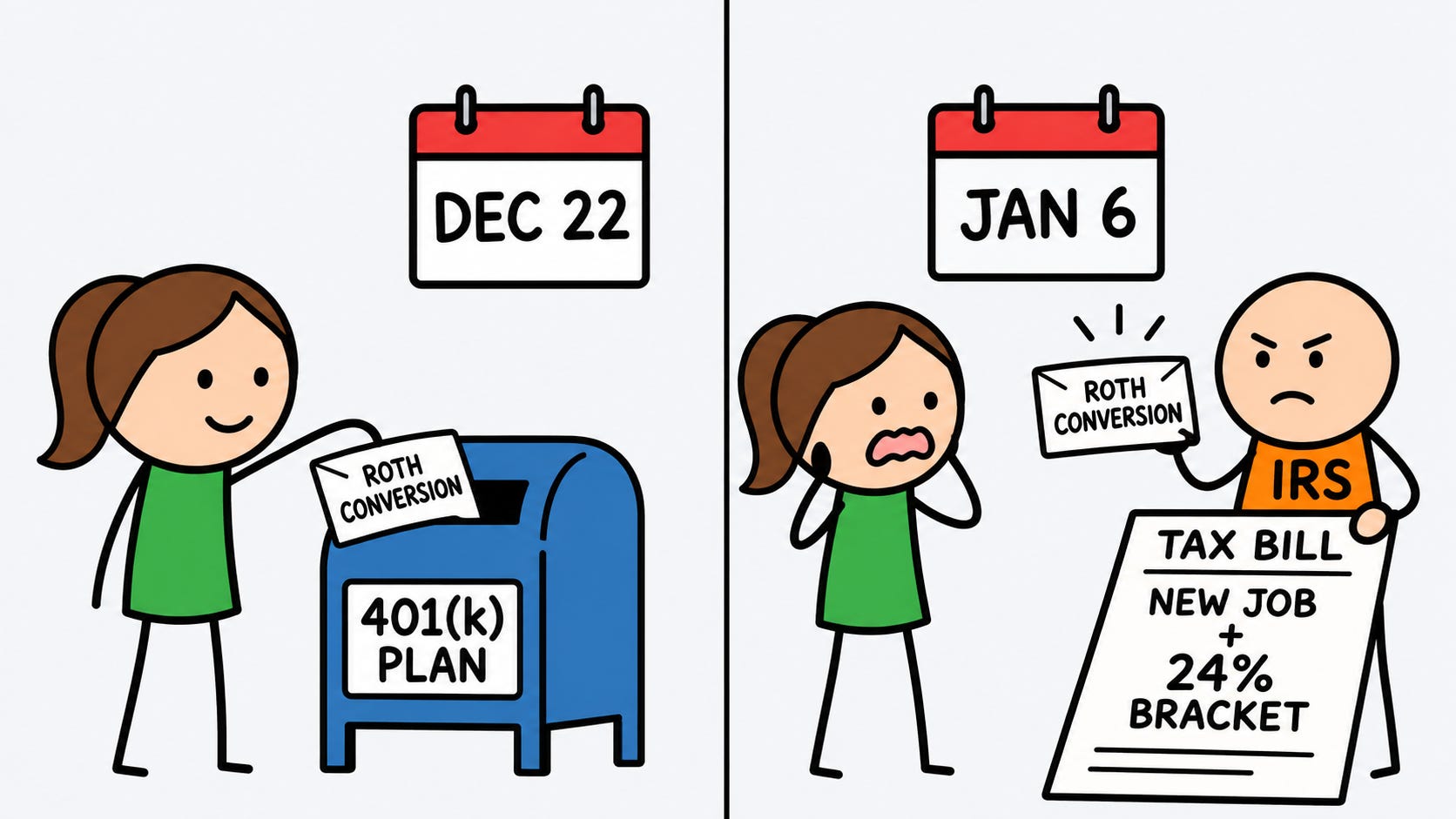
Federal income tax is figured one calendar year at a time, and the brackets start over every January 1. A layoff cuts the year’s wages short, so the year can end up taxed at a lower rate than the years around it. Money converted from pretax savings to a Roth IRA is taxed as ordinary income in the year it converts. That puts a layoff year on the short list of years when a conversion can cost less than usual.
A layoff year is also rarely as empty as it feels in the middle of it. Severance, a vacation payout, unemployment benefits and a new job’s first paychecks all land on the same return, and the real number is usually not known until late in the year.
The rule underneath all of this fits in one sentence. The taxable part of any amount converted to a Roth IRA is included in income for the year the money leaves the pretax account. For an IRA, that is the date the custodian distributes it. For a 401(k), it is the date the plan pays it out by direct rollover to the Roth IRA. What is converted adds to whatever else the year already holds.
A layoff year’s income tally includes more than people expect. Wages up to the last day count. Severance counts as wages in the year it is paid, which can be a different year from the layoff if it arrives in January or in installments. Unused vacation paid out counts. Unemployment benefits are taxable income, reported on a Form 1099-G. A new job that starts in the fall adds its wages too. The room left before the next bracket begins is what is left after all of it.
The layoff also changes what can be converted. While someone works for an employer, the 401(k) generally stays put. After separation, the old plan’s balance can usually be paid out by direct rollover, and that rollover can go straight to a Roth IRA. A direct rollover to a Roth IRA has no mandatory 20% withholding, so the full amount converts and the tax comes from somewhere else.
What happens if the conversion lands after December 31? It belongs to the next year’s return, taxed alongside whatever that year brings, which for someone back at work is often a full salary. A plan that takes two weeks to process a rollover request made on December 20 moves the conversion into January. There is no way to backdate it.
What happens if the conversion turns out too large? Nothing undoes it. A conversion cannot be recharacterized back to a traditional IRA, so the amount converted is taxed even if the year’s other income comes in higher than projected.
What happens if the tax is paid out of the conversion itself? For someone under 59.5, the withheld amount is a distribution that never reached the Roth IRA, so it is taxable and can carry the 10% early distribution tax. The tax can come from savings instead, through an estimated payment, where the annualized method on the underpayment form matches it to the quarter the income arrived, or through extra withholding from other income before year-end, which counts as paid evenly through the year.
Two more effects follow from the conversion’s place on the return. The conversion raises adjusted gross income, which is the number that sets other things: a marketplace premium tax credit for someone who bought health coverage after the layoff, the rate on capital gains, and for older workers, the share of Social Security that is taxed. And moving 401(k) money into a Roth IRA moves it out of the plan, which gives up the plan’s penalty exception for people who leave their job in or after the year they turn 55. IRAs have no version of that exception.
Last is the clock that matters for anyone under 59.5. Each conversion starts its own five-year period, counted from January 1 of the year it happens. Taking the converted dollars back out of the Roth IRA within that period and before 59.5 brings back the 10% tax on the amount that was taxable when converted. For someone who might need the money while between jobs, that is a reason to convert only what can stay put.
Priya is 47, single, and earned a salary that kept her in the 24% bracket for years. She is laid off on March 31 and starts a new job the following January.
Her income for the year is $30,000 of wages through March, a $15,000 severance payment in April, $1,800 for unused vacation in the same check, and $9,000 of unemployment benefits from May through October. In early November, with all of those amounts known, her tax preparer runs a projection. Her taxable income lands in the 12% bracket with about $10,000 of room before the 22% bracket starts.
Her old 401(k) holds $85,000, all pretax. She asks the plan for a direct rollover of $10,000 to a new Roth IRA and the rest to a traditional IRA. The plan processes the request on November 18. The $10,000 is taxable income for the year, adding about $1,200 of federal tax. She pays it from savings with an estimated payment the following January, using the annualized method to show the income arrived late in the year. Nothing is withheld from the rollover.
Her health coverage is COBRA, so the conversion has no premium tax credit to shrink. Had she been on a marketplace plan with an advance credit, the extra $10,000 would have counted toward the income that sets that credit, and part of it could have come back on her return.
Her five-year clock for the conversion starts January 1 of the conversion year. Her emergency fund covers the months without work, so the converted money stays where it is. Had she needed to pull the $10,000 back out of the Roth IRA two years later, at 49, she would have owed $1,000 of additional tax on top of what she already paid.
Suppose she had waited until December 22 to send the request and the plan paid it out on January 6. The conversion would have landed in the year her new salary started, taxed at 24%.
A layoff year can make a conversion cheaper, and the size of the window depends on numbers that keep arriving through the fall. Converting in pieces as the year’s income becomes clear keeps any surprise smaller.
What matters is the year’s full income tally, the date the money actually leaves the pretax account, how the tax gets paid, and whether the converted dollars can sit for five years. For anyone mapping how conversions across several years interact with future required distributions, our RMD and Roth conversion planner lays the years side by side.
I write one of these every day, one retirement rule, explained in plain language and verified against the source. The daily email is free: subscribe here.
Full archive, worksheets, and search live at RetirementNewsRundown.com.
Disclaimer
This article is for educational and informational purposes only. It is not tax, legal, or financial advice and does not create an advisor-client relationship. Always consult appropriate professionals regarding your specific situation.