A layoff rarely ends with one clean last paycheck. There is the final check for the last stretch of work, a payout for unused vacation, maybe a bonus or a commission that was already in the pipeline, and a severance payment that might arrive in one lump or in installments over months. Each of those payments is wages. Only some of them can go into the 401(k).
The plan sorts them by what the money was for and when it shows up. Pay for work already done, paid soon after the job ends, can usually still take a deferral. Pay for leaving the job cannot, no matter how soon it arrives or how much of it there is.
The rule starts with what counts as compensation for the plan. Money paid after a job ends still counts if it lands inside a window that closes on the later of two dates: two and a half months after the last day of employment, or the end of the plan’s limitation year that includes that last day. For plans that use the calendar year, that second date is December 31.
Inside that window, two kinds of payments can count.
The first is regular pay that would have been paid anyway if the job had continued. The final paycheck for hours already worked fits here, along with overtime, shift differentials, commissions and bonuses earned for that work. If the plan’s definition of compensation includes them, the employee’s deferral election applies to them the same way it applied to every earlier paycheck.
The second is a payout of unused vacation, sick or other leave, but only if the employee could have used that leave had the job continued, and only if the plan document chooses to include it. Some plans do. Many leave it out.
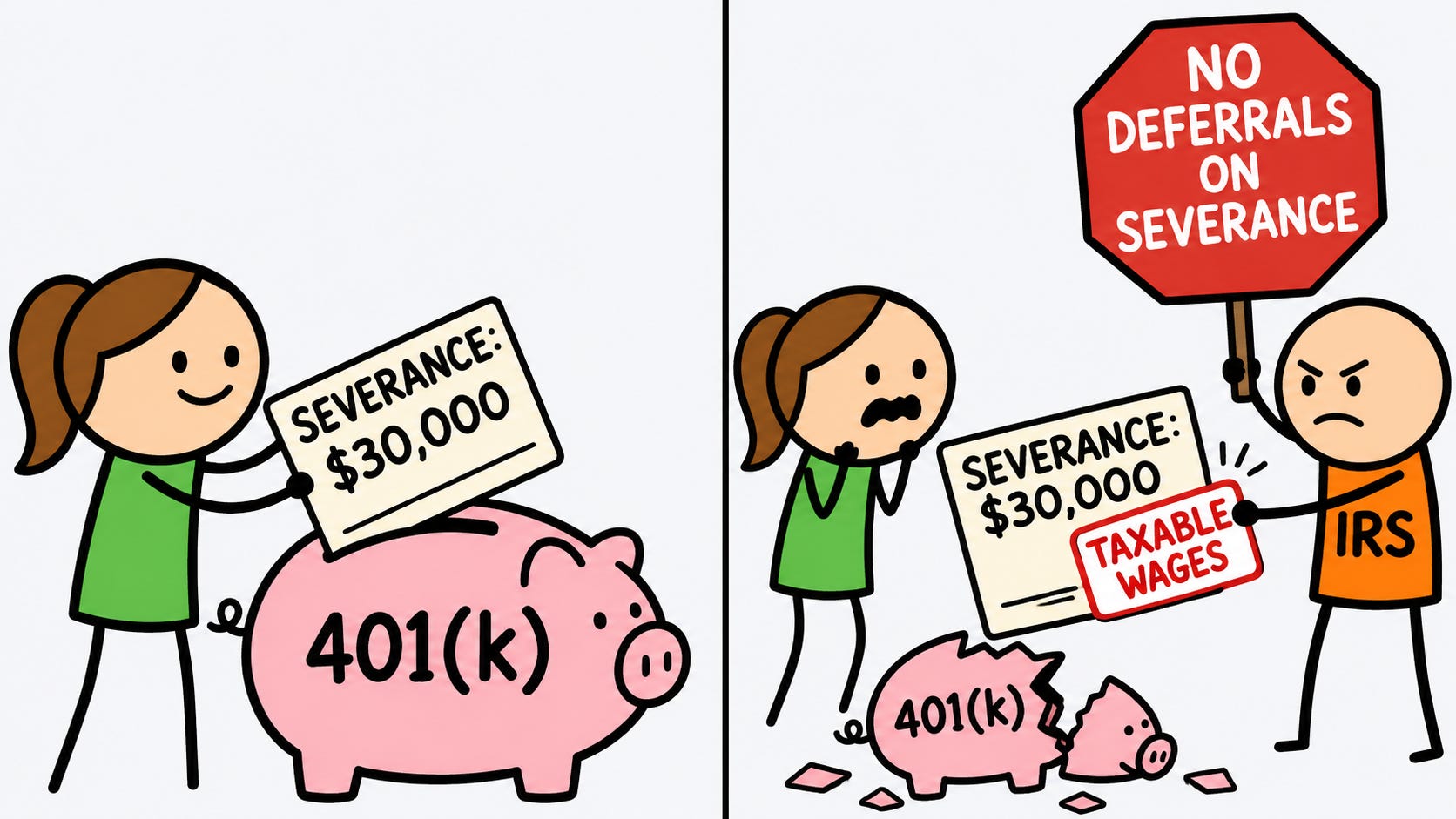
Severance pay paid after the job ends does not count as compensation for this purpose. Money paid because the job ended, whether it is called severance, a separation package or a parting thank-you, cannot take a 401(k) deferral, even if it arrives the day after the last day of work. The same rules apply to 403(b) plans.
The deferral election also has timing of its own. An election can only apply to pay that has not been paid yet. A standing election from before the layoff generally carries over to the qualifying final checks automatically. Changing it after the layoff, to push more of the vacation payout into the plan for example, works only if the change is made before that money is paid and the plan’s procedures allow it.
What happens if a qualifying payment arrives after the window closes? It is ordinary taxable wages, and it can no longer be deferred. A bonus for work done before a September departure, paid the following March, is outside the window under a calendar-year plan.
What happens if the payroll system takes a deferral from severance anyway? That is an operational failure in the plan. The usual correction returns the improper deferral, with its earnings, to the former employee as taxable income. Any matching contribution tied to that deferral gets adjusted as part of the same fix.
One more limit follows the employee to the next job. The annual cap on deferrals, including any age-based catch-up the plans allow, belongs to the person and covers every 401(k) and 403(b) they contribute to in the year. A new employer’s payroll system has no record of what went in at the old one. If the combined total goes over, the employee has to ask one of the plans to pay out the excess and its earnings by April 15 of the following year, and the plan can set an earlier date for that request. Miss the deadline, and the same dollars are taxed in the year they were deferred and again when they eventually come out.
Dana is 52 and works in procurement for a calendar-year company with a 401(k). Her deferral election is 10% of pay, and her plan’s definition of compensation includes regular pay, bonuses and leave payouts. Her last day is September 30.
On October 10 she receives her final paycheck. It includes $4,000 for her last two weeks of work and $3,000 for unused vacation she could have taken if she had stayed. Her election applies to both, so $700 goes into the 401(k).
Her severance is $30,000, paid in a lump sum on October 31. None of it can be deferred. It is taxable wages, with the usual withholding and payroll taxes, and her 401(k) election has no effect on it.
Dana’s window runs to the later of mid-December and December 31, so December 31. Her annual performance bonus, $5,000 for work she did before she left, is paid with everyone else’s on December 15. It is inside the window and was earned for her work, so her 10% election takes $500 of it.
Suppose the company had paid that bonus in February instead. It would fall outside the window, and the whole $5,000 would be taxable wages with nothing going to the 401(k).
In November, Dana starts a new job with its own 401(k) and an election of 15%. Her deferrals at the old job total enough that the two plans together will pass her annual limit, catch-up included, by mid-December. The new plan has no way to know that. Keeping the total under her limit, or requesting a timely correction, is on her.
Had Dana’s last day been November 30 instead, the two-and-a-half-month window would have run into mid-February, and a February bonus earned for her work could have taken a deferral.
Most of this happens on autopilot. A deferral election in place before the layoff keeps applying to the final checks the plan counts as compensation, and the payroll system stops when the window closes. Severance going out with no 401(k) deduction is the rule working as designed.
What matters is which payments the plan document counts as compensation, especially leave payouts, the date the window closes, and the running total of deferrals across every employer in the year. For where the 401(k) balance itself can go once the job is over, our rollover IRA guide covers the options.
I write one of these every day, one retirement rule, explained in plain language and verified against the source. The daily email is free: subscribe here.
Full archive, worksheets, and search live at RetirementNewsRundown.com.
Disclaimer
This article is for educational and informational purposes only. It is not tax, legal, or financial advice and does not create an advisor-client relationship. Always consult appropriate professionals regarding your specific situation.