A 401(k) plan is allowed to show a former employee the door twice. The first time is the layoff. The second arrives a few weeks or months later, when the plan decides the account is small enough to send away without asking. If the vested balance is $7,000 or less, a plan that includes this provision can pay it out with no consent from the participant and no consent from a spouse.
Most people find out about this from a letter they assume is junk mail. The letter says the account will be distributed unless they choose where it goes, gives a deadline, and then the deadline passes while they are busy looking for a job. The money moves anyway.
The rule has three tiers, and the balance decides which one applies.
Above $7,000, the plan needs the participant’s consent to pay it out before the later of age 62 or the plan’s normal retirement age. Until then the account can sit there after the layoff, and nobody at the old employer can force it out. A plan termination or a required minimum distribution follows its own rules.
From just over $1,000 up to $7,000, the plan can distribute without consent, but it cannot mail a check by default. If the participant makes no choice, the plan has to roll the money directly into an IRA it sets up with a provider it picks. That account is invested to preserve principal, often in a cash-like investment such as a money market fund. It can earn less than a long-term retirement portfolio, and fees can reduce the balance. Nothing is withheld and nothing is taxed, because the money never left tax-deferred status.
At $1,000 or less, the plan can send a check. A check for $200 or more comes with 20% withheld for federal income tax. Under $200, nothing is withheld.
Before any of this happens, the plan has to send the rollover notice that explains the options. The participant gets at least 30 days to make a choice and can choose sooner. In that window, the participant can direct the money to an IRA of their own, to a new employer’s plan if it accepts rollovers, or take the cash.
Two details catch people off guard. A plan can ignore money that was rolled in from an earlier job when it measures the $7,000. A large account built mostly from an old rollover can be forced out in full if the plan’s own contributions are small. Unvested employer money does not count either, since it was never the participant’s to begin with.
The automatic rollover requirement also has an age limit. It applies to forced payouts made before the later of age 62 or the plan’s normal retirement age. Past that point, a plan that cashes out a small balance can send a check with 20% withheld, even when the amount is over $1,000.
What happens if the participant does nothing? For a balance over $1,000, the default IRA is the outcome. The money is still tax-deferred and can be moved to any other IRA later by a direct transfer, with no deadline attached. What it costs is the growth lost in a cash fund and whatever fees the provider charges in the meantime.
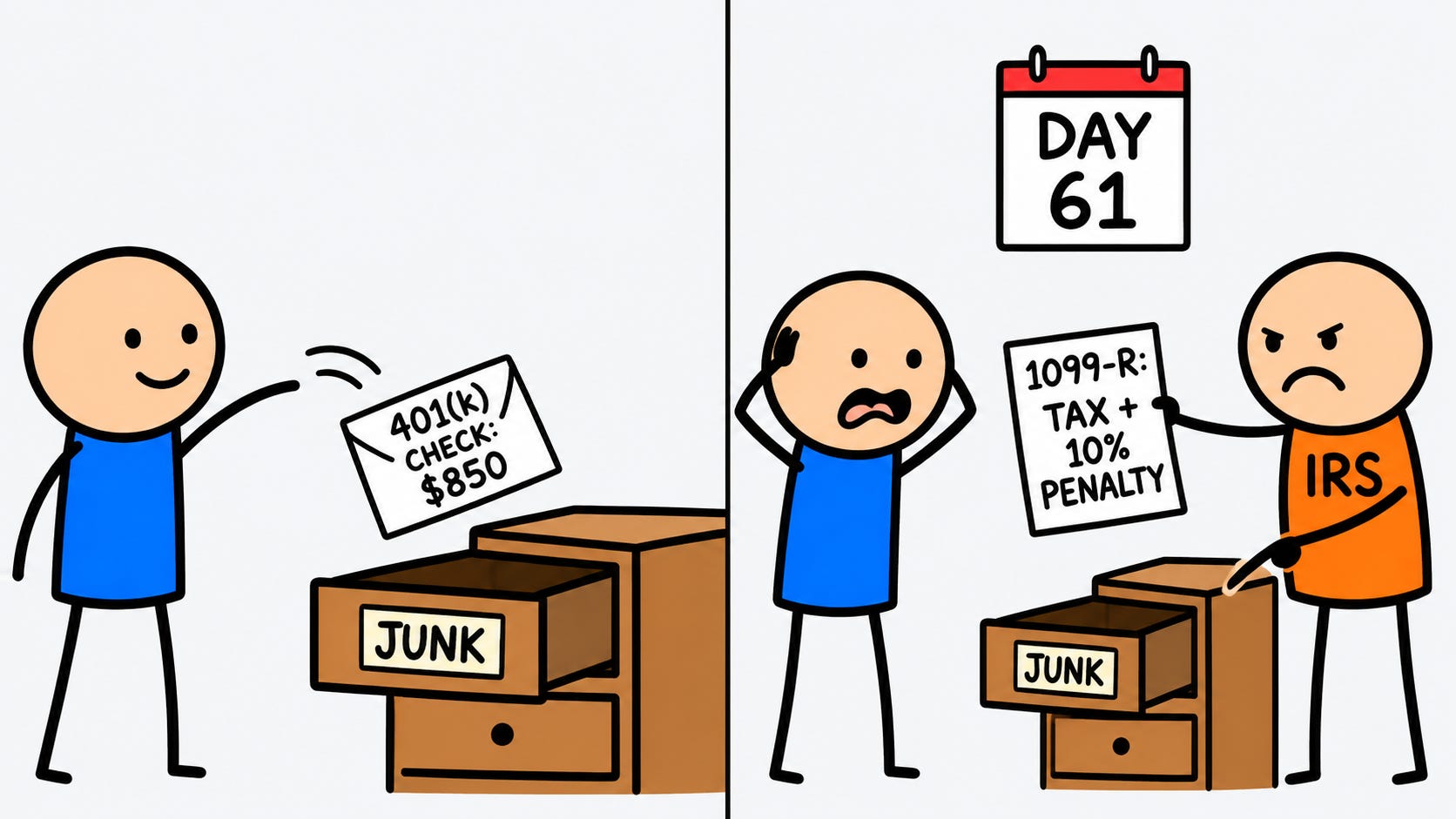
What happens if a check arrives and sits in a drawer? Leaving it uncashed does not keep it from being a taxable distribution. The plan reports it on Form 1099-R, and the 60-day rollover clock starts when the participant receives it. To keep it out of income, the full amount, including the 20% that was withheld, has to go into an IRA or another plan inside that window. The withheld portion has to come from other savings. Whatever is not rolled is taxable, and for someone under 59.5 who left the job before the year they turned 55, the taxable part can carry the 10% early distribution tax too. The IRS can waive the 60-day deadline in limited circumstances, and a short list of reasons lets a person self-certify a late rollover to the receiving custodian.
Tasha and Luis are laid off from the same distribution company in March. Tasha is 34. Luis is 41.
Tasha’s 401(k) holds $6,400 of her own deferrals and vested match, all pretax. Her unvested match is forfeited. In May she receives the rollover notice with a 30-day response window. She is three interviews deep and the envelope goes on the counter. In July, the plan rolls $6,400 into an IRA at its chosen provider, invested in a money market fund with an annual fee. She owes no tax. In October, she opens an IRA at a brokerage and has the $6,400 moved there by direct transfer. Nothing about the delay cost her a tax bill.
Luis’s balance is $850, also all pretax. In May, the plan sends him a check for $680, with $170 withheld. He has 60 days from the day he receives it. If he deposits $850 into an IRA within that window, using $170 of his own savings to cover the withholding, nothing is taxable and the $170 comes back to him as a credit on his return. If he cashes the check and spends it, $850 is taxable income for the year, plus an $85 early distribution tax, and the $170 withheld counts toward the bill.
Their coworker Gwen, 50, has a $3,000 balance from contributions at this job and $28,000 she rolled in from an earlier employer. Her plan’s document excludes rollover money when it measures the $7,000, so her account qualifies as small. In July, the full $31,000 goes into the plan’s default IRA. It stays tax-deferred, and she can move it whenever she likes.
A forced cash-out sounds worse than it usually is. For any balance over $1,000, the default is an IRA, the tax deferral survives, and the money can be moved later at no tax cost. The account is still the participant’s property. The one thing a layoff takes away here is the option to leave a small balance in the old plan indefinitely.
The cases that cost money are the small checks. A check of $1,000 or less counts as a taxable distribution once it is received, cashed or not, and the 60-day clock to roll it starts the day it arrives. For anyone weighing where an old plan balance can go once it is free to move, our rollover IRA guide walks through the destinations and how each transfer works.
I write one of these every day, one retirement rule, explained in plain language and verified against the source. The daily email is free: subscribe here.
Full archive, worksheets, and search live at RetirementNewsRundown.com.
Disclaimer
This article is for educational and informational purposes only. It is not tax, legal, or financial advice and does not create an advisor-client relationship. Always consult appropriate professionals regarding your specific situation.