When a business sells and its 401(k) terminates, the owner often ends up with two big checks in the same year: the sale price, and a full distribution from the plan. The sale money is taxed under its own rules. The plan money is taxable only to the extent it is not rolled over, and how it gets rolled is a sequence of small decisions where the order matters.
Most of the steps are paperwork. A few of them, done out of order, turn tax-deferred money into income, an excess contribution in an IRA, or a loan balance that becomes taxable without anyone noticing until the 1099-R arrives.
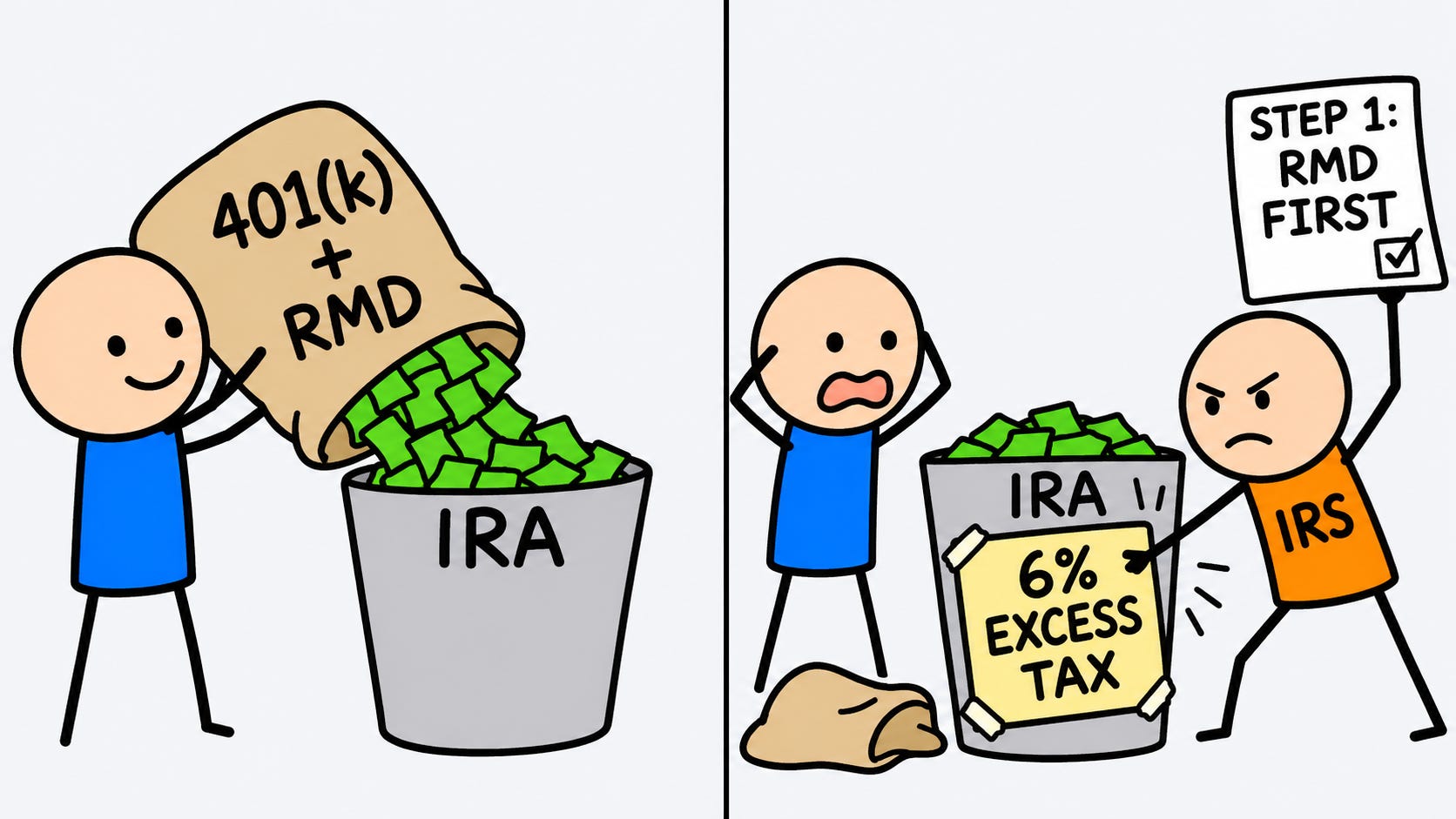
The first step applies only to owners past RMD age. A required minimum distribution for the year cannot be rolled over to anything, and when a plan pays out a balance in a year an RMD is due, the RMD portion comes out first. It goes to the owner and is taxable. What happens if it gets rolled anyway? Money that cannot legally be rolled over becomes an excess contribution in the IRA that receives it. Pulling it back out with its earnings by the tax return due date, extensions included, generally avoids the 6% tax, and a six-month window after a timely filed return can also help. Otherwise the excess faces a 6% tax each year it stays, limited by the IRA’s year-end value.
The second step is any outstanding plan loan. When a plan terminates or the owner leaves employment, a loan in good standing is usually paid off by reducing the account, called a plan loan offset. That offset counts as a distribution. An offset triggered by the termination or severance is a qualified plan loan offset, and the owner has until the due date of that year’s tax return, including extensions, to roll the same amount into an IRA from other money. What happens if that deadline passes? The offset stays taxable income for the year, and for someone under 59.5 it can carry the 10% penalty too.
The third step is the rollover itself, and the cleanest route is a direct rollover from the plan to the IRA. Nothing is withheld, and nothing has to be redeposited. If the plan instead cuts a check to the owner, it must withhold 20% of the taxable part of the money that could have been rolled over. The owner then has 60 days to deposit the full pre-withholding amount into an IRA, which means replacing the withheld 20% from other funds. What happens if only the net check goes in? The 20% that was not replaced becomes taxable income, and the withheld amount counts as tax paid on the return. The IRS can waive the 60-day deadline in limited circumstances.
The fourth step is matching each kind of money to the right destination. Pretax money goes to a traditional IRA, or to a Roth IRA as a taxable conversion. A Roth 401(k) balance goes to a Roth IRA. After-tax contributions in the plan can be split off to a Roth IRA when the plan pays them out together with the pretax money. Company stock carries its own one-time choice that has to be made before any rollover.
The sale proceeds are not retirement plan money. They are taxed under the rules for the sale, usually as capital gain for a stock sale, and they land on the same tax return as any part of the plan distribution that was not rolled over. They can, however, supply the outside cash for replacing withholding or completing a loan offset rollover.
Ray is 74, past his RMD age, and sells his manufacturing company’s stock. The company terminates its 401(k) before closing. His account holds $900,000: $840,000 of traditional pretax money, which includes a $40,000 loan he took two years ago, and a $60,000 Roth 401(k) balance. His RMD for the year is $35,000.
In December, the plan pays out. The $35,000 RMD goes to Ray and is taxable. The $40,000 loan is offset against the account. Because the termination triggered the offset, Ray has until the due date of that year’s return, October 15 the next year with an extension, to deposit $40,000 into his traditional IRA from his sale proceeds and keep it out of income. The remaining $765,000 of traditional money goes by direct rollover to a traditional IRA, and the $60,000 Roth balance goes by direct rollover to a Roth IRA.
His taxable income from the plan for the year is the $35,000 RMD, plus the $40,000 offset if he does not roll it.
Had Ray asked for a check instead of a direct rollover, the plan would generally have had to withhold 20% of the taxable rollover-eligible amount, including the loan offset, with the withholding taken from the cash paid to him. The RMD follows separate withholding rules. When the rest moves by direct rollover, a standalone loan offset produces no cash from which to withhold. To preserve the tax-deferred treatment of a cash distribution, Ray would need to replace the withheld amount and complete that rollover within 60 days. He would still have until his extended tax-return deadline to roll over the qualified plan loan offset. Had he rolled the RMD along with everything else, his IRA would have held a $35,000 excess contribution.
The order of these moves leaves Ray’s total savings where they were and decides how much of them is taxed in a year that already includes a business sale.
What matters is the sequence: RMD out first if one is due, the loan offset tracked against the tax return deadline, direct rollovers for everything else, and each type of money sent to the account that can take it. For owners past RMD age figuring the required amount before the rest moves, our RMD calculator runs the numbers.
I write one of these every day, one retirement rule, explained in plain language and verified against the source. The daily email is free: subscribe here.
Full archive, worksheets, and search live at RetirementNewsRundown.com.
Disclaimer
This article is for educational and informational purposes only. It is not tax, legal, or financial advice and does not create an advisor-client relationship. Always consult appropriate professionals regarding your specific situation.