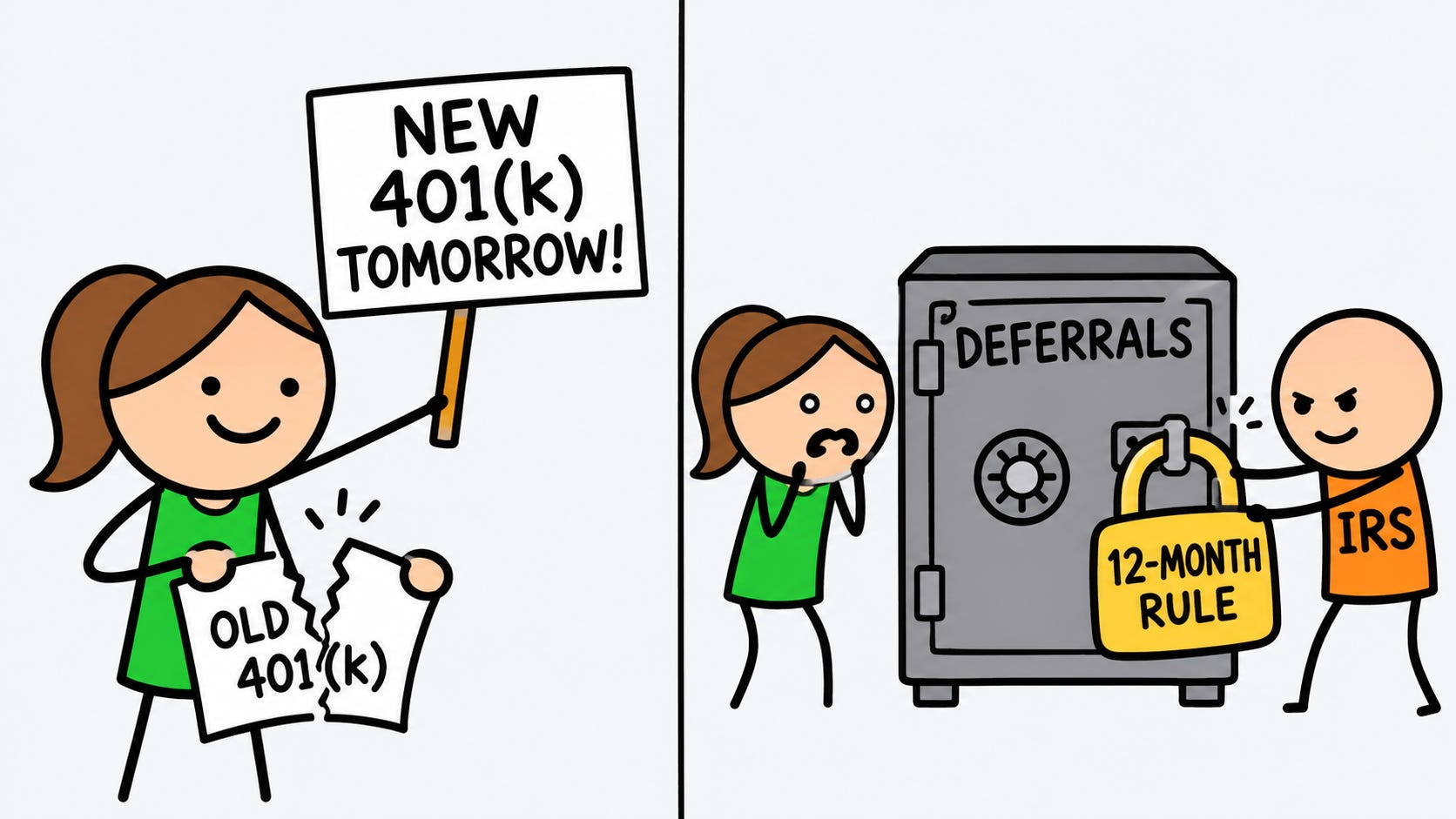
Terminating a 401(k) is one of the few events that lets employees take their own salary deferrals out of a plan while they are still working for the same company. Normally that money stays locked until they leave, reach 59.5, become disabled, or show a hardship. A qualifying plan termination can open that door for everyone at once.
The IRS attaches one condition to that door, and it trips up employers who think of a plan termination as the same thing as switching providers. If the company keeps or starts another 401(k)-type plan around the same time, the termination stops being a distribution event for the deferrals.
The rule says a terminating plan cannot pay out elective deferrals on account of the termination if the employer maintains an alternative defined contribution plan. In practice that means another profit-sharing or 401(k)-type plan for the same employer.
The timing window is wider than most people expect. A plan counts as an alternative if it exists at any point from the termination date through 12 months after the terminating plan has distributed all of its assets. A new 401(k) that starts the day after the old one terminates counts. So does one that starts 11 months after the last check goes out.
Several kinds of plans do not count as alternatives: SEPs, SIMPLE IRA plans, 403(b) plans, certain 457 plans, and employee stock ownership plans. There is also a small-overlap exception. If fewer than 2% of the employees eligible under the terminated plan are eligible under the other plan throughout the 24 months that begin 12 months before the termination date, the other plan does not count.
The rule reaches salary deferrals and the safe harbor and corrective contributions that share their restrictions. Ordinary matching and profit-sharing money follows the plan’s own terms and can generally be paid out on termination either way. Distributions of deferrals on termination also have to be lump sums.
Who counts as the employer is fixed as of the termination date. That is what makes a termination before a stock sale work. If the seller’s company terminates its plan before the closing, the buyer is not yet part of the same employer on the termination date, so the buyer’s own 401(k) is not an alternative plan. A termination after the closing brings the buyer’s plan into the test.
What happens when the rule blocks the payout? The deferrals cannot leave because of the termination. They stay in the plan until some other distribution event applies to each employee, such as leaving the job or reaching 59.5, or they move into the other plan. Paying them out anyway is an operational failure in the plan that has to be corrected.
What happens if the new plan comes later? The window decides it. An employer that terminates a 401(k), finishes the distributions, and waits more than 12 months after the last one before starting a new 401(k) or profit-sharing plan is outside the rule. One that starts the new plan sooner is inside it.
Carla owns a marketing agency with 15 employees and a 401(k) whose fees have crept up. She wants a cheaper provider, and her first instinct is to terminate the old plan on March 31 and open a new 401(k) on April 1.
That sequence puts the new plan inside the window. The old plan cannot pay out deferrals because of the termination, so employees cannot take those balances as termination distributions and roll them to IRAs. The ordinary match money can be distributed under the plan’s terms, but the deferrals still have to go somewhere. Leaving them behind does not complete the termination, and a plan still holding assets past the payout window can be treated as ongoing. The deferral balances generally have to move by a transfer or merger into another plan, or stay under the plan’s distribution restrictions until each employee has another qualifying event.
Her provider offers a different path: move the existing plan to the new provider as a continuing plan, or merge the old plan into the new one, with no termination at all. Nothing is distributed and nothing is blocked.
Had the goal been to get the employees their balances, the path would run differently: terminate the old plan, finish the distributions by October, and offer a SEP in the meantime, since a SEP does not count as an alternative. A new 401(k) would then wait until more than 12 months after the October distributions.
Meanwhile, her friend Dev sells his engineering firm’s stock to a larger company that has its own 401(k). His firm terminates its plan two days before closing. On the termination date, the buyer is not his employer, so the buyer’s plan is not an alternative, and his employees can take lump sums and roll them wherever they choose.
The successor plan rule protects the idea that 401(k) deferrals are retirement money, so a termination that is really a provider switch does not become a cash-out for everyone. For most employers, it only matters when a termination and a new defined contribution plan land close together.
What matters is the order and the dates: whether another defined contribution plan exists from the termination date through 12 months after the last distribution, whether it falls under one of the exceptions, and whether a sale’s termination date comes before the closing. For how the termination itself unfolds after the resolution, our breakdown of terminating a plan before a sale and the 12-month clock after walks through the steps.
I write one of these every day, one retirement rule, explained in plain language and verified against the source. The daily email is free: subscribe here.
Full archive, worksheets, and search live at RetirementNewsRundown.com.
Disclaimer
This article is for educational and informational purposes only. It is not tax, legal, or financial advice and does not create an advisor-client relationship. Always consult appropriate professionals regarding your specific situation.