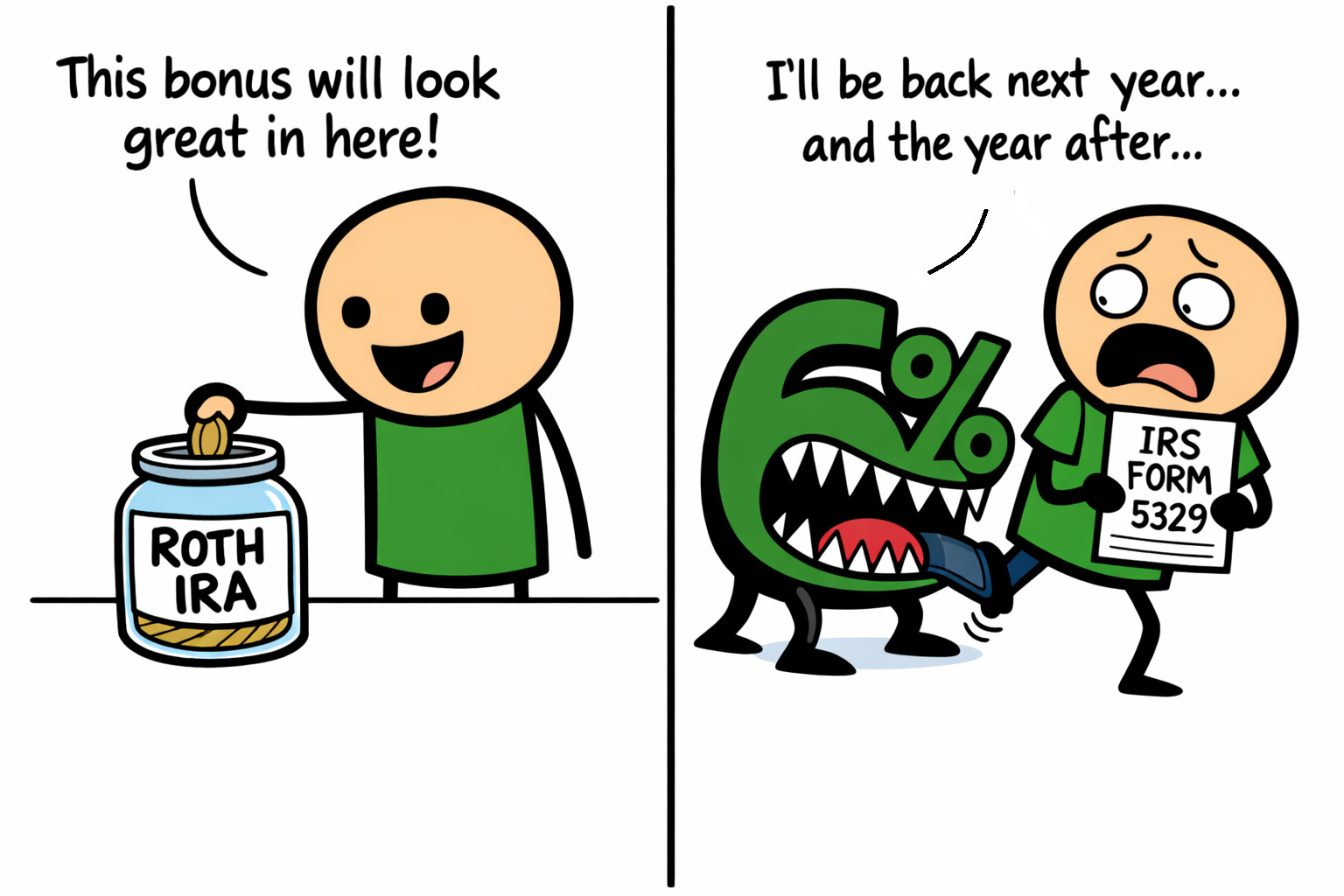
The IRS doesn’t send you a warning when you put too much money into an IRA. There’s no pop-up. No letter. No friendly nudge from your custodian. The money goes in, the year ends, and the penalty starts running. Quietly. In the background. Every single year until you fix it.
Most people don’t find out they have an excess contribution until they’re sitting with their accountant the following spring. By then, the first year’s penalty is already locked in. And if they ignore it or don’t understand it, the second year starts compounding.
This is how the excess contribution penalty actually works.
The penalty is 6% of the excess amount, applied every year the excess remains in the account. It’s reported on Form 5329 and it’s owed on top of your regular income tax. This isn’t a one-time fee. It’s a recurring annual penalty that resets every December 31 the money is still sitting there.
There’s one nuance most people miss. The 6% isn’t always calculated on the excess amount itself. The IRS takes the lesser of two numbers: 6% of the excess contribution, or 6% of the total fair market value of the IRA as of December 31. If your IRA lost money and the account value dropped below your excess amount, the penalty is based on the smaller number. Small consolation, but it matters in bad market years.
The penalty covers every type of excess. You contributed more than the annual limit. You contributed to a Roth IRA when your income was too high. Your employer deposited too much into your SEP or SIMPLE. You rolled over funds incorrectly. The IRS treats all of these the same way. Too much money in the account, 6% per year, starting the first calendar year the excess exists.
The 6% applies per account type, not per account. If you have three traditional IRAs and the excess is in one of them, the IRS still looks at the total. The penalty is based on the aggregate excess across all your traditional IRAs combined. Same for Roth IRAs. The accounts are separate pools, but within each pool, everything is added together.
And this is the part that makes people nervous. The penalty doesn’t stop after one year. If you over-contributed $7,000 in 2024 and didn’t fix it by December 31, 2025, you owe the 6% for both years. If it’s still there at the end of 2026, you owe it for three years. There is no statute of limitations on this penalty while the excess remains in the account. The IRS will assess it for every year it applies, and if you file Form 5329 late, they can go back and collect.
Say you’re 45 years old and you contribute $7,500 to your Roth IRA in March 2026. At the time, you expect your modified adjusted gross income to be under the limit. Then you get a bonus in November. Your MAGI ends up at $170,000. You’re single. The 2026 Roth IRA income phase-out for single filers starts at $153,000 and ends at $168,000. At $170,000, your allowable contribution is zero.
That entire $7,500 is now an excess contribution.
On December 31, 2026, your Roth IRA is worth $52,000. The penalty for 2026 is 6% of $7,500 (the excess), which is $450. You owe that on your 2026 tax return, reported on Form 5329, Part IV.
Now let’s say you don’t realize this until September 2027. You filed your 2026 tax return in April without Form 5329. The excess is still in the account. On December 31, 2027, it’s still there. Now you owe $450 for 2026 AND another $450 for 2027. That’s $900 in penalties on a $7,500 contribution that was never supposed to be there.
If you’d caught it before your tax filing deadline on April 15, 2027 (or October 15, 2027 if you filed an extension), you could have withdrawn the excess plus the net income attributable to it. No penalty for 2026.
If you’d caught it before your tax filing deadline on April 15, 2027 (or October 15, 2027 if you filed an extension), you could have withdrawn the excess plus the net income attributable to it. No penalty for 2026.
The net income attributable is the part that trips people up. It’s the IRS formula for figuring out how much your excess contribution earned (or lost) while it was sitting in the account. The formula multiplies your excess contribution by the adjusted earnings of the entire IRA during the time the excess was in there, divided by the opening balance of the account at the time of the contribution (plus any contributions or transfers added during that period). In this example, say the Roth IRA was worth $44,500 when the $7,500 went in during March 2026, and the account earned $5,200 by the end of the computation period. The NIA would be $7,500 times $5,200 divided by $52,000, which comes out to $750.
That $750 comes out with the $7,500 and gets added to your 2026 taxable income. If you’re under 59½, the NIA portion also gets hit with the 10% early distribution penalty. The $7,500 itself comes back tax-free because it was an after-tax Roth contribution. But the earnings it generated while sitting in the wrong account belong to the IRS.
This is where DIY corrections go sideways. People withdraw the $7,500 and think they’re done. They forget the NIA. The custodian needs the exact number to report the distribution correctly on Form 1099-R with the right distribution code. If you tell them to pull $7,500 and the NIA was $750, the correct withdrawal is $8,250. Get that number wrong and you’ve either left a partial excess in the account (penalty continues) or taken out too much (now you have an early distribution problem).
The Excess Contribution Correction Tool at retirementnewsrundown.com runs this calculation for you and generates the exact withdrawal amount to give your custodian
If you missed that window, you still have options. You can withdraw the excess (without the NIA) and stop the penalty from applying to future years. You won’t get a refund on the years the penalty already applied, but you stop the bleeding. Or, if you’re eligible to contribute the following year, you can apply the excess toward next year’s contribution limit. If your income drops back under the threshold in 2027, that $7,500 excess from 2026 becomes your 2027 contribution. The 6% penalty still applies for 2026, but it stops accumulating going forward.
There’s one more correction method people overlook. Recharacterization. If you contributed to a Roth IRA and your income ended up too high, you can recharacterize the contribution as a traditional IRA contribution instead. The Recharacterization Calculator at retirementnewsrundown.com shows the exact transfer amount, including the NIA adjustment, and walks through the filing requirements. This has to be done by your tax filing deadline, including extensions. If you recharacterize before that deadline, the IRS treats it as if the money went to the traditional IRA from the start. No excess. No penalty. No Form 5329.
The excess contribution penalty isn’t complicated. It’s 6% per year, every year, until the money comes out or gets absorbed into a future year’s limit. The anxiety comes from not knowing where the exits are. There are three correction paths (withdraw, absorb, recharacterize), each with different deadlines, different tax consequences, and different paperwork. The penalty itself is mechanical. The correction is where people need to pay attention.
The difference between a $0 penalty and a multi-year compounding bill usually comes down to one thing: how quickly someone notices the problem.
I write one of these every day, one retirement rule, explained in plain language and verified against the source. The daily email is free: subscribe here.
Full archive, worksheets, and search live at RetirementNewsRundown.com.
Disclaimer This article is for educational and informational purposes only. It is not tax, legal, or financial advice and does not create an advisor-client relationship. Always consult appropriate professionals regarding your specific situation.