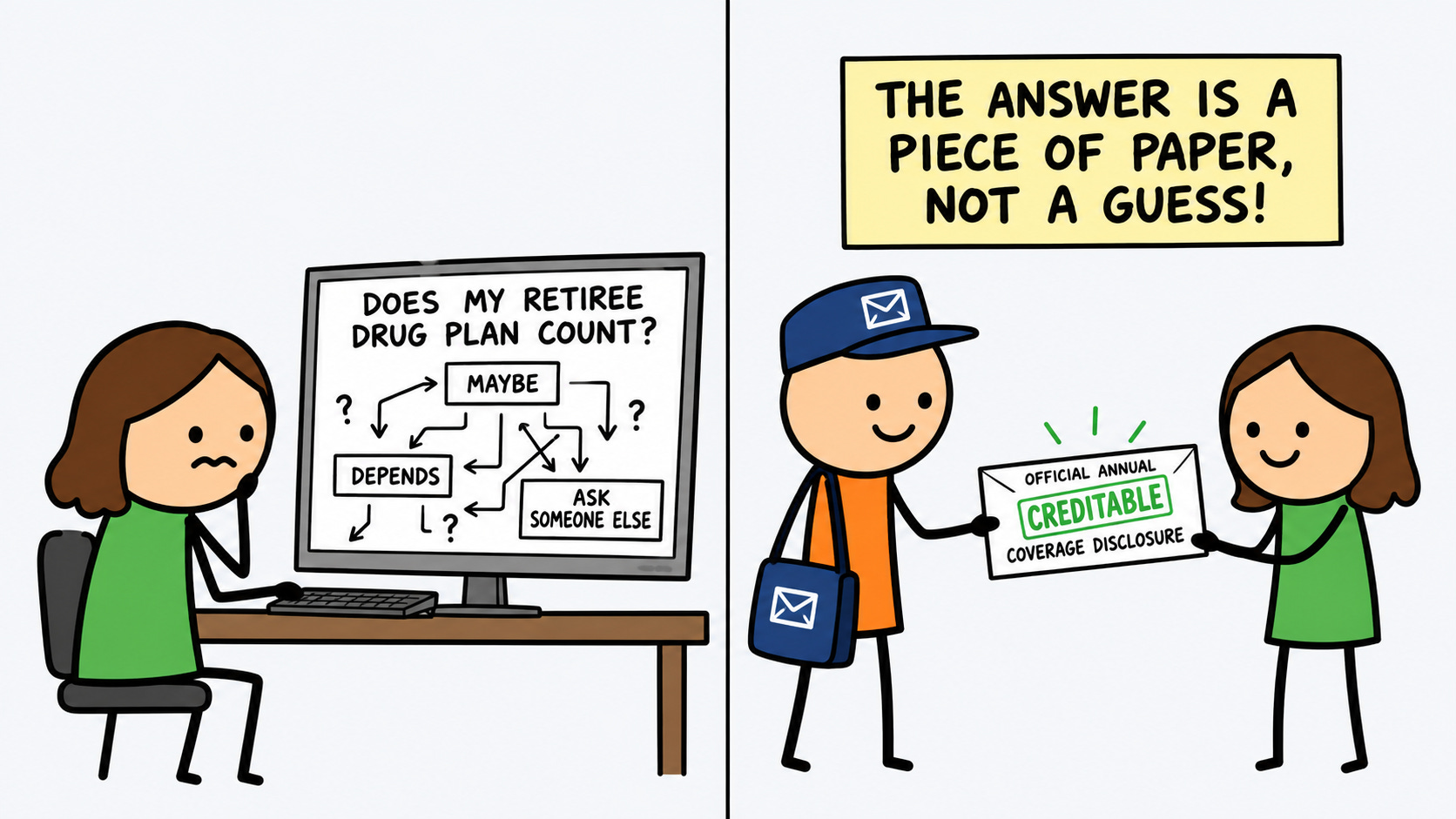
A woman that’s about to turn 65 tries to answer one question before her birthday, does the drug coverage she already has count, so she can skip Medicare’s drug plan without a penalty later.
She finds plenty of lists. Employer coverage counts. Union coverage counts. Veterans benefits count. Somewhere she reads that certain Medigap policies count, which raises the obvious question of which ones. Her own plan is an employer retiree arrangement that was bought out and renamed twice, and no list mentions it.
The lists aren’t going to answer her question Somebody has already made a determination about her specific plan, and whoever made it is required to hand it to her in writing.
Creditable drug coverage means coverage expected to pay, on average, at least as much for prescriptions as standard Medicare drug coverage. That is an actuarial comparison against a benchmark, not a property of what kind of insurance you happen to have.
Which is why the rule puts the question on the people who run your plan. Entities offering prescription drug coverage to Medicare-eligible people have to make that determination every year and give you a disclosure notice with the answer. If you never got it or cannot find it, you can request it, and they have to provide it.
That changes what you should be researching. You need to obtain a document that already exists.
The categories are still worth knowing, because they tell you where creditable coverage usually turns up. Employer and union coverage, including the federal employee health program. Military-related coverage such as veterans benefits and TRICARE. Indian Health Service coverage. Qualified state pharmaceutical assistance programs. And certain Medicare supplement policies since some qualify and others do not.
Notice what that list does. Every item is a place to look rather than an answer, and the Medigap entry proves it. Two people holding what they both describe as a Medigap policy can get opposite answers.
Now the distinction that trips people up who were been paying attention, which is that Medicare asks two different questions and your insurance card has the answer but it can be different.
For the medical side, Part B, the question is whether your coverage comes from current employment. That is a factual question about whether somebody is still working, and it has nothing to do with how generous the plan is. Coverage that continues after the job ends fails that test no matter how good it is.
For the drug side, Part D, the question is the actuarial one above. How much the drug benefit is expected to pay. Employment status is not part of it.
So coverage that does nothing for your Part B enrollment window can still be creditable for drug purposes, and the reverse happens too. The same card, two tests, two answers. Anybody who concluded from the Part B rules that their post-employment coverage is worthless for everything has drawn the wrong conclusion, and the notice is where the drug answer actually comes from.
COBRA is the cleanest illustration of that. Electing COBRA does nothing for your Part B window, which runs from the day the job ended no matter what you elect afterward. But COBRA prescription coverage can be creditable for drug purposes if the plan meets the actuarial standard, and the disclosure requirement reaches Medicare-eligible people on COBRA along with their dependents. Medicare also treats the end of COBRA that included creditable drug coverage as an event that opens a drug plan enrollment window. One card, two rules, and only the notice tells you where you stand on the second one.
Two timing points. If your coverage turns out not to be creditable, the 63-day clock runs from when creditable coverage ended, not from when you found out. Discovering the problem in March does not move the starting line.
The second point cuts the other way and is worth knowing before you resign yourself to waiting. Losing creditable coverage, or having it change so that it is no longer creditable, can itself open a special enrollment window for Medicare drug coverage. The annual period from October 15 through December 7 is another way in, though not always the next one available. So when something changes, the question is which window is open now rather than how long until autumn.
One more that costs people their coverage rather than money. Some employer and union plans can end health coverage for you, your spouse, or your dependents if you take separate Medicare drug coverage, and Medicare warns about precisely that. Retiree plans carry the same risk. Ask the benefits administrator before enrolling in anything, because this is the sort of thing people discover afterward.
Say a man retires at 64 with retiree health coverage from a former employer and turns 65 the following year. Each autumn a notice arrives saying the drug coverage is creditable, and he files them. At 65 he skips Medicare’s drug plan, which costs him nothing, because he holds documentation that his coverage met the standard.
Four years later the employer restructures the plan and that autumn’s notice says the drug coverage is no longer creditable, effective January 1. That sentence is the entire point of the notice, and it lands during the annual enrollment period so he can act on it. He enrolls in November, effective January 1. No gap, no penalty.
Run the version where he files the notice without reading it. Coverage stops being creditable on January 1, and the change itself opened an enrollment window he never used, because as far as he knew nothing had happened. He notices in August when a pharmacy bill looks wrong, well past 63 days, with the months from January already counting. Whatever route he takes from there, each full uncovered month is another percent on his premium for as long as he has drug coverage.
Same coverage, same restructuring, same folder. The difference is whether one sentence got read in November.
The useful move is to stop asking whether your type of coverage counts and start asking who owes you the answer in writing.
That is your benefits administrator, your plan, or whoever mails the annual notice. One phone call produces either the document or the admission that nobody made the determination, and the second answer is itself informative.
Read the notice for the word creditable, and read it every year. A plan that was creditable last year can stop being creditable this year, and that change arrives in the same envelope people file unopened. The notices going out now are timed to land before the October enrollment window opens for exactly that reason.
Keep the ones that say creditable, since they are what answers the question years later if Medicare assesses a penalty. Act on the ones that say otherwise, during the enrollment window that follows.
And if your coverage is ending because a job is ending, that event opens its own Medicare enrollment window with its own paperwork and proof requirements. Our Medicare special enrollment period checklist covers what triggers it and which documents establish it.
The question is genuinely answerable, just not from a list, which is why people hunting for their coverage type come away thinking the rule is vague. The rule is precise. It was addressed to your plan rather than to you.
I write one of these every day, one retirement rule, explained in plain language and verified against the source. The daily email is free: subscribe here.
Full archive, worksheets, and search live at RetirementNewsRundown.com.
Disclaimer
This article is for educational and informational purposes only. It is not tax, legal, or financial advice and does not create an advisor-client relationship. Always consult appropriate professionals regarding your specific situation.