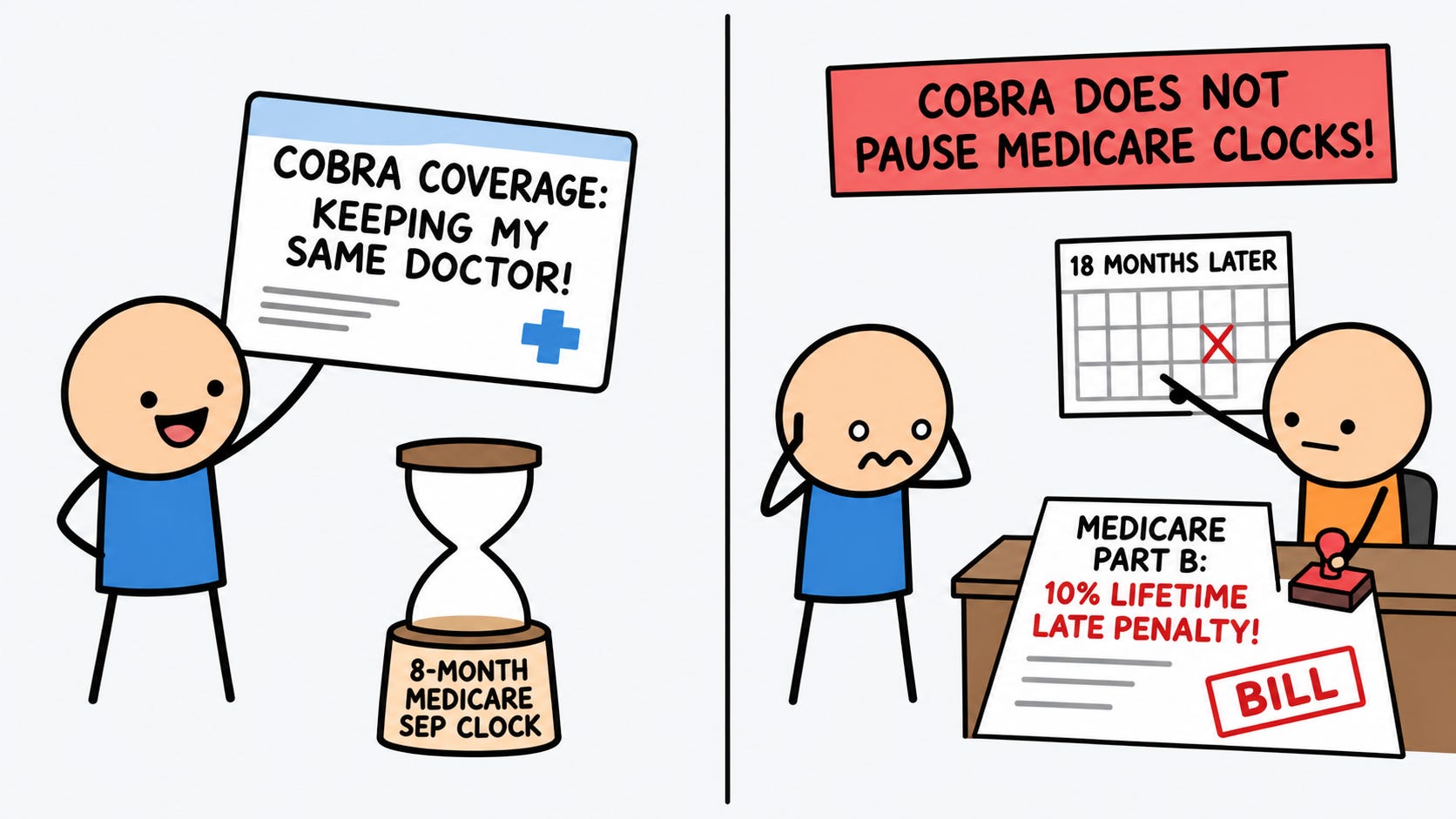
A man turns 65 while still working. His benefits office confirms that his current employment group health plan lets him delay Part B without a penalty, so he stays on the company plan while he works. He retires at 68 and elects COBRA, because COBRA is the thing everybody knows about and it keeps the same doctors and the same card. Eighteen months later the COBRA runs out and he goes to sign up for Medicare properly.
He learns two things in the same phone call. The first is that he cannot enroll right now, because the window closed ten months ago and the next one does not open until January. The second is that when he does enroll, his premium carries a permanent surcharge, because Medicare has been counting the whole time he was on COBRA as time he could have had Part B and chose not to.
COBRA felt like coverage. It was coverage. It was just not the kind that stops this particular clock.
Medicare runs two separate late enrollment penalties and they do not work the same way, which is how people who understand one get surprised by the other.
The drug penalty counts months. One percent for each full calendar month you went without creditable drug coverage, applied to a national figure that changes annually.
The Part B penalty counts years, and only whole ones. Ten percent for each full twelve-month period you could have had Part B and did not, applied to the standard Part B premium. Partial periods do not count at all, which produces a cliff rather than a slope. Eleven months late costs nothing. Thirteen months late costs ten percent, every month, for as long as you have Part B.
Both penalties are permanent. Neither expires or burns off. Waiting longer only moves you up the ladder, and with Part B the ladder has big steps.
The thing that legitimately protects you from the Part B penalty is coverage from current employment. While you or your spouse are actively working and covered by that employer’s group health plan, you can delay Part B and nothing accrues. This is real and the benefits office was right about it.
The protection ends when the work does. You get a special enrollment period of eight months, counted from when the employment ends or the group health coverage ends, whichever happens first. Sign up inside those eight months and there is no penalty.
Here is the part that catches people, and it is worth being blunt about. COBRA is not group health plan coverage for this purpose. Neither is retiree coverage. Medicare’s own guidance says plainly that COBRA does not extend the limited time you have to sign up, and that getting COBRA does not change when the special enrollment period ends. The eight months run from the day the job ended, while you are sitting there holding what looks and feels like an active insurance card.
Employer size creates a separate problem, and it is worth keeping it separate. Once you are 65 or older and covered through current employment, an employer with 20 or more employees generally pays first with Medicare second. An employer with fewer than 20 generally has it the other way around, with Medicare paying first. That arrangement does not by itself decide whether a late enrollment penalty applies, and current employment coverage can still open the special enrollment period either way. What it does decide is whether your claims get paid properly. Delaying Part B at a small employer can leave a real hole, because the employer plan may pay only the share it owes after Medicare was supposed to have paid first, and Medicare was not there.
Miss the eight months and the consequence arrives in two parts. The penalty is one. The other is that you cannot enroll whenever you notice. You wait for the general enrollment period, which runs January 1 through March 31, and coverage begins the month after you sign up. Somebody who realizes in May has no Part B until the following spring.
Say a woman retires at 66 on March 31 and elects COBRA on April 1.
Her special enrollment period starts when the job ends, so it runs April through November. She does not know that, because her COBRA card works fine and nobody mentions Medicare.
COBRA ends eighteen months later, in September of the following year. She calls Medicare in October. The special enrollment period closed the previous November, ten months earlier. She enrolls during the next general enrollment period, in February, and her Part B begins in March.
Count the exposure. The countable period starts in April of the first year and runs through the month she enrolls. Enrolling in February gives 23 countable months, which contains one full twelve-month period, so her penalty is ten percent. Wait one more month and enroll in March instead, and the count reaches 24 months, a second full period, and the penalty doubles to twenty percent. One month of delay, ten percentage points, permanently.
Then count the gap. COBRA ended at the end of September and Part B began in March, leaving October through February without either. Five months at 67 with no Medicare, and COBRA’s own coordination rules mean the coverage may already have been paying less than she assumed during the months before that.
Now run it correctly. Same retirement, same COBRA election, but she signs up for Part B in July of the first year, well inside the eight months. No penalty and no Medicare gap. The one thing to settle with the COBRA administrator is what happens to the remaining COBRA once Medicare starts, because enrolling in Medicare frequently ends it.
The useful correction is to attach the clock to the right event. The eight months start when the job ends, and nothing you do afterward moves them. Not COBRA, not severance, not retiree coverage, not a spouse’s plan if that spouse is also retired.
So the question to ask on the way out the door is what date the employment actually ended, because that date is the one Medicare will use later, and it is often not the date you stopped going to the office. Get it in writing while the benefits department still has you in their system.
If you are already past the eight months, the general enrollment period in the first quarter is the route back in, and the penalty is what it is. The one thing still worth doing is enrolling at the earliest point available rather than the most convenient one, because each additional full year you wait adds another ten percent to a premium you will pay for the rest of your life.
And if you are approaching a retirement date now, the special enrollment period is a set of forms with its own evidence requirements, including proof of the employment and the coverage. Our Medicare special enrollment period checklist covers what triggers the window, which documents to gather, and the dates that determine whether a penalty attaches.
Medicare is counting one thing here, which is months you were eligible for Part B without having it. COBRA is invisible to that count, however good the coverage was and however sensible electing it seemed at the time.
I write one of these every day, one retirement rule, explained in plain language and verified against the source. The daily email is free: subscribe here.
Full archive, worksheets, and search live at RetirementNewsRundown.com.
Disclaimer
This article is for educational and informational purposes only. It is not tax, legal, or financial advice and does not create an advisor-client relationship. Always consult appropriate professionals regarding your specific situation.