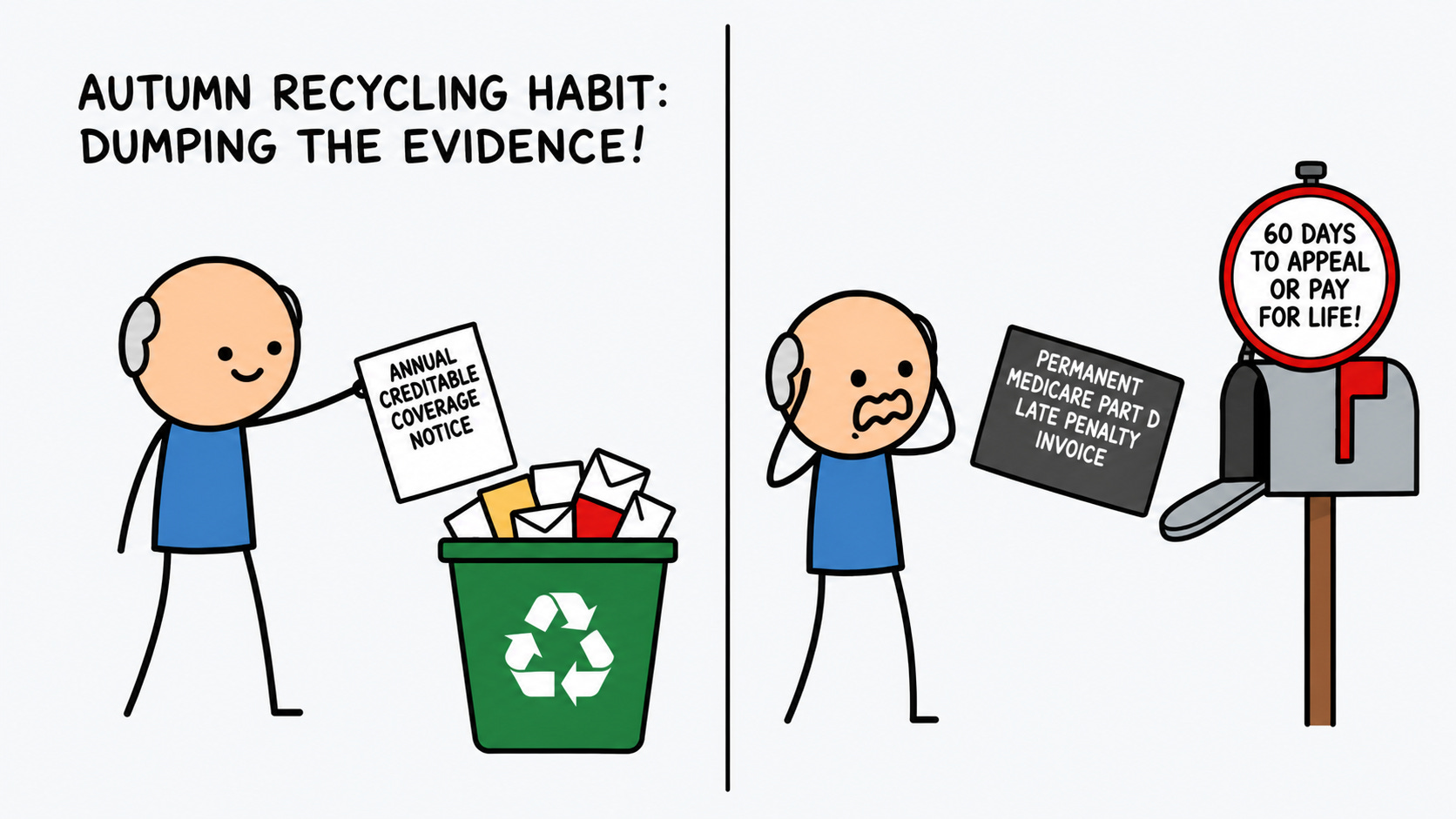
A man works until he is 68, covered the whole time by his employer’s health plan, which includes prescription drugs. He retires in the spring, signs up for a Medicare drug plan, and a few weeks later gets a letter informing him he owes a late enrollment penalty. It will be added to his premium every month for as long as he has Medicare drug coverage, which at 68 is a long runway.
He had drug coverage continuously for the previous six years. He can describe the plan, name the pharmacy, and produce a shoebox of receipts. What he cannot produce is the cleanest piece of evidence for it, because that arrived every autumn looking exactly like the rest of the open enrollment mail and went straight into recycling.
Medicare’s drug program assumes you enroll when you first become eligible. If you do not, the assumption is that you waited until you got sick, so a penalty is attached. The work-around is having other drug coverage at least as good as Medicare’s in the meantime, which the program calls creditable coverage.
Creditable means the plan is expected to pay, on average, at least as much for prescriptions as standard Medicare drug coverage would. That is a judgment the plan sponsor makes and then has to tell you about, which is where the letter comes from. Employers and other sponsors who offer drug coverage to Medicare-eligible people are required to disclose whether that coverage is creditable, in writing, before October 15 each year, and again at a handful of other moments: before your initial enrollment window, when your coverage starts, when the plan’s creditable status changes or the coverage ends, and any time you ask.
That October date is deliberate. Medicare’s annual enrollment period opens October 15, so the notice is timed to land while you can still act on it.
The rule the notice protects you from is a gap of 63 or more days in a row without Medicare drug coverage or other creditable coverage, after your initial enrollment period ends. Stay under 63 days and nothing happens. Cross it and the meter starts.
Two separate layers are at work there, and mixing them up is how people miscalculate this. The 63 days is only the trigger, a yes or no question about whether a penalty applies at all. Once the answer is yes, the size of the penalty is counted differently, in full uncovered calendar months.
The penalty is one percent of the national base beneficiary premium for every full calendar month you went uncovered, rounded to the nearest dime and added to your monthly premium. That base figure is set annually and moves, so the penalty recalculates each year rather than locking in at the rate when you enrolled. Twenty-four uncovered months means a permanent twenty-four percent surcharge on a number that keeps changing.
Waiting does not soften any of this. Every additional full month you stay uncovered adds another point to the multiplier, and the penalty does not expire, burn off, or reset when you change plans. It follows you. People who qualify for Extra Help, Medicare’s low-income subsidy, do not pay it at all.
If a penalty letter arrives anyway, there is a correction window, and it is short. You have 60 days from the date on that letter to request a reconsideration, which is where you submit proof that you had creditable coverage during the months Medicare thinks you did not. The contractor generally decides within 90 days, sometimes a bit longer for good cause. You pay the penalty while the review runs, and you get it back if you win.
Three different clocks, worth keeping straight. October 15 is a calendar date, fixed every year, for the notice and for the opening of annual enrollment. The 63 days is a rolling count measured from when your other coverage ended. The 60 days is a correction window that opens only when a penalty letter arrives. Missing it makes the dispute considerably harder, though Medicare can still consider a late request when there is a good reason for the delay.
Say a woman turns 65 in March and keeps working with employer drug coverage. Her employer’s notice says creditable, and she files it. She retires four years later, her coverage ends June 30, and she enrolls in a Medicare drug plan effective September 1.
The gap runs July and August, 62 days. She stays under the threshold and owes nothing.
Change the retirement date by a week so her coverage ends June 23. Her uncovered period now runs June 24 through August 31, a 69-day gap. She has crossed the trigger. The penalty then counts full uncovered calendar months, and both July and August qualify, so it is based on two months rather than one. Seven days of calendar drift turned no penalty at all into a two percent surcharge that can follow her for the rest of her life.
Now the harder version. She enrolls on time but Medicare has no record of her employer coverage, so a letter arrives assessing 48 months. She can attest to the coverage without producing paperwork, and the filed notices make that attestation easy to back up if anybody questions it. She sends a reconsideration request inside the 60 days and the penalty comes off. Had she discarded them, she would be asking a former employer’s benefits department to reconstruct four years of coverage records, which is a request with a success rate best described as variable.
The useful reframe is that the notice is evidence rather than information. Once you have read it and confirmed the coverage is creditable, it has done nothing for you until the day somebody disagrees with you about it, and that day can arrive years later.
So keep them, all of them, one per year, for every plan that covered you after you become Medicare eligible. A folder is enough. If you are already past that point and the letters are gone, the employer or plan sponsor can usually supply copies, and it is a far easier ask while the company still exists and the benefits staff still remember the plan.
Watch for the notice around the start of October, and read the word creditable specifically. A plan can change status from one year to the next, and a notice telling you this year’s coverage is not creditable is the one that actually requires you to do something, during an enrollment window that closes December 7.
And if a penalty letter shows up that you believe is wrong, the date on that letter starts a 60-day clock. That is the piece people lose, usually by deciding to deal with it later. Our retirement deadline guide tracks the annual dates this sits alongside.
The penalty is arithmetic run against a records question, and records questions are winnable by the person who kept the records.
I write one of these every day, one retirement rule, explained in plain language and verified against the source. The daily email is free: subscribe here.
Full archive, worksheets, and search live at RetirementNewsRundown.com.
Disclaimer
This article is for educational and informational purposes only. It is not tax, legal, or financial advice and does not create an advisor-client relationship. Always consult appropriate professionals regarding your specific situation.