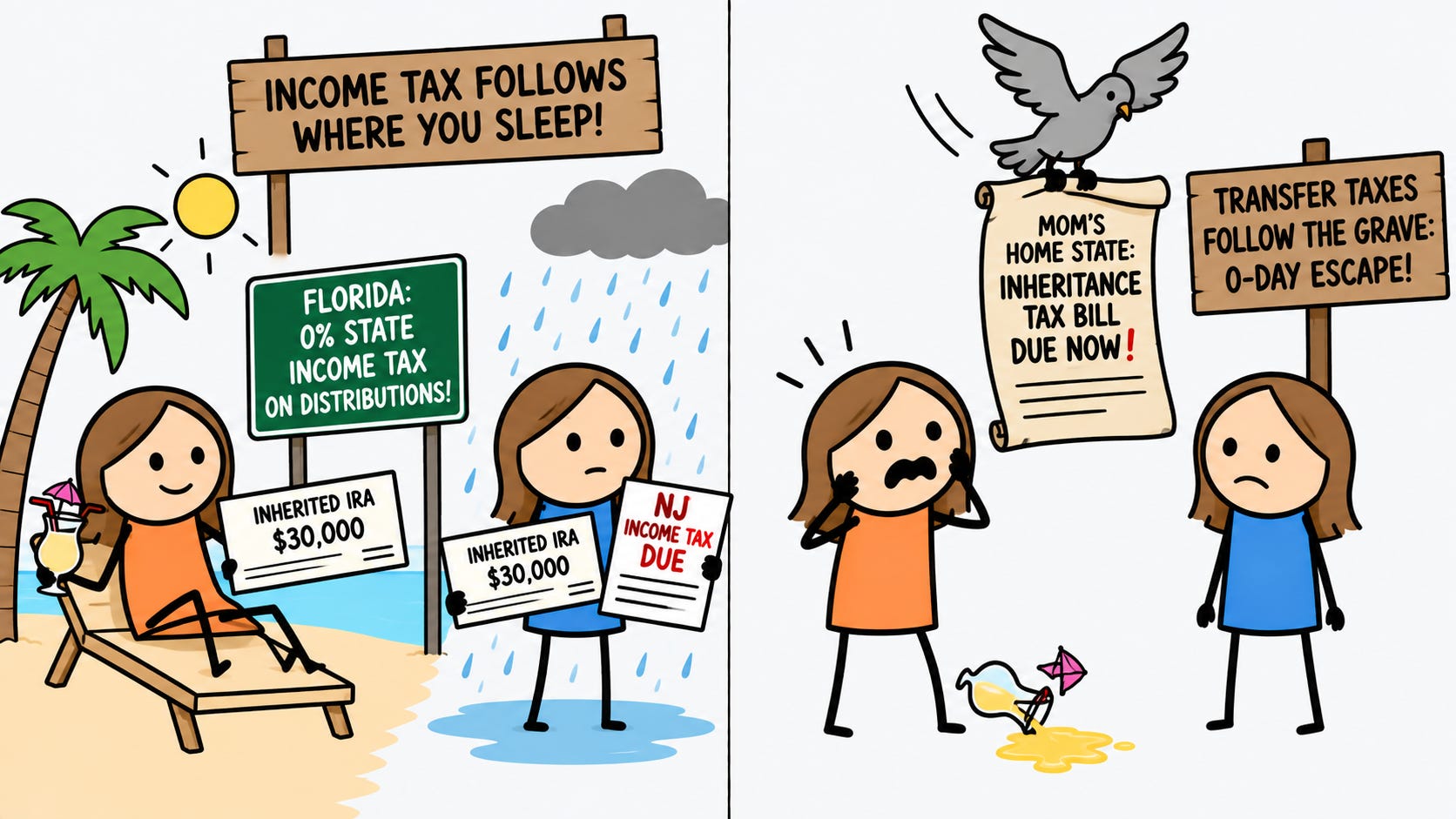
Two sisters inherit their mother’s IRA in equal shares. Mom lived her entire adult life in one state and never seriously considered leaving it. One sister settled three hours away in the next state over. The other moved across the country decades ago to a state with no income tax, for reasons that had nothing to do with taxes and have aged extremely well anyway.
They each take the same distribution from their inherited accounts in the same month. One owes state income tax on it. The other owes nothing. Neither result has anything to do with their mother, her state, where the IRA was held, or which custodian printed the check.
Then a bill arrives from their mother’s state addressed to both of them, and it turns out that state does have a claim after all. Just not the one they were bracing for.
Two separate taxes show up when somebody inherits a retirement account, and they point in opposite directions. Almost every confused conversation about this is really two conversations wearing one coat.
The first is income tax on the distributions. The taxable portion of what you pull from an inherited traditional IRA is generally ordinary income to you, and the state that gets to tax it is the state where you live when you receive it. Your residency, your distribution, the day it lands. The decedent’s state has no claim merely because the decedent lived there, since federal law stops a state from taxing retirement income belonging to somebody who is not its resident, and an inherited IRA is still an IRA.
Take the money later and the answer can change, which is the part worth sitting with. Distributions you take after moving are taxed by wherever you live then. A beneficiary who relocates partway through the payout window will have handed two different states two different slices of the same inherited account, and both states will be right.
The second tax is inheritance tax, and it flips the rule completely. It starts on the decedent’s side of the transaction rather than yours. For an IRA owned by a resident decedent, that person’s home state rules are the first place to look, and your own address usually does not change the result. Only a small and shrinking number of states impose it. Where it applies, the rate usually depends on how closely related you were, so spouses and often children are exempt or taxed lightly while distant relatives and friends pay the most.
Waiting does not help here, because this tax attaches at death rather than at distribution. Leaving the account untouched for a decade changes nothing about it. What waiting can do is add interest and penalties, since the states that impose this generally want a return and payment within months of the death, and some offer a discount for paying early. That is the opposite shape from the income tax, where timing is a live variable.
State estate tax is a third thing again, charged to the estate rather than to you, settled before anything reaches your hands.
Now the assumption that gets people.
Plenty of states exempt some retirement income, and beneficiaries tend to assume the exemption rides along with the account. Sometimes a portion does. New York has treated inherited accounts holding rolled-over public retirement money as keeping their exempt character up to the amount originally rolled in, while gains earned inside the IRA afterward are taxable unless they fit the state’s separate retirement income exclusion. In New York, several beneficiaries can also end up sharing the decedent’s available exclusion rather than each receiving a full one, which surprises people who assumed otherwise.
Elsewhere the wall is age. Many state retirement income exclusions require the person claiming them to be a certain age, and a 41-year-old who inherits an IRA is a 41-year-old. Here waiting genuinely can help, since reaching the qualifying age can open an exclusion that was closed before. It can also run out the clock, because a ten-year payout window does not pause while you age into a tax break.
One smaller mechanic. Once the account is retitled, your residence information and withholding elections become the inputs the custodian uses to apply whichever state’s withholding rules it decides apply, which means the money can start flowing to your state, or keep flowing to the decedent’s if stale paperwork carried over. Catch it before a distribution and you fix a field. Catch it after and you are filing a refund claim with a state you have no other business with.
Each sister inherits half of a $400,000 traditional IRA and takes $30,000 in March. One lives in Minnesota, one in Florida.
The Minnesota sister reports that distribution federally and on her Minnesota return, because that is where she lived when it arrived. The Florida sister reports the same amount federally and owes no state income tax. Same account, same month, same parent, different answer, driven by an address.
Their mother’s state is not finished. It imposes inheritance tax on what passed to each daughter at death, at a rate set by the relationship rather than by geography. The Florida address does nothing for it, both sisters owe the same, and it fell due within months of the funeral.
Now suppose the Minnesota sister moves to Florida in year four and empties the account. Those later distributions carry no state income tax, while the first three years remain Minnesota’s. The inheritance tax is unchanged, settled years earlier.
The useful move is to stop asking which state taxes the IRA. The account does not have one answer and never did.
Ask who is being taxed. Income tax on a distribution is a tax on you, so your state on the day you take it governs, and moving changes the answer going forward. Inheritance tax is a tax on the transfer from the decedent, so their state governs, your address is irrelevant, and the clock on it started at death whether anybody noticed or not.
Three things are worth confirming before the first distribution. Whether the decedent’s state imposes an inheritance tax, since that carries a deadline of its own that arrives early and announces itself to nobody. Whether your state offers a retirement income exclusion and whether an inherited account and your current age qualify for it. And what address the account carries after retitling.
If you and your co-beneficiaries live in different states, expect your outcomes to diverge, and expect that to be correct rather than a mistake somebody made. You are separate taxpayers who happen to share a parent.
Our inherited IRA calculator works out the distribution schedule the federal rules require, which is the number all of this state analysis then attaches itself to.
I write one of these every day, one retirement rule, explained in plain language and verified against the source. The daily email is free: subscribe here.
Full archive, worksheets, and search live at RetirementNewsRundown.com.
Disclaimer
This article is for educational and informational purposes only. It is not tax, legal, or financial advice and does not create an advisor-client relationship. Always consult appropriate professionals regarding your specific situation.