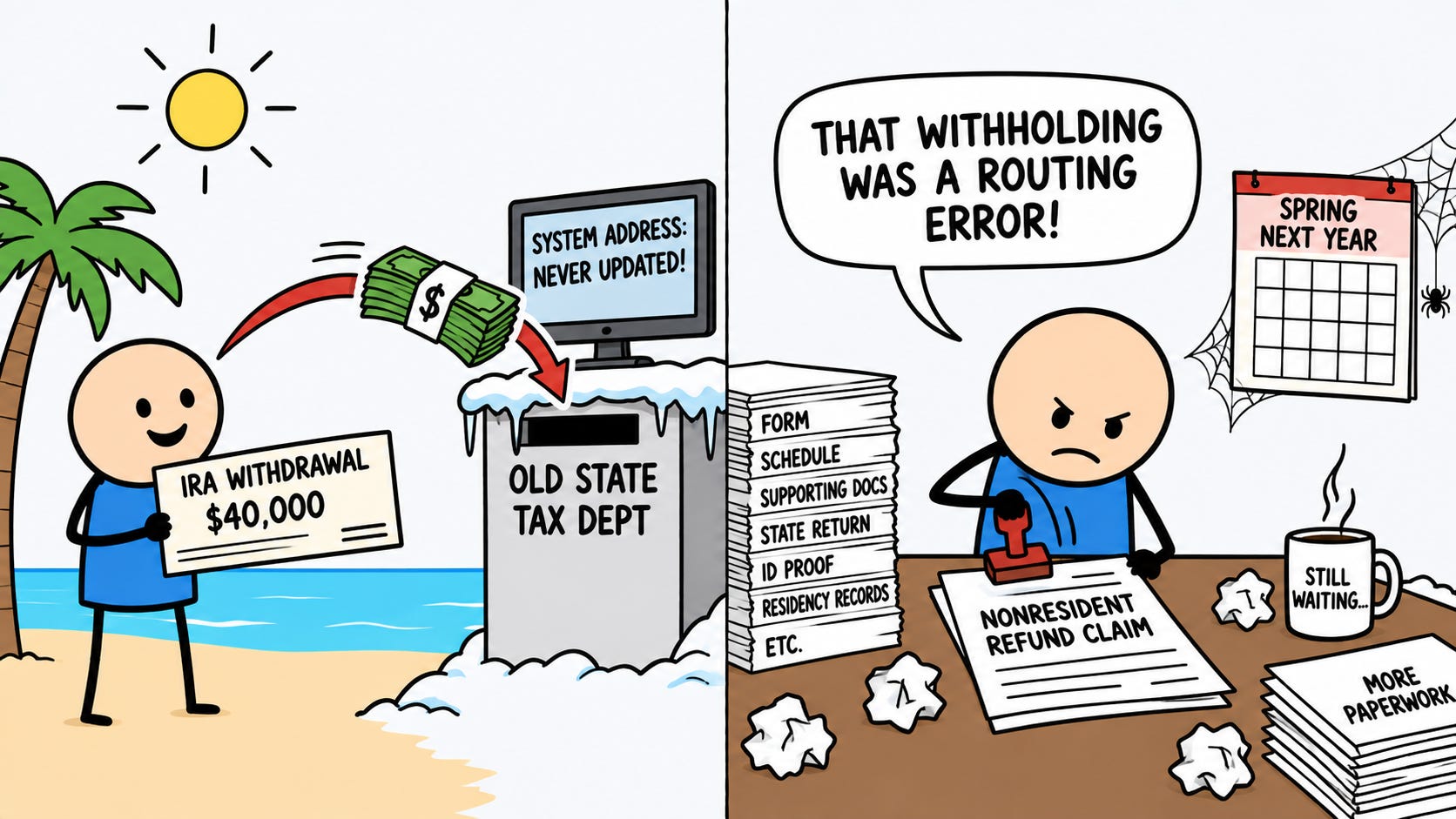
Fourteen months after moving out of a state with an income tax, a woman takes a $40,000 withdrawal from her IRA. The confirmation arrives and there is a line on it for state tax withheld, payable to the state she left. She does not live there. She has not lived there in over a year. Her driver’s license, her voter registration, and her mail all say otherwise. The custodian withheld for the old state anyway, because as far as its system is concerned, that is still where she lives.
Nobody made a mistake, exactly. She updated her address with the bank, the credit cards, the doctor, and the post office. The IRA custodian was on a different list, or it was on the list and the change never propagated to the tax election sitting underneath the account. The money went out the door regardless, and getting it back is a project.
State withholding on a retirement distribution comes out of three things working together: the payer’s record of where you live, the withholding rules of whichever state that is, and any state withholding election sitting on the account. If your custodian still has the old state attached to your IRA, it can apply that state’s rules months after you moved, because its record is the starting point for everything that follows.
There is a fourth input people rarely think about, which is whether the payer has any tax presence in the state at all. A payer without taxing jurisdiction in a given state may have no withholding obligation there, which is part of why two custodians can publish different lists of which states require withholding and both be describing their own situation accurately.
States take different approaches to retirement withholding, and the details vary enough that the payer simply applies the rules of the state it believes applies to you.
Some states make withholding mandatory. If the record says you live there, the custodian withholds, whether or not you asked and whether or not you want it. A handful of the mandatory states carve out exceptions or let you elect zero, and those exceptions are the part custodians implement inconsistently. Some states key their withholding directly off your federal election. Oregon runs a version of this worth understanding: an individual who elects no federal withholding is treated as having elected no Oregon withholding unless they tell the payer otherwise. A federal choice made without much thought ends up setting the state answer too. Some states allow withholding but leave it up to you. And some states have no retirement withholding mechanism at all.
That last group generates the most confusion, because it covers two very different situations. States with no income tax belong there for obvious reasons. But a state can have an income tax and still not provide routine withholding on retirement distributions. Hawaii is an example. Nothing comes out through the payer, and depending on the character of the payment, tax may still be due. Availability of withholding is a statement about plumbing. Whether tax is owed is a separate question with its own answer.
A few mechanical points that trip people even when the address is right.
Federal and state withholding are separate systems, even where a state ties its own withholding rules to your federal election. Changing the federal election does not reliably produce the correct state election, and a custodian that dutifully honors your federal choice may be applying a state default you never picked.
Changing your address does not retroactively fix a distribution already in flight. Custodians generally lock the withholding destination when the withdrawal is initiated, so an address update the same week can arrive too late for that payment and apply only to the next one.
And each payer is its own separate universe. A pension administrator, two IRA custodians, and an old employer plan are four different address records with four different state withholding elections. Updating one changes exactly one.
Say a man moves in March from a state with a mandatory withholding rule to a state that also taxes income, at a lower rate. He updates his address with almost everything and misses the IRA custodian.
In September he withdraws $50,000. The custodian sees the old state in the record, applies that state’s mandatory rate, and sends the money there. Say that comes to $3,000.
Two things are now wrong at the same time.
The old state is holding $3,000 of his money. Assuming he was genuinely no longer its resident in September, the distribution itself was not taxable there, so the withholding was never tax and is entirely recoverable. Getting it back means following whatever refund procedure that state requires for the year, which in many states is a nonresident return reporting no taxable retirement income and claiming the full amount withheld. If the payer can correct the withholding internally during the year, some of this resolves faster. If it cannot, he waits for the state’s return or refund process to open.
Meanwhile his actual state of residence received nothing. That state taxes the $50,000 and has collected zero against it all year. Depending on what else he has paid in, he can land in underpayment territory and owe a penalty on top of the tax, which is a genuinely irritating outcome for somebody who was overwithheld by $3,000 the whole time. The money existed. It was just pointed at the wrong state.
Now change the destination. He moves to a state with no income tax instead. The old state still withholds the $3,000, he still has to claim it back, but there is no shortfall on the other end because the new state wants nothing. Same error, half the consequences.
The fix is small and the window for it is right after you move.
Update the address with every payer separately, and treat that as a different task from updating it with the bank. Then look at the state withholding election on each account as its own field, because the address and the election are stored separately and one can update without the other.
After the first distribution following a move, read the confirmation. The state line on that document tells you what the custodian actually believes, which is more reliable than what a service representative told you over the phone. If it names the wrong state, the next distribution is the one to fix, since the one in front of you has already gone.
If money did go to the old state, start by asking the payer whether it can correct the withholding in the same year, because that is the short path when it exists. Otherwise the recovery runs through whatever return or refund claim that state requires, and in many states that is a nonresident return for the year. Retirement distributions taken while you were a nonresident are not that state’s to tax, so the claim is generally for the full amount withheld rather than for part of it. The federal protection that keeps a former state away from your pension is what makes the claim clean, and it works only because you were genuinely a nonresident, which is the same question everything else about a move turns on.
And if the withdrawal is a required distribution, the amount is fixed before any of this starts, which makes it the easiest one to plan the withholding around. Our RMD calculator produces that figure.
The thing to take away is that withholding is a routing instruction rather than a tax calculation. The custodian follows an address and sends money where that address points. When the address is stale, the instruction is wrong, the money is still yours, and the paperwork to retrieve it is the price of a field nobody updated.
I write one of these every day, one retirement rule, explained in plain language and verified against the source. The daily email is free: subscribe here.
Full archive, worksheets, and search live at RetirementNewsRundown.com.
Disclaimer
This article is for educational and informational purposes only. It is not tax, legal, or financial advice and does not create an advisor-client relationship. Always consult appropriate professionals regarding your specific situation.