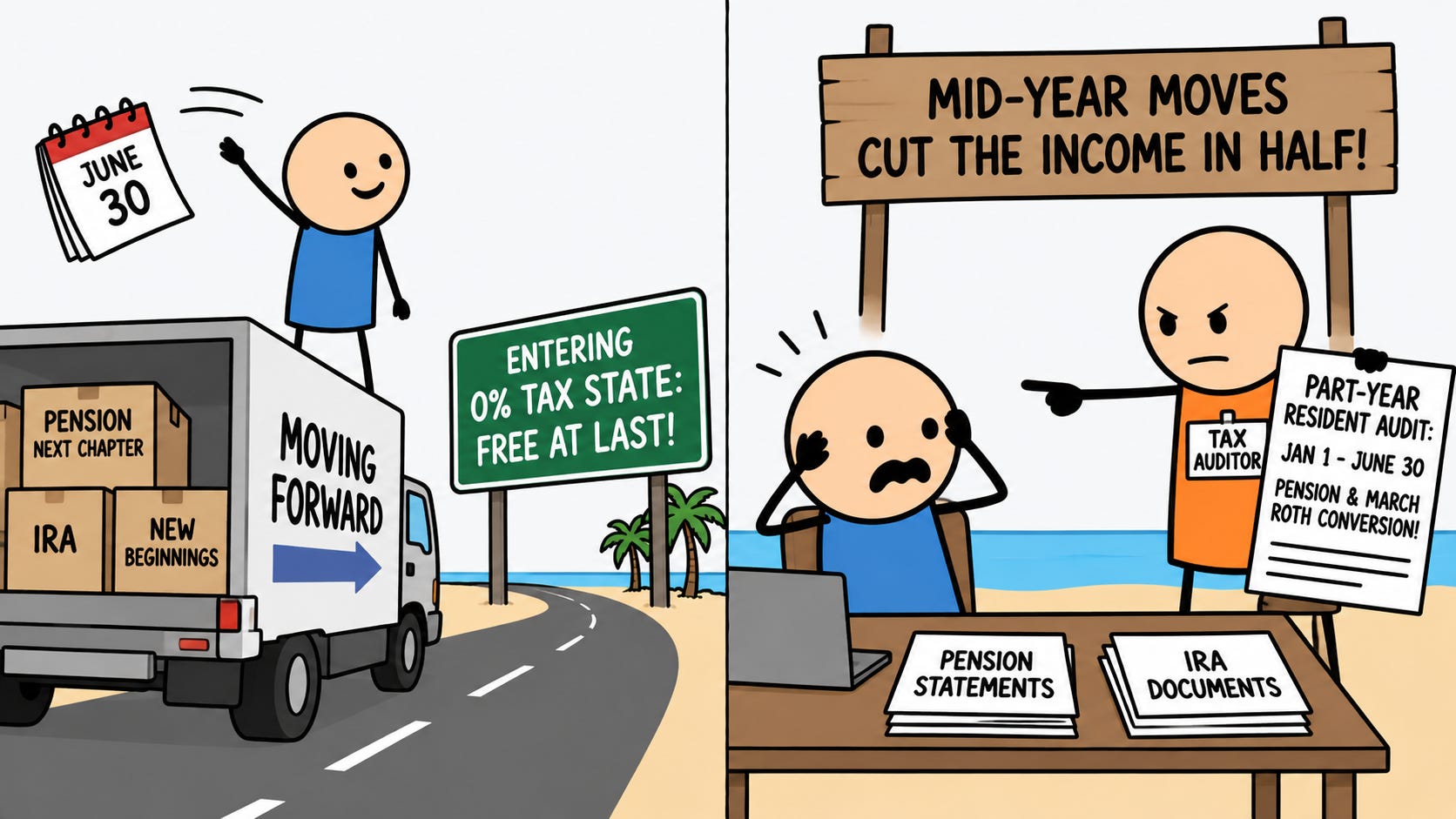
A couple closes on a house in a state with no income tax and hands over the keys to the old one on the last day of June. July arrives and they consider themselves free. The pension keeps paying, the IRA withdrawals keep coming, and as far as they are concerned the state they left is somebody else’s problem now. The following spring they file nothing at all, since the new state has no income tax and they do not live in the old one anymore.
Then the letter comes. The old state wants a return for the year, and it wants tax on the first half of the pension. That part is correct, which is the annoying bit. Moving in the middle of a year does not cut the year in half. It cuts the income in half and hands each piece to a different state.
Retirement money follows a simple rule with a fussy application. A pension payment, an IRA withdrawal, or a Roth conversion is generally taxable by the state where you are legally a resident when the income arrives. Legally a resident, not wherever the statements get mailed. Once you are genuinely a nonresident of the state you left, federal law stops that state from taxing covered retirement income just because the work behind it happened there.
Run that across a mid-year move and one pension splits into two tax problems. Payments from January through June belong to the state you left. Payments from July forward belong to the state you moved to. Same pension, same plan, same monthly amount, two different states with two different rates and two different sets of rules about whether pension income is taxable at all.
Which usually means a part-year resident return in the state you left, and if the new state has an income tax of its own, a part-year return there as well. Move somewhere with no income tax and the old state’s part-year return may be the only one you file. Either way that return divides the year at the date your residency changed and reports what belongs to each side. Skipping it leaves the first half of the year unreported, and the old state generally knows you existed, because you filed there last year.
Now the piece that catches people who think they understand the rule. Not everything that arrives after retirement follows the where-you-lived test. Payments that are really compensation for work you already performed, severance, a cashed out vacation balance, deferred pay that does not meet the federal protection rules, follow the place where you did the work. Retirement distributions follow where you live. So a person who moves in June and gets a severance check in August can owe the old state on the severance while owing the new state on the August pension payment. Two payments in the same month going to two different states on two different theories.
And then there is the part that can undo everything above, which is the question of whether the old state agrees you left at all.
You have one domicile. That is your real home, the place you intend to return to, and it moves when you actually move and cut the connections. Some states run a second test alongside it, and that second test does not care about your intentions at all. New York is the classic example. Somebody domiciled somewhere else can still be treated as a New York resident if they keep a permanent place of abode there for substantially all of the year and spend 184 days or more in the state, with any part of a day generally counting as a day. Other states write their own versions, so the housing requirement and the day count depend on which state you left.
That matters here because the federal protection that stops a former state from taxing your pension only protects people who are not residents. Get classified as a resident by the day count, and there is nothing to protect. The old state taxes the whole year, pension included, and your new state taxes the part of the year you lived there, and now you are a resident of two places at once for tax purposes.
Depending on which states are involved, a resident credit for tax paid to the other state may prevent some or all of that double taxation. These credits are often narrower than people expect. They frequently reach only income considered sourced to the other state, which is a poor fit for retirement distributions and investment income that is not really sourced anywhere. The credit can close most of the gap and still leave part of it open.
One smaller mechanic worth knowing. Many states that exempt some retirement income, or exempt a set amount of it, prorate that break for a part-year resident. Half a year of residency can mean half the exclusion. The exemption you researched before moving may not arrive at full size in the year you actually arrive.
Say a man retires at 66 and moves on June 30 from a state with an income tax to one without.
His pension pays $3,800 a month. Six payments landed before the move, so $22,800 goes on a part-year return in the old state. The six after the move, another $22,800, belong to the new state, which happens to tax none of it.
In March, still living in the old state, he converted $80,000 from his traditional IRA to a Roth. He was a resident of the taxing state on the day he did it, so that $80,000 is taxable there. Had the same conversion happened in September, after the move, the old state would have had no claim to it. Nothing about the conversion changed. The calendar did.
In August his former employer pays out $9,000 of accrued vacation. That is pay for work performed in the old state, so the old state can tax it even though he was long gone by August.
Now change one fact and assume the state he left has a statutory residency rule along New York’s lines. He keeps the old house available all year instead of selling it, and he goes back often enough to cross the day threshold. He may now be treated as a resident of that state for the entire year despite having genuinely moved his domicile. If that is where it lands, the first half of the pension was never the issue. The whole $45,600 is on the table, the conversion is unquestionably theirs, and he is filing as a resident of a state he believes he left in June.
What settles this is whether you can show the old state that you stopped being its resident. The moving date is a claim. The evidence behind it is mostly boring and mostly gathered in advance.
The day count is the first thing a revenue department looks at, and it is the easiest thing to lose an argument about, because partial days often count and memories do not hold up against credit card records and phone location history. Keeping a home available in the old state is the other half of the test, and selling or genuinely giving up that home removes half the argument before it starts.
The rest is the ordinary paperwork of having actually moved. Driver’s license, voter registration, vehicle registration, where the mail goes, which doctors and dentists you see, where the bank statements are addressed. None of it is exciting and all of it gets asked about.
Where timing is concerned, the retirement transactions you control are the ones this rule reaches cleanly. A Roth conversion or a discretionary IRA withdrawal gets taxed according to where you were a resident on the day you did it, so which side of the move it sits on determines which state collects. Other transactions run on their own sourcing rules. Real estate, a business interest, deferred compensation, and pay tied to services you performed in a particular state can stay taxable there no matter where you have moved. Knowing which side of the move a transaction sits on is a separate question from knowing whether it was a good idea, and it is the only one this rule answers.
If your move was clean and your records are in order, the part-year return in the state you left is the entire event and it closes without drama. If the old house is still there and the visits are frequent, the conversation is about residency rather than about pensions, and it starts long before anybody looks at a pension statement. Our retirement account deadline guide tracks the timing rules that interact with all of this.
I write one of these every day, one retirement rule, explained in plain language and verified against the source. The daily email is free: subscribe here.
Full archive, worksheets, and search live at RetirementNewsRundown.com.
Disclaimer
This article is for educational and informational purposes only. It is not tax, legal, or financial advice and does not create an advisor-client relationship. Always consult appropriate professionals regarding your specific situation.