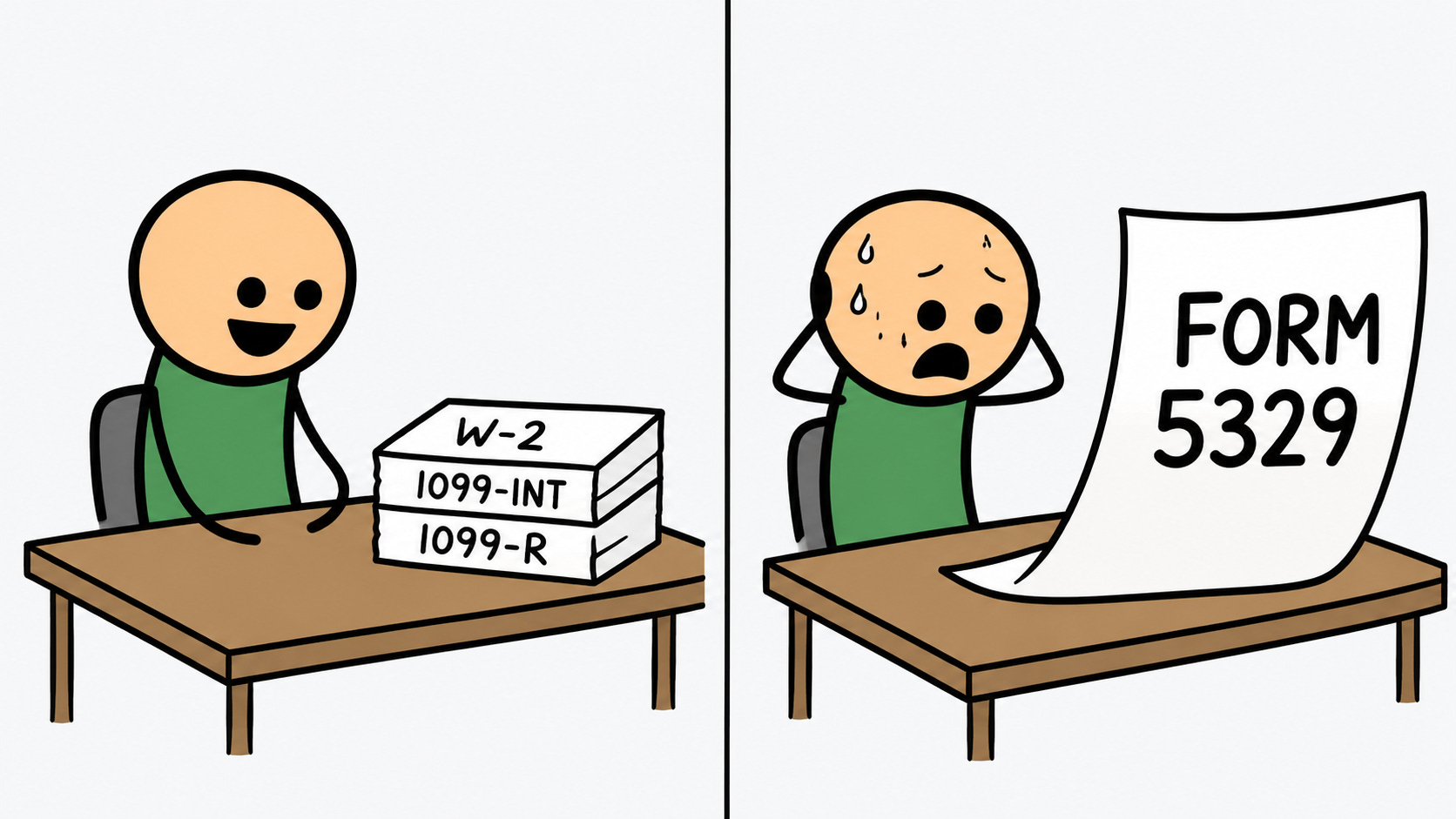
Most of a tax return gets built from forms other people hand you. An employer sends a W-2. A custodian sends a 1099-R. A bank sends a 1099-INT. You collect the paper, the numbers flow into your return, and the system mostly runs itself. Form 5329 does not work that way. Nobody mails it to you. It does not show up in a packet. It is the form you are expected to know exists and to fill out on your own, and most people meet it for the first time right after something went wrong.
Form 5329 is where the penalties on retirement accounts get reported. The full name is “Additional Taxes on Qualified Plans (Including IRAs) and Other Tax-Favored Accounts,” which is a long way of saying this is the form for the taxes that only apply when a rule was missed.
Form 5329 covers several different penalties, and it keeps them in separate sections so they do not bleed into each other. One section handles excess contributions to a traditional IRA. Another handles excess contributions to a Roth IRA. Another handles the early distribution penalty when you take retirement money before age fifty nine and a half. Another handles the missed required minimum distribution. The form is built so you fill out only the part that applies to you and ignore the rest.
The two parts that bring most people here are the excess contribution and the missed RMD.
For an excess contribution, the form is where the six percent excise tax gets calculated and reported. The important detail is that this is not a one-time filing. The six percent applies for every year the excess sits in the account uncorrected, which means a 5329 for each of those years. One excess contribution left alone for three years is three separate Form 5329 filings, one per year, each reporting the six percent again.
For a missed RMD, the form does two jobs. It reports the shortfall, the amount you should have withdrawn and did not. It is also where you ask for relief. The penalty for a missed RMD is twenty five percent of the shortfall, and it drops to ten percent if you correct it within the correction window. The IRS can also waive the penalty entirely for reasonable cause. You request that waiver on Form 5329 by reporting the shortfall, taking the missed distribution, and following the form’s instructions for noting reasonable cause. The form is the only place that request officially lives.
Now the timing. Form 5329 normally rides along with your tax return for the year it relates to, attached to your 1040. It follows the same tax-filing deadline. If you are not required to file a return at all, which happens to plenty of retirees, you can still file Form 5329 by itself as a standalone form, signed and dated, by the date the return would have been due.
What happens if you file it later instead, or never file it. The penalty does not disappear because the form was skipped. The six percent on an excess and the excise tax on a missed RMD are owed whether or not the form was ever submitted. Filing the form is how the IRS learns the penalty exists and how a correction gets documented. Skipping it does not erase the tax, and it can leave the matter open longer than if you had simply reported it. If you discover a missed year after the fact, you file that year’s version of Form 5329 for that year. A back year gets cleaned up with its own form, not folded into the current one.
Someone turns the age that triggers required withdrawals and takes nothing, assuming the custodian will send a notice when action is needed. The year ends with no distribution taken. The following spring, while preparing the tax return, the missed RMD surfaces.
They take the missed distribution right away, in the spring, as soon as they catch it. Then they file Form 5329 for the year the RMD was missed. On the form they report the shortfall, and because they corrected it promptly, they follow the form’s instructions to note the reasonable cause and request a waiver of the penalty. The missed distribution has been taken, the form documents the correction, and the request for relief is on the record.
Compare that to doing nothing. Without the 5329, there is no shortfall reported, no correction documented, and no waiver requested. The excise tax still applies, and now it sits unaddressed with no statement explaining anything. The form was the difference between a handled situation and an open one.
Form 5329 has a reputation it does not fully deserve. Because it only appears alongside mistakes, people treat the form as the bad news itself. The penalty is the bad news. The form simply reports it, and in the case of a missed RMD, the form is also what can make the penalty go away.
What truly matters is understanding what the form does. It creates the official record that a retirement account rule was missed and, ideally, corrected. Each penalty has its own section. Each year stands on its own filing. A current-year issue goes on this year’s form, and a back-year issue goes on that year’s form. The deadlines track the tax return, and the standalone option exists for anyone who does not file a return at all.
If you are filing a 5329, something did go sideways. That part is real. The form is also the tool that closes the loop. It reports the problem, documents the fix, and for a missed RMD, carries the request that can erase the penalty completely. Knowing the form exists, and knowing which section applies to you, is most of what it takes to handle it. Filing it is how the situation goes from open to resolved.
I write one of these every day, one retirement rule, explained in plain language and verified against the source. The daily email is free: subscribe here.
Full archive, worksheets, and search live at RetirementNewsRundown.com.
Disclaimer This article is for educational and informational purposes only. It is not tax, legal, or financial advice and does not create an advisor–client relationship. Always consult appropriate professionals regarding your specific situation.