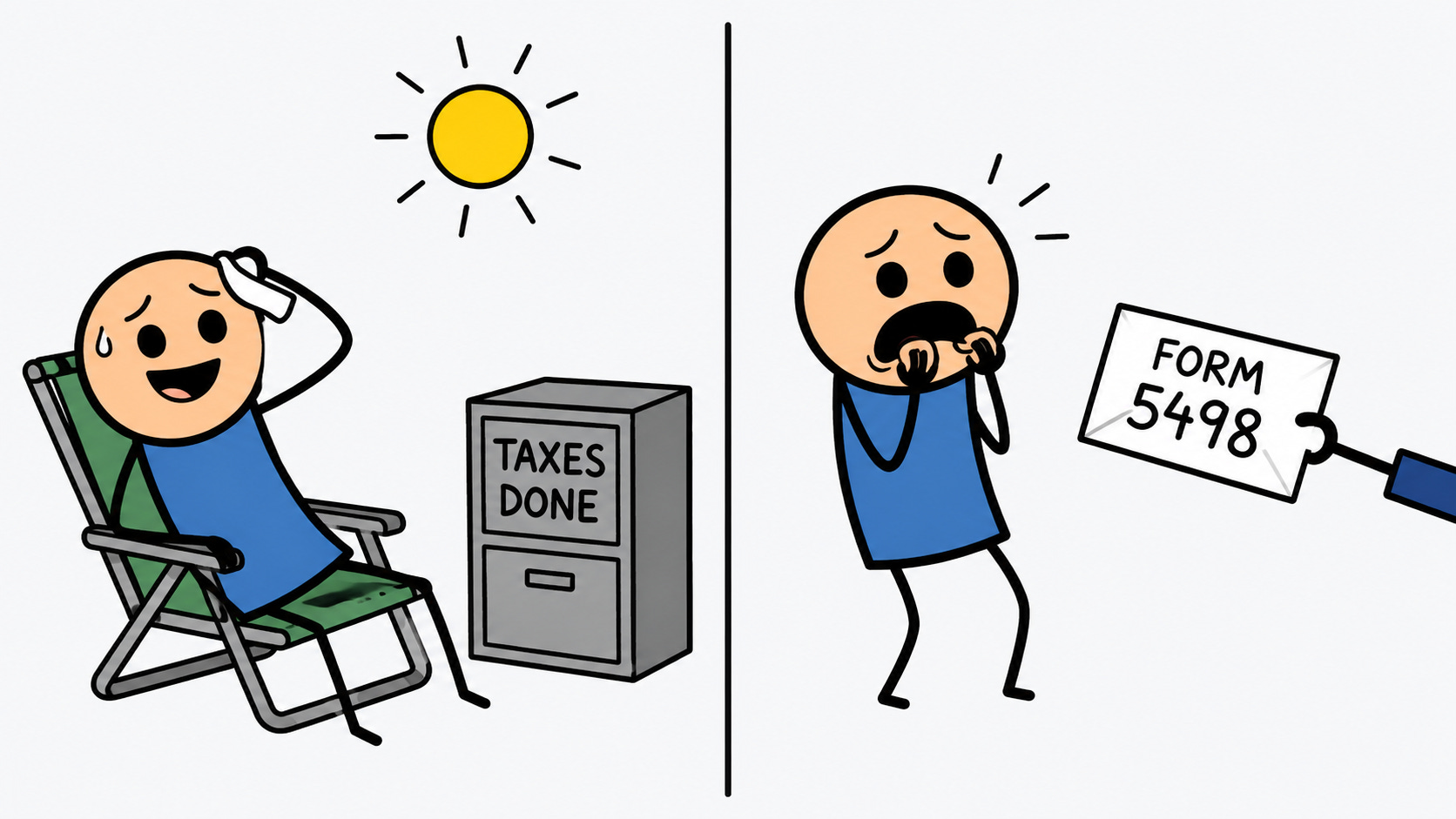
Tax season ends and you exhale. The return is filed, the refund is on its way or the payment cleared, and the folder of tax documents goes back in the drawer. Then, weeks later, an envelope arrives with a tax form inside. The number on it is 5498, a form you may have never consciously looked at, and it is landing well after you already filed. The instinct is immediate. Did I miss something. Do I owe more. Do I need to redo the return.
None of that. Form 5498 arriving after you filed is not a sign that something went wrong. The form is built to arrive late, by design, and understanding why is the whole point of this.
Form 5498 is called “IRA Contribution Information,” and the most important fact about it is who handles it. You do not file Form 5498. You do not attach it to your tax return. You do not fill anything in. Your IRA custodian creates the form, sends one copy to the IRS, and sends a copy to you for your records. Your job with this form is to read it, not to do anything with it.
What the form reports is a full picture of activity in your IRA for the year. It shows the contributions you made for that tax year. It shows rollover amounts that came into the account. It shows Roth conversions. It shows recharacterizations. It reports the fair market value of the account at the end of the year, and it flags separately any assets that are hard to value, like real estate or a private holding, so those do not get lost inside the total. And it flags whether a required minimum distribution applies for the year ahead. One form, one account, one year of activity, summarized.
Now the timing, which is where the confusion lives. The custodian’s deadline to send Form 5498 is the end of May. That is later than the April tax filing deadline, and that gap is not a mistake or a delay. It is structural. You are allowed to make a prior-year IRA contribution any time up until the April filing deadline. A contribution made in March or April can still count for the previous tax year. Because of that, the custodian cannot finalize the contribution figures for a tax year until that April window closes. The form legitimately cannot be complete and accurate until after the date most people have already filed.
So three different deadlines are in play, and keeping them separate clears up most of the worry. The calendar-year deadline is what the form covers, a full tax year of activity. The tax-filing deadline in April is the last day a prior-year contribution can be made and the day most people file. The end of May is the custodian’s furnishing deadline, the day the form itself has to reach you. The form arrives last on purpose, because it is reporting on a window that does not close until April.
What happens if the form shows something wrong. Since you did not create it, you do not fix it by amending anything on your end. If the 5498 reports a contribution in the wrong year, or the wrong amount, or misses a rollover, you contact the custodian and ask for a corrected Form 5498. The custodian issues the correction and refiles it with the IRS. If your actual tax return was also wrong because of the same underlying issue, that is a separate matter handled separately, but the 5498 itself is the custodian’s document to correct.
Someone makes an IRA contribution in February and designates it for the previous tax year, which the rules allow right up to the April deadline. They file their tax return in early March, claim the contribution, and consider the year closed.
In the middle of May, a Form 5498 arrives. It reports that February contribution, correctly assigned to the previous tax year. For a moment it looks alarming, a tax form showing up two months after filing. But the form is doing exactly what it should. It is confirming, after the fact, the contribution they already reported in March. Nothing is owed. Nothing needs to be redone. The form is the custodian’s receipt for a contribution the taxpayer already accounted for.
Compare that to a version where the form is wrong. Suppose the 5498 had assigned that February contribution to the current year instead of the previous one. The fix is a phone call to the custodian requesting a corrected form, not an amended return triggered by the 5498. The form follows the contribution, and when the form is wrong, the form is what gets corrected.
Form 5498 has a way of arriving like bad news and turning out to be nothing of the sort. The discomfort comes entirely from timing. A tax form showing up after tax season feels like a loose end, or a bill, or a mistake catching up with you. Form 5498 is none of that, just a summary sent for your records of things you already knew you did.
What truly matters is knowing what the form is for. It is the custodian’s annual report of what happened in your IRA, including contributions, rollovers, conversions, year-end value, and whether an RMD is coming. You do not file it, you do not attach it, and you do not need it in hand to complete your return, because you already know what you contributed. The form simply confirms it.
The late arrival is the feature people misread as a flaw. The form waits until the prior-year contribution window has fully closed in April so the numbers it reports are final. When it lands at the end of May, the right move is to read it, check that it matches what you actually did, and file it with your records. If it matches, there is nothing to do. If it does not, the custodian corrects it. Either way, the envelope you were afraid to open was only ever a receipt.
I write one of these every day, one retirement rule, explained in plain language and verified against the source. The daily email is free: subscribe here.
Full archive, worksheets, and search live at RetirementNewsRundown.com.
Disclaimer This article is for educational and informational purposes only. It is not tax, legal, or financial advice and does not create an advisor–client relationship. Always consult appropriate professionals regarding your specific situation.