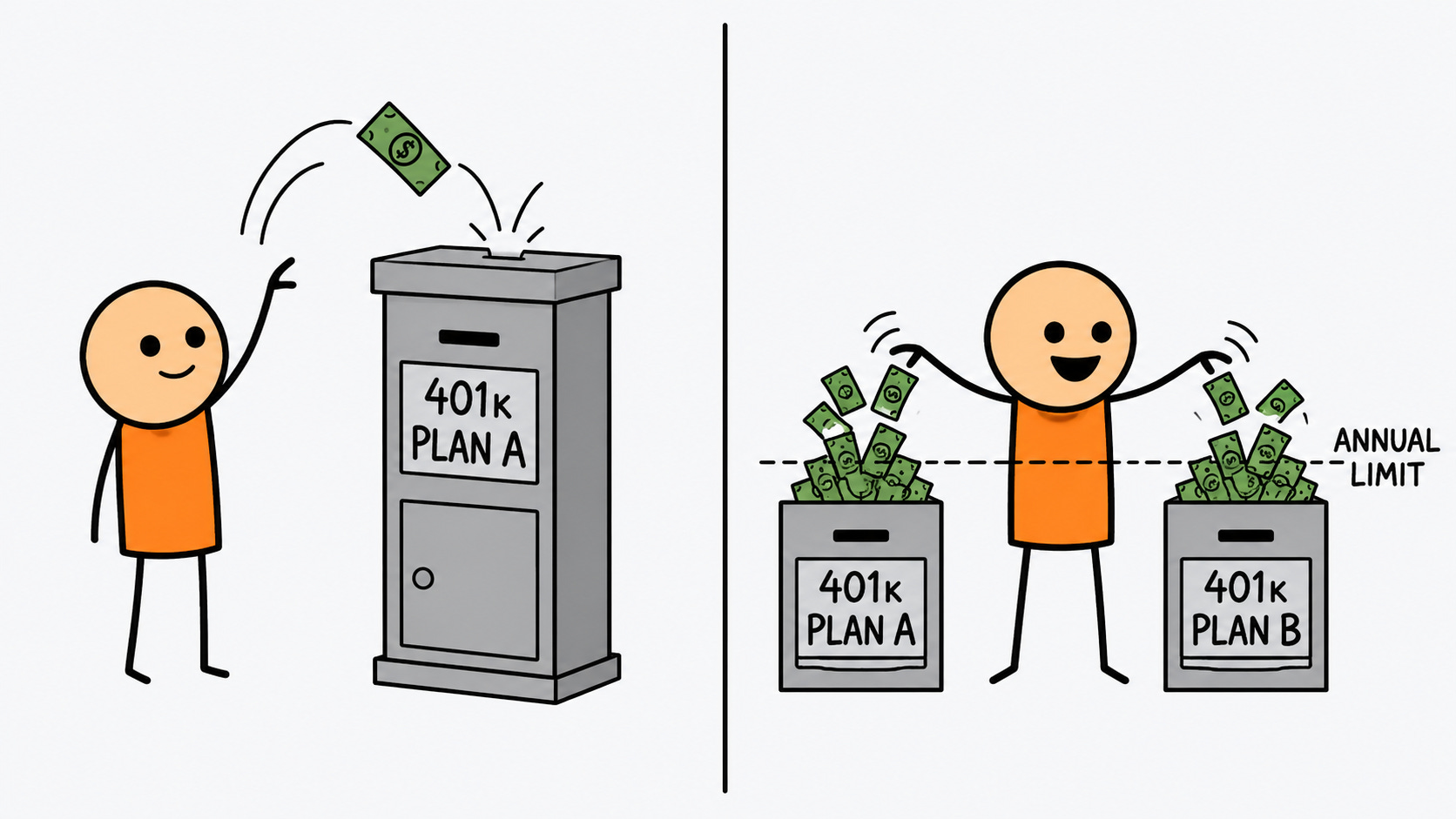
A single 401k plan does something useful for you that most people never notice. It tracks how much you have deferred during the year and stops you the moment you hit the annual limit. Your paycheck contributions simply shut off. You never see a warning because you never need one. The plan handles the ceiling for you, and that convenience trains people to assume the ceiling is the plan’s job to enforce.
The annual deferral limit belongs to you, the person, not to any single plan. It covers every dollar you defer into every 401k you touch in a calendar year, added together. One plan can only watch its own contributions. The problem shows up the moment a second plan enters the picture, because the second plan has no idea the first one exists.
The limit in question is the elective deferral limit, the cap on the money you choose to send from your paycheck into a 401k. Your employer’s match does not count toward it. After-tax contributions outside the deferral category do not count toward it either. What it measures is your own elective deferrals, and it measures them as an annual, per-person total across every plan you participated in for the calendar year.
If you spent the whole year with one employer, this never comes up. The plan caps you and you are done. The trap is two plans in one year. That happens when you change jobs and contribute at both the old and the new employer, or when you work two jobs at once and defer into both plans. Each plan starts your counter at zero. Each plan will let you defer all the way to the full limit. Defer the full amount at both, and you have exceeded the limit by whatever the second plan let through, even though no single plan did anything wrong.
That overage is an excess deferral, and here is the correction. You have to notify one of the plans and request a corrective distribution of the excess, plus the earnings it generated. The hard deadline for that distribution is April 15 of the year after the excess happened. This is a correction deadline, and it is worth being precise about what that means. It is not the tax-filing deadline. A filing extension moves your tax return due date. It does not move this April 15. The excess deferral correction window closes on that date no matter what you do with your return.
There is an earlier practical deadline hiding inside that one. The plan needs time to process the distribution, so most plans ask you to request the corrective distribution well before April 15, often by around the start of March. April 15 is when the money has to be out. The request usually has to be in much sooner.
Now the part that actually matters, what happens if you correct it versus what happens if you do not. Correct it on time and the excess deferral is taxable in the year you deferred it, which is fair, since it was income you set aside. The earnings that come out with it are taxable in the year they are distributed. A timely corrective distribution is generally not hit with the early distribution penalty. One year of tax on the excess, one year of tax on the earnings, and the matter is closed.
Miss the April 15 deadline and the math turns ugly. The excess deferral is still taxable in the year you deferred it. But because it was never removed, it stays trapped in the plan, and if it was a pre-tax deferral, it gets taxed a second time when it finally comes out at retirement. Excess designated Roth 401k deferrals have their own tax treatment, because the contribution was already taxed going in. There is no later cleanup that undoes the missed deadline. After April 15, the tax problem is locked in for that excess.
Someone leaves one employer in the summer and starts at another in the fall. At the first job, paycheck deferrals ran most of the year, and a large share of the annual limit was already used by the time they left. At the new job, eager and organized, they set a healthy deferral percentage. The new plan, starting their counter at zero, accepts it.
By year end, the two plans combined have taken in more than the annual limit allows. Neither plan flagged anything, because neither could see the other.
In February, doing taxes with two W-2s in hand, the overage becomes obvious. They contact the new employer’s plan, request a corrective distribution of the excess plus earnings, and the plan returns it before April 15. The excess is taxed for the year they earned it, the earnings are taxed in the year they come back, and the double taxation never happens.
An excess 401k deferral sounds like a serious violation, the kind of thing that brings a penalty and a letter. The reality is less dramatic. There is no special excise tax here, nothing like the repeating charge that applies to an excess IRA contribution. The whole consequence comes down to one fork in the road, and the fork is the April 15 deadline.
What truly matters is recognizing when you are even at risk. One employer for the whole year, and this is not your problem, the plan handled it. Two plans in one calendar year, from a job change or a second job, and the limit becomes yours to track, because no plan is tracking it for you. That is the entire trigger. If that describes your year, the fix is straightforward as long as you act in time. Notify one plan, request the corrective distribution of the excess and its earnings, and get it done before April 15.
The reason the deadline carries so much weight is what sits on the other side of it. Correct the excess in time and it is taxed once, like the income it always was. Let the deadline pass and the same dollars get taxed twice, once now and once decades later. Knowing whether you had two plans this year tells you exactly where you stand.
I write one of these every day, one retirement rule, explained in plain language and verified against the source. The daily email is free: subscribe here.
Full archive, worksheets, and search live at RetirementNewsRundown.com.
Disclaimer This article is for educational and informational purposes only. It is not tax, legal, or financial advice and does not create an advisor–client relationship. Always consult appropriate professionals regarding your specific situation.