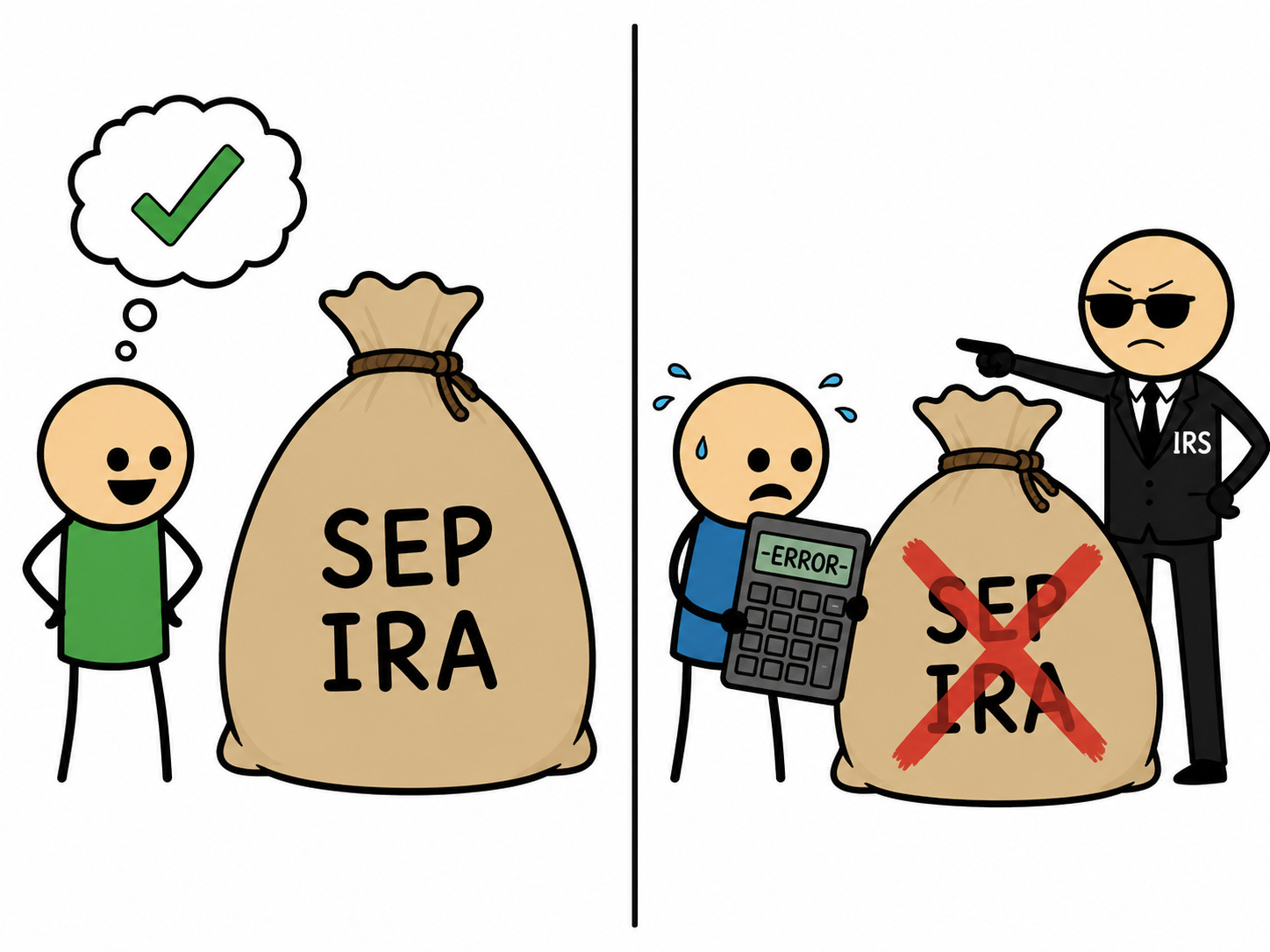
A SEP IRA looks simple from the outside. The business owner makes a contribution based on a percentage of compensation, the money lands in an IRA, and the deduction shows up on the tax return. What does not show on that pleasant picture is how easy it is to contribute too much, and how rarely anyone catches it on the way in.
The custodian holding the SEP IRA does not audit your math. It accepts the deposit, codes it as a SEP contribution, and reports it on Form 5498. The IRS does not check the math at deposit either. The check happens later, when the contribution gets compared to the deduction limits that depend on numbers nobody finalized until tax time. By then, the excess is already sitting in the account, doing the same thing every excess IRA contribution does, waiting for someone to notice.
A SEP over-contribution is what happens when the contribution exceeds the deduction limit allowed for the year. This article is focused on traditional pre-tax SEP IRA contributions. SECURE 2.0 now allows Roth treatment for certain SEP contributions if the employer permits it and the participant elects it, but Roth SEP excess corrections can involve different tax mechanics.
For an employee covered by a SEP, the limit is a percentage of compensation, capped at an overall dollar limit. For a self-employed owner contributing for themselves, the math is trickier than it looks. The contribution itself reduces the income the contribution is calculated against, which means the effective rate the owner can contribute is lower than the rate that would apply to an employee. This is where most over-contributions come from. The owner applies the employee rate to their full self-employment earnings, runs the math once, and overshoots.
The custodian will accept whatever you send. Same processing versus policing problem as a regular IRA contribution. Eligibility against the deduction limit gets resolved on your tax return, after the math is final, often months after the deposit.
That leaves you with a familiar correction set. The cleanest path is a return of excess. You contact the custodian, withdraw the excess plus the earnings it generated, and have it out of the SEP by your tax filing deadline including extensions. Treated this way, the excess never triggers the six percent excise tax. The earnings come out as taxable income for the year of the contribution, and a timely corrective distribution is generally not hit with the early distribution penalty.
What happens if you do it later instead. After the tax filing deadline with extensions, the six percent excise tax applies for the year the excess sat in the account, and it applies again every year the excess remains. The fix at that point is to remove only the excess principal, which stops the six percent going forward. You no longer have to calculate earnings on a late correction. The other option is the SEP-specific one. In some cases, the excess may be carried forward and applied against a later year’s allowable SEP contribution limit. It does not retroactively remove the six percent for the years the excess already sat in the account.
Three different deadlines are worth keeping straight here. The calendar-year deadline matters because the SEP limit is calculated against compensation earned in that year, and the six percent applies for any year the excess is in the account at year end. The tax-filing deadline, including extensions, is the window for the clean return of excess that avoids the six percent entirely. The carryforward option is a correction window that does not end on a single date, but it only solves the problem for future years, not for the year the excess actually occurred.
A self-employed consultant has a good year. In December, anticipating strong final numbers, they fund their SEP based on twenty five percent of their net self-employment income, the rate they remembered seeing on a chart. The deposit lands in the SEP IRA before year end. The custodian accepts it and confirms it.
In the spring, while preparing the tax return, the math gets done correctly. The owner’s effective contribution rate is lower than the employee rate, because the contribution itself reduces the income the percentage applies to. The contribution they made was several thousand dollars more than the deduction limit allows.
They contact the custodian, request a return of the excess plus its earnings, and the SEP IRA distributes the excess before the October extended deadline. The corrected deduction reflects only the allowed SEP contribution. Any earnings distributed with the timely correction are taxable for the contribution year, and the timely correction avoids the six percent excise tax.
A SEP over-contribution sounds like a serious failure of a retirement plan, but it is mostly a math problem that gets caught at tax time and gets fixed at tax time. The most common cause is the rate confusion between employees and owners. The second most common cause is contributing early in the year based on an estimate and watching the final number come in lower. Both of those produce an excess that the custodian had no way to flag.
What truly matters is which deadline you are still inside. Catch the excess before your tax filing deadline including extensions and the correction is clean. Pull the excess and its earnings, take the small tax hit on the earnings, and the SEP is back to a deductible contribution with no excise tax attached. Miss that window and the six percent enters the picture, and it applies for every year the excess remains in the account, until you either pull it out or absorb it into a future year’s contribution under that year’s limit.
Knowing where you are on that timeline tells you what your fix actually costs. Inside the window, the cost is a small amount of taxable earnings. Outside the window, the cost is six percent for each year you wait. Leaving the overage in place is the only thing that turns a math error into a recurring cost.
I write one of these every day, one retirement rule, explained in plain language and verified against the source. The daily email is free: subscribe here.
Full archive, worksheets, and search live at RetirementNewsRundown.com.
Disclaimer This article is for educational and informational purposes only. It is not tax, legal, or financial advice and does not create an advisor–client relationship. Always consult appropriate professionals regarding your specific situation.