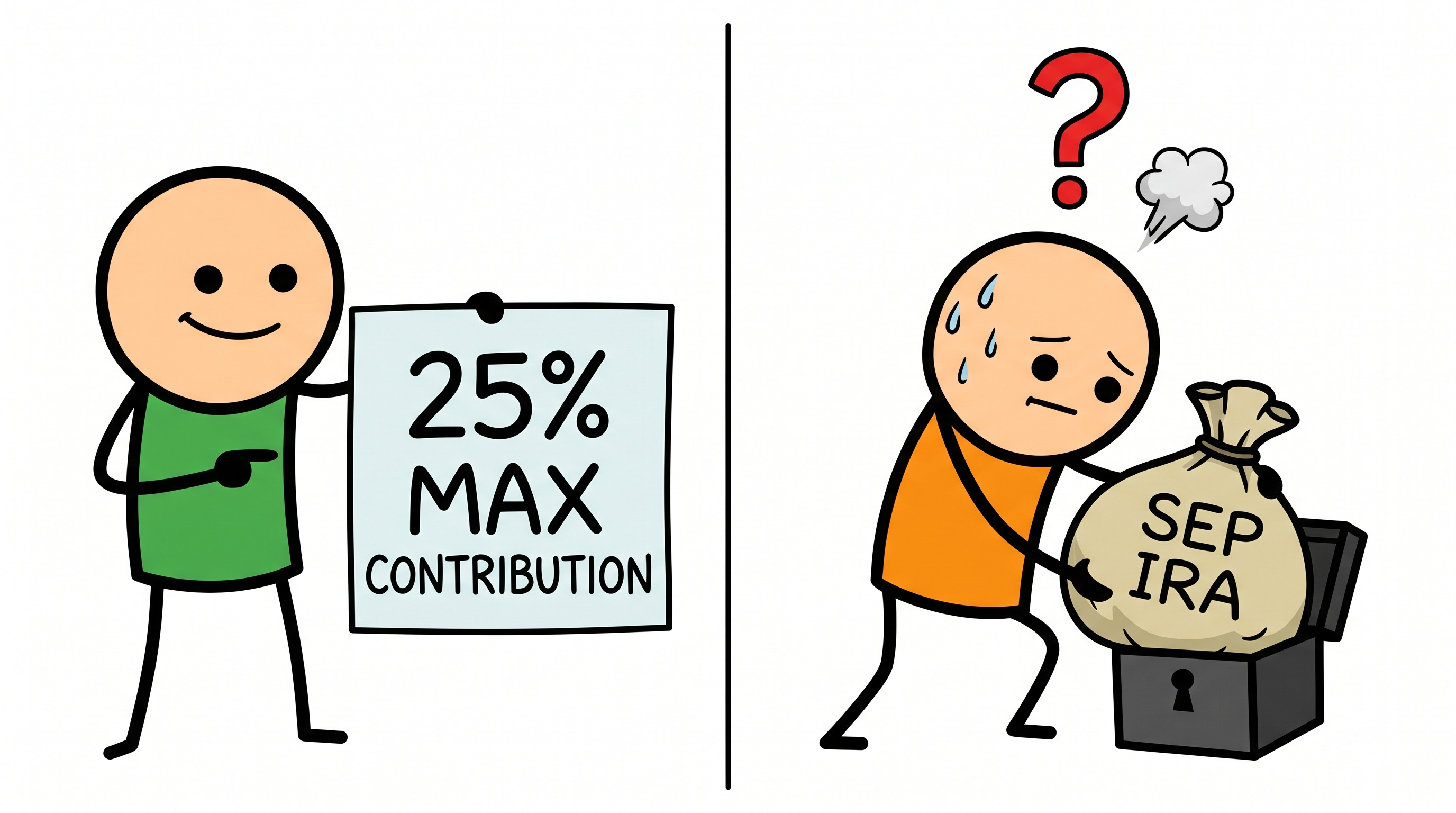
Every guide to SEP plans leads with the same headline number. Twenty-five percent. Set aside a quarter of your pay, the rule of thumb goes, and you earn a sizable deduction. So a self-employed person does the obvious thing, takes the business profit, multiplies by twenty-five percent, and pencils in a contribution. Then the accountant or the worksheet hands back a smaller figure, and the reflex is to hunt for a data-entry error.
The math is working as designed. That twenty-five percent is the rate for an employee, measured against the wages on a W-2. When you are both the boss and the only worker, there is no W-2. Your pay is your business profit, and that profit has to absorb the very contribution it funds. The number bends downward every time, and it does so for a reason worth understanding.
Here is what drives the gap. For a common-law employee, a SEP contribution can reach twenty-five percent of compensation, usually measured using the employee’s wages under the plan. For the owner, the base shifts to net earnings from self-employment, which is the Schedule C net profit reduced by the deductible portion of self-employment tax. That subtraction shrinks the base before any contribution math begins.
Then the circular part kicks in. A self-employed person’s own contribution is deductible and comes out of the same earnings the rate is applied to, so the contribution reduces the base that determines the contribution. The IRS settled that loop long ago by publishing a reduced rate. A plan written at twenty-five percent produces an effective rate of twenty percent of net earnings. A plan written at ten percent produces 9.0909 percent. The shortcut behind those numbers is the plan rate divided by one plus the plan rate, and Publication 560 prints a rate table so you never have to touch the algebra.
Two ceilings sit on top of the result. Only so much income counts toward the calculation, capped at the annual compensation limit, and the contribution cannot exceed the annual dollar limit for defined contribution plans. Both figures climb most years, which is why they belong on the limits page rather than in your head.
Timing is the generous part. A SEP rides your business tax return rather than the calendar. You can establish and fund one for a given tax year right up to the due date of that year’s return, extensions included. For a calendar-year sole proprietor, that generally means April 15 of the following year, or October 15 with a valid extension on file. Let December 31 pass and you lose nothing. Let the filing deadline pass, extensions and all, and the contribution stops being deductible for that year. Run the rate wrong and put in too much, and you have an excess contribution, which carries its own correction path and its own clock.
Picture a freelance designer, a sole proprietor, who closes the year with one hundred thousand dollars of net profit on the Schedule C. Quick mental math says twenty-five thousand into the SEP. The worksheet has other ideas.
Start with the self-employment tax adjustment. The deductible half of her self-employment tax runs about seven thousand sixty-five dollars, which pulls her net earnings from self-employment down to roughly ninety-two thousand nine hundred. That figure is the real base. Apply the reduced rate of twenty percent rather than the headline twenty-five, and the contribution lands near eighteen thousand six hundred dollars. That falls well short of the twenty-five thousand the quick math promised, and the difference traces back to the same dollars doing two jobs, funding the contribution and clearing the self-employment tax adjustment, before the rate ever reaches them.
On timing, say she runs the numbers in the spring after the year closes. She can open and fund that eighteen thousand six hundred any time through April 15. File an extension and she has until October 15 to move the money and still claim it for the prior year. The contribution stays tied to the tax year she earned the income, while the deadline to act on it rides with the return.
The smaller number reflects the system staying consistent with itself. The twenty-five percent figure was never built to be multiplied against a sole proprietor’s profit, and the reduced rate exists so the deduction and the contribution land on the same answer.
What matters is knowing which number you start from. Start from gross revenue and you overshoot by a mile. Start from Schedule C profit and the full twenty-five percent and you overshoot by a predictable margin. Start from net earnings after the self-employment tax adjustment, apply the reduced rate, mind the two ceilings, and the figure that comes out is the one that survives scrutiny.
The deadline hands you room that most retirement rules withhold. A SEP runs on your filing deadline, extensions included, which lands later than the December 31 cutoff many other plans answer to. Knowing that turns a figure that looked like a shortfall into a figure that simply shows how the math was always going to resolve. You finish the year knowing exactly where you stand.
I write one of these every day, one retirement rule, explained in plain language and verified against the source. The daily email is free: subscribe here.
Full archive, worksheets, and search live at RetirementNewsRundown.com.
Disclaimer This article is for educational and informational purposes only. It is not tax, legal, or financial advice and does not create an advisor–client relationship. Always consult appropriate professionals regarding your specific situation.