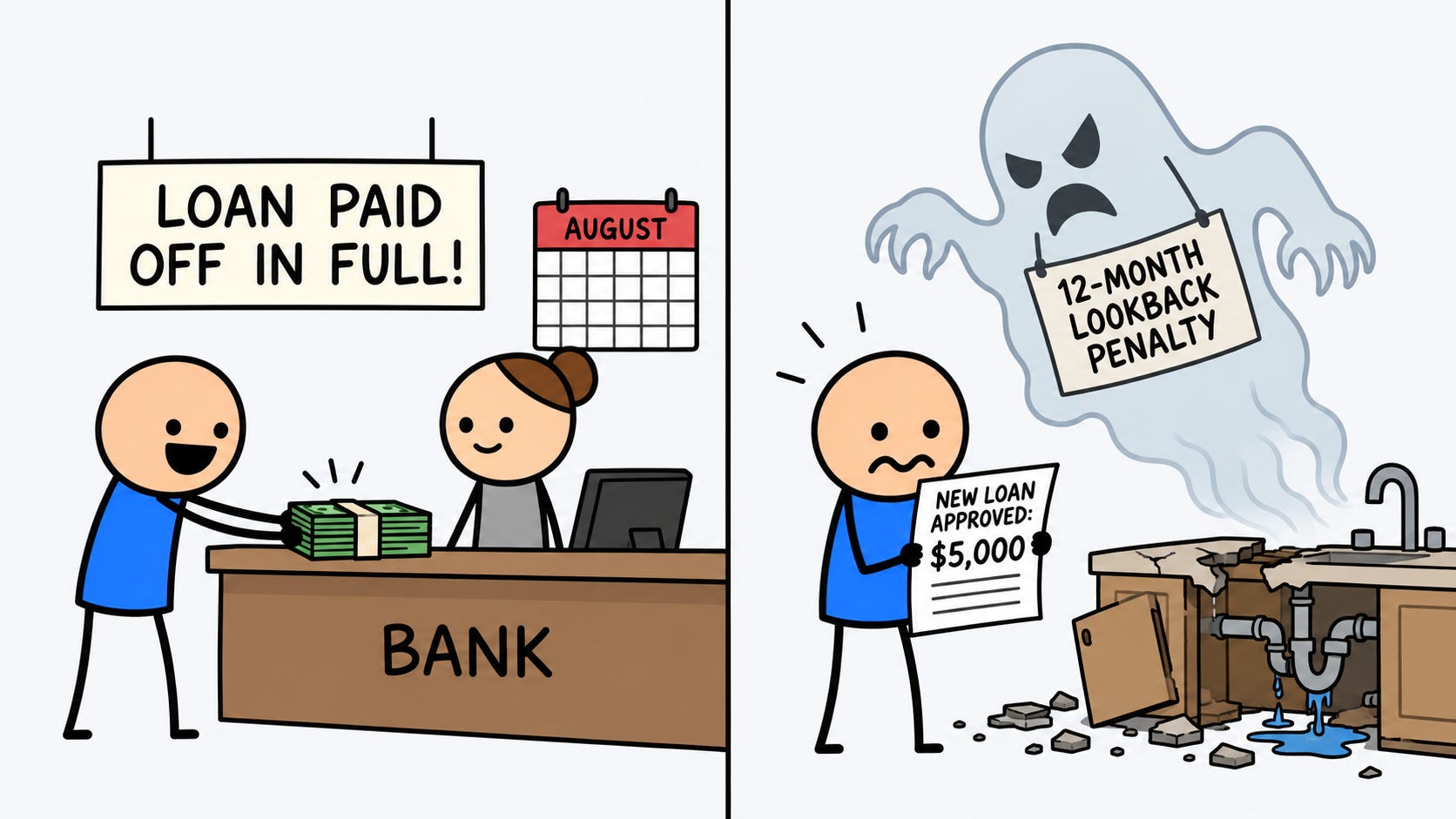
A man with $184,000 vested in his 401(k) needs $40,000 to finish a kitchen that has been torn apart since spring. He has heard the loan limit is $50,000, and half his balance is well above that, so he puts in for $40,000 and starts scheduling contractors.
The plan approves $22,000.
He did have a loan before. He took $28,000 in October of last year for a truck, and he wiped it out in one payment the following month when a bonus landed. The debt is settled. It does not appear on his statement. It is still sitting inside the calculation that just cut his request nearly in half.
The amount a plan can lend you is the lesser of two numbers, and most people have only ever heard about one of them.
The first is half your vested account balance. Vested matters here, because employer contributions you have not yet earned the right to keep are invisible to this math even though they show up in your total.
The second number is where people get surprised. It starts at $50,000, and it is reduced by the difference between your highest outstanding loan balance at any point during the twelve months ending the day before your new loan, and whatever you still owe on the day the new loan is issued. If another loan is still running, its current balance also eats into that same capacity.
Work that through for the man with the kitchen. He applied in September. The twelve months behind him include last October and November, when he owed the full $28,000, because he never amortized it down. He owes nothing today. The difference is the full $28,000, so his ceiling is $22,000 rather than $50,000. Half his vested balance is $92,000, which is the larger figure, so the lower one governs. Twenty two thousand dollars is the entire amount his plan is permitted to lend him, and it is the number he got.
The rule exists so nobody can keep a permanent $50,000 loan alive by repaying it every December and re-borrowing it every January. What it does in practice is penalize people who paid a loan back early and responsibly, which is the opposite of how it feels it should work.
Now the part worth knowing about timing, and the part almost everybody gets wrong. That twelve month window rolls. It is measured backward from the date of your new loan, and it has nothing to do with the calendar year and nothing to do with your tax return. What matters is that the window looks at your highest balance anywhere inside it, so your capacity comes back only when the whole window is clear of the old loan. For the man above, that is twelve months past the November payoff, which puts him in December of this year rather than September. Wait three months and his ceiling goes back to $50,000.
A few other things shape the number. The rule allows a plan to lend the greater of $10,000 or half your vested balance, which would let somebody with $14,000 vested borrow $10,000 instead of $7,000. Plans are not required to offer that, and anything above half your vested balance has to be secured some other way, because only half of it is permitted to stand as collateral. Your plan document decides whether it is available at all.
Plans have wide latitude generally. A plan is allowed to offer no loans. It can allow one at a time, or two, or none for terminated participants. It can set a minimum. If your employer runs more than one plan, or your employer belongs to a group of related companies, the loans across all of them get added together for this limit. Plans of genuinely unrelated employers are counted separately. And if you have had several loans inside the same window, the calculation gets murkier, because the IRS has acknowledged more than one acceptable way to identify the highest balance.
Repayment terms come with the loan. You get five years, with substantially level payments made at least quarterly. A loan used to buy your principal residence can run longer. Taking the loan later does not buy you a longer term.
If a plan lends you more than the limit allows, only the excess is treated as a taxable distribution rather than the whole loan. The IRS correction program can repair that through a corrective repayment and a reallocation of the payments already made, but the fix runs through your employer rather than through you.
Take a woman with $140,000 vested who borrows $45,000 in March to cover a gap while selling one house and buying another.
She repays the whole thing in August when the first house closes. In October her daughter needs help with graduate school tuition and she asks the plan for $30,000.
Her highest balance in the prior twelve months is $45,000. She owes nothing now. So her ceiling is $50,000 minus $45,000, which is $5,000. Half her vested balance is $70,000, far above that, so the $5,000 governs. She borrowed and repaid $45,000 in good faith and can access $5,000.
Waiting helps her less than she would hope. The following April is no real improvement, because the window still reaches back into the previous spring and summer when the loan was outstanding and barely paid down. Her capacity climbs as those balances fall out the back, and the full $50,000 returns only once the window holds no balance from that loan at all, which is a year past the August payoff.
So her real choice in October is $5,000 now or $30,000 next September. For tuition, neither is much of a choice. What would have helped is knowing the shape of this window back in March, before she borrowed the first time.
The useful thing here is that the number your plan will quote you is knowable before you ask, and it rests on two facts you already have.
One is half your vested balance, which your statement shows. The other is the highest balance you have carried on any plan loan in the past twelve months, which you also know, and which most people forget counts for anything once the loan is gone.
If that second number is doing the damage, the calendar is the fix rather than the paperwork. Find the date your old loan actually hit zero, not the date you took it and not the date it peaked, and add twelve months and a day. That is when your full borrowing capacity comes back. Nothing you file changes it and no form speeds it up.
It is also worth asking the plan for the figure before you commit to anything that depends on it. Contractors, tuition deposits, and closing dates are poor things to schedule around a number you estimated yourself. The loan section of our 401(k) guide walks through how plans handle the request, the paperwork, and what happens to the loan if you leave the job before it is paid off.
Borrowing from your own account feels like it should be simple, and the mechanics of taking the money mostly are. The limit is the part that surprises people, and it surprises them at the worst possible moment, which is after they have already promised the money to somebody else.
I write one of these every day, one retirement rule, explained in plain language and verified against the source. The daily email is free: subscribe here.
Full archive, worksheets, and search live at RetirementNewsRundown.com.
Disclaimer
This article is for educational and informational purposes only. It is not tax, legal, or financial advice and does not create an advisor-client relationship. Always consult appropriate professionals regarding your specific situation.