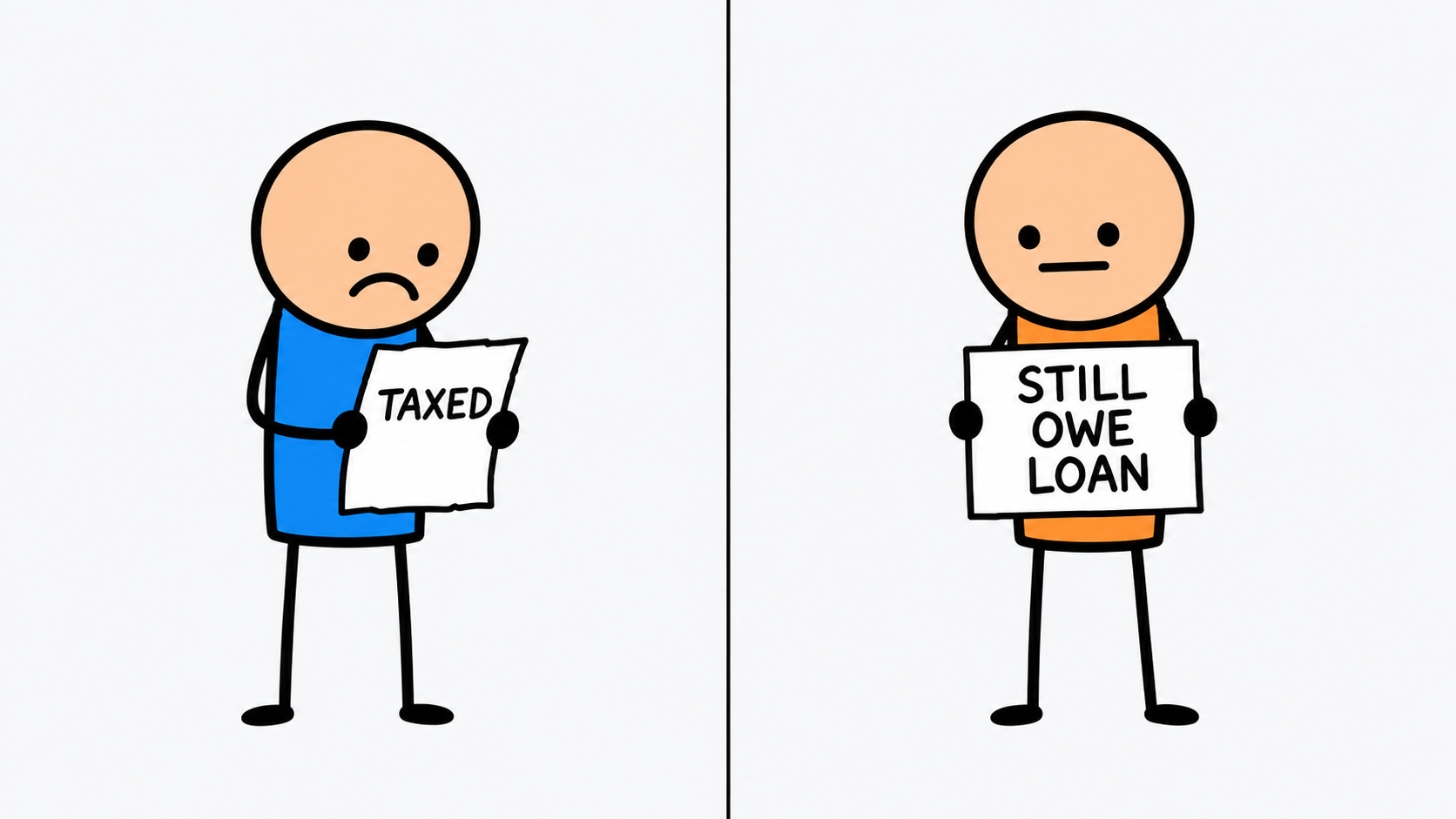
A man with a 401(k) loan hits a rough patch. His hours get cut in February, he misses two loan payments over the spring, and by the time things stabilize in July he assumes he will catch up whenever he can.
In January a Form 1099-R arrives reporting the entire remaining loan balance as a distribution. He is 47, so the amount is generally subject to the 10 percent additional tax on top of ordinary income tax.
He has read that a loan that becomes taxable when you leave a job can be rolled over, so he calls an IRA custodian to arrange it. He cannot. And when he checks his account, the loan is still there, and he still owes it.
A 401(k) loan can become taxable in two different ways, and the two are not interchangeable. One of them you can undo yourself. The other you cannot.
A plan loan offset happens when the plan reduces your account balance to settle an outstanding loan, usually because you left the job or the plan terminated. It is an actual distribution, it is taxable, and it is an eligible rollover distribution. You can undo the tax by rolling over an equal amount, within 60 days, or by your tax return due date including extensions if it meets the qualified conditions. That is the situation with a real deadline and a real fix.
A deemed distribution is what happens when the loan itself fails the rules. No job change required. It can happen while you are still employed and still contributing.
Several things trigger one. A loan term longer than five years, unless the loan was for a principal residence. Payments that are not level and at least quarterly. No legally enforceable written agreement. A loan amount above the permitted limit. And the common one, missing an installment payment when it is due.
The amount that becomes taxable depends on which failure occurred. A missed payment makes the entire outstanding balance taxable, plus accrued interest. A loan over the limit makes only the excess taxable. A structural failure in how the loan was written makes the whole original loan amount taxable.
Before that happens, there is a window, and it is the only one in this story. A plan may offer a cure period, and the longest one permitted runs to the last day of the calendar quarter following the quarter in which the missed payment was due. A payment missed in February sits in the first quarter, so the cure period can run through June 30. Make up the missed payments by then, or refinance the loan to fold them in, and nothing is deemed. Miss that date and the deemed distribution occurs as of the last day of the cure period.
Now the two facts that make a deemed distribution the worse outcome.
It cannot be rolled over. The IRS says so plainly: a deemed distribution is not eligible to be rolled over into an eligible retirement plan. There is no 60-day window and no filing deadline extension, because there is no rollover available at any deadline. The tax is simply due. Employer-level correction programs exist for some plan loan failures, but those run through the plan sponsor rather than through anything you can arrange with an IRA custodian.
And the loan does not disappear. A deemed distribution is a tax event and nothing more. It does not reduce your plan balance and it does not cancel the debt. The loan stays outstanding on the plan’s books, you are still required to make the repayments, and the unpaid balance still counts against how much you can borrow in the future. So you have paid tax on money you still owe to your own account, and the account is no smaller for it.
One consolation exists and it is worth knowing about. Repayments you make after a deemed distribution become basis in the plan, which means that money is not taxed again when you eventually withdraw it. You paid tax on it once already. Continuing to repay is what stops it from being taxed twice.
The paperwork tells you which one you are in. A deemed distribution is reported with code L. A qualified plan loan offset is reported with code M. Those are different letters for different problems, and only one of them has a remedy.
Say a woman has a 401(k) loan and payroll deductions stop when her hours are cut. The February payment is missed. Assume the outstanding balance including accrued interest runs to about $16,000.
February is in the first quarter, so under the maximum cure period her deadline to fix it is June 30.
Version one. In May she makes up the missed payments and resumes the schedule. Nothing is deemed, nothing is taxable, the loan continues on its terms.
Version two. June 30 passes with the payments still missed. That entire $16,000 becomes a deemed distribution as of that date. She gets a 1099-R with code L for that tax year. At a 22 percent marginal rate that is roughly $3,520 in tax, plus a 10 percent additional tax of $1,600 at her age unless an exception applies. None of it can be rolled over.
She still owes the $16,000 to the plan. If she resumes paying, those payments become basis, so they are not taxed a second time later. If she stops, the balance keeps limiting what she can borrow going forward.
Compare that with the same woman leaving her job with the same $16,000 loan current and in good standing, and the plan then offsetting that balance against her account. The offset is taxable in the same way and can be rolled over, with a deadline running to her tax return due date. Same dollar amount, same account, completely different set of options.
The useful thing to carry is that the cure period is the entire game, and it is short and quarterly.
If a payment gets missed, the question is which calendar quarter it was due in, because the deadline is the end of the following quarter. A payment missed in early January gets nearly six months. A payment missed in late March gets three. Same rule, very different amounts of time, depending on where in the quarter the payment fell.
Check whether your plan actually offers a cure period, because a plan is permitted to offer one and is not required to. If the plan document does not include it, the deemed distribution can occur much sooner.
If you are inside a cure period now, the two ways out are making up the missed installments or refinancing the loan to include them. Both are conversations with the plan administrator rather than something you handle alone.
And if a deemed distribution has already happened, the decision worth understanding is whether to keep repaying. The tax is done either way. Repaying restores your account and creates basis that protects those dollars from a second round of tax. Our rollover IRA guide covers which distributions are eligible to move, which is the question underneath all of this.
People tend to think of a defaulted loan as a single event with a single consequence. It is really two different events with two very different consequences, and the one that arrives while you are still employed is the one with no way back.
I write one of these every day, one retirement rule, explained in plain language and verified against the source. The daily email is free: subscribe here.
Full archive, worksheets, and search live at RetirementNewsRundown.com.
Disclaimer
This article is for educational and informational purposes only. It is not tax, legal, or financial advice and does not create an advisor-client relationship. Always consult appropriate professionals regarding your specific situation.