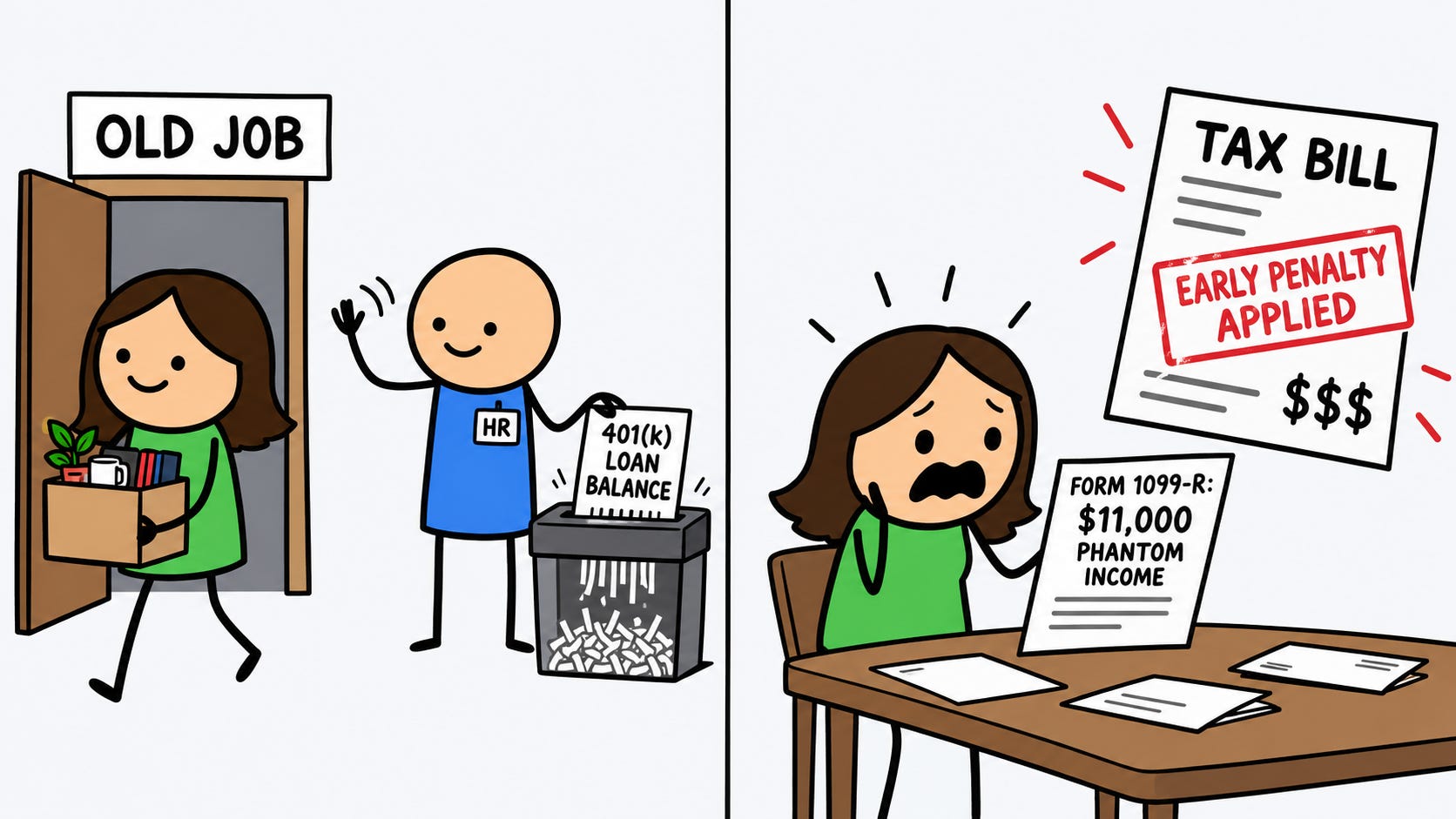
A woman takes a $19,000 loan from her 401(k) to cover a roof and a transmission in the same bad spring. She repays it faithfully out of every paycheck for two years. In September she takes a better job somewhere else, and the balance is still around $11,000.
She never receives a check for $11,000. Nobody hands her anything. Her account balance simply drops by the remaining loan amount, which she vaguely registers as the loan being settled.
In January a Form 1099-R arrives reporting an $11,000 distribution. She is 44, so the tax bill includes an early distribution penalty on top of ordinary income tax, on money that never passed through her hands.
What happened is a plan loan offset, and the name describes the mechanism. A plan may require an outstanding loan to be repaid when employment ends, or treat it as in default at that point. If the plan then reduces your account balance by the unpaid amount to settle the debt, that reduction is the offset. Some plans instead allow repayment to continue after you leave, so this is a plan by plan question.
That reduction counts as an actual distribution, the same category as walking in and taking money out. It is taxable as ordinary income for the year it happens, and if you are under 59.5 it can carry the early distribution penalty unless an exception applies.
Here is the part that changes everything, and it is the reason this article exists. A plan loan offset is an eligible rollover distribution. You can roll it over, and if you do, the tax disappears.
Rolling it over means depositing that amount into an IRA or another employer plan. The complication is that the plan never gave you the money. It kept your balance and cancelled your debt. So rolling over an $11,000 offset means finding $11,000 from somewhere else and depositing it yourself.
That is a real obstacle and it is precisely why the deadline matters so much.
An ordinary plan loan offset follows the standard rollover rule, which gives you 60 days. For somebody who has just changed jobs and needs to produce five figures in cash, 60 days is frequently not enough.
A qualified plan loan offset gets far longer. The offset qualifies when three things are true. The offset happened because the plan terminated or because you had a severance from employment. The loan was in good standing immediately before that event, meaning you were current on it. And for a severance, the offset occurred within twelve months of your separation.
Meet those conditions and your deadline becomes your tax return due date for the year of the offset, including extensions. For a calendar year taxpayer, an offset in September gives you until the following April, with extension relief potentially carrying it into October. That is a year or more to assemble the money, against 60 days.
Two practical details make this easier than it sounds.
Withholding generally takes twenty percent out of eligible rollover distributions, which would normally mean you have to replace more than you received. It does not apply here. When the only amount that is not directly rolled over is the loan offset, no withholding is required, because there is no cash to withhold from.
The other detail cuts the other way. A plan is not required to offer a direct rollover of the offset amount. You arrange this one yourself, with an IRA custodian of your choosing.
And the 1099-R tells you which situation you are in. A qualified plan loan offset is reported with code M in the box that describes the distribution. That code is your signal that the longer deadline applies.
If you miss whichever deadline applies to you, the offset stays taxable for that year. There is no later fix.
Take the woman with the $11,000 balance. Her last day was September 30 and the plan offset the loan in October.
Her loan was current and the offset followed her severance within twelve months, so it is a qualified plan loan offset. Her 1099-R arrives with code M. Her deadline to roll it over is the filing due date for that tax year, so April of the following year, extending to October if she files an extension.
She opens an IRA, and between a bonus in February and some savings, she deposits $11,000 into it by early April. On her return she reports the $11,000 distribution and the $11,000 rollover. Nothing is taxable and no penalty applies.
Run the version where she assumes nothing can be done. She reports the $11,000 as income. At a 22 percent marginal rate that is roughly $2,420 in federal tax, plus a 10 percent early distribution penalty of $1,100 because she is 44, plus whatever her state takes. The account she borrowed from is also permanently $11,000 smaller, because she never replaced the balance.
Now change one fact. She had fallen behind on payments before she left. Whether the later offset can be rolled over at all now depends on the loan’s status under her plan’s repayment and cure period rules. If the loan had already become a deemed distribution, that amount cannot be rolled over on any deadline. If instead there is an ordinary offset that fails the qualified conditions, the 60-day rule applies, and by the time the 1099-R arrives in January that window closed in December.
The useful thing to know is that a loan offset is reversible, and the reversal has a deadline that depends on facts you can determine immediately.
Three of them settle it. Was the offset caused by leaving the job or the plan ending. Was the loan current at the time. And did the offset happen within twelve months of your last day. Three yeses point to the long deadline.
The 1099-R confirms it, but the 1099-R arrives in January and the clock started in the autumn. Anybody with an outstanding loan and a new job is better served working this out in the first week than waiting for the form.
Then the practical question is where the money comes from, and that is what the long deadline is for. Somebody with until next October has time for a bonus, a tax refund, or a few months of saving. Somebody on the 60-day clock usually does not.
If the amount is beyond reach, a partial rollover still helps. Roll over what you can and the rest is taxable, and the portion you replace is neither taxed nor penalized. Our rollover IRA guide covers the mechanics of getting money into the receiving account correctly.
The unfairness people feel about this is real. You borrowed your own money, you paid it back with interest to your own account, you changed jobs, and the tax code treats the leftover balance as though you cashed out. Knowing the deadline is the difference between that being a story about unfairness and a story about paperwork.
I write one of these every day, one retirement rule, explained in plain language and verified against the source. The daily email is free: subscribe here.
Full archive, worksheets, and search live at RetirementNewsRundown.com.
Disclaimer
This article is for educational and informational purposes only. It is not tax, legal, or financial advice and does not create an advisor-client relationship. Always consult appropriate professionals regarding your specific situation.