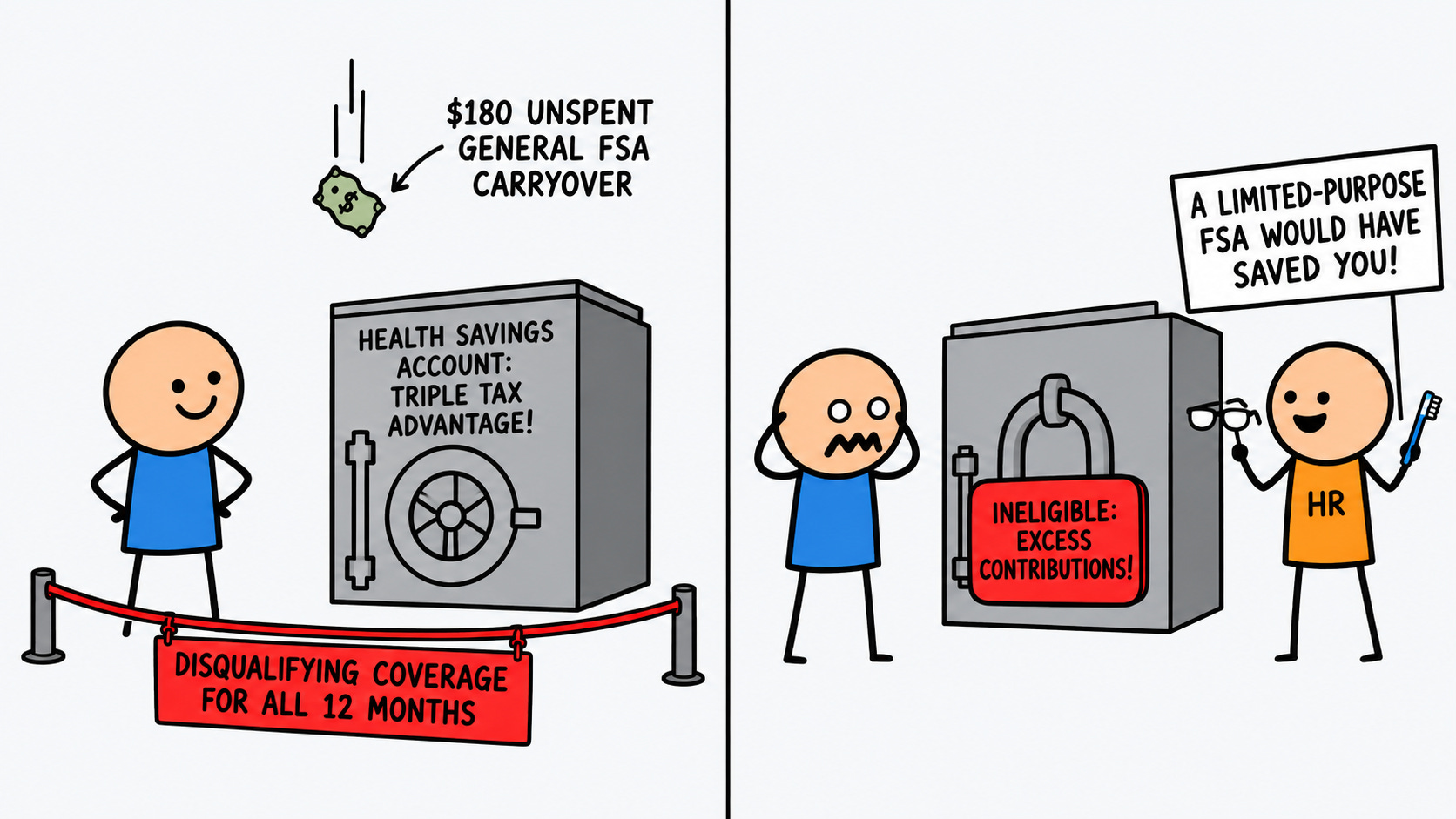
A man switches to a high deductible health plan at open enrollment specifically so he can start funding a health savings account. He has read about the triple tax treatment, he likes that the money is his forever, and he sets up a payroll contribution starting in January.
In March his benefits administrator mentions, in passing, that his health FSA carryover from last year is still sitting in his account. About $180 he never got around to spending. That $180 has made him ineligible to contribute to the HSA for the entire plan year.
Nobody did anything wrong. The carryover feature that rescued his leftover FSA money is the same feature that blocked the account he switched plans to open.
Contributing to an HSA requires two things. You have to be covered by a qualifying high deductible health plan, and you have to have no other health coverage that pays medical expenses before that deductible is met. The second requirement is where FSAs come in.
A general purpose health FSA pays for essentially any qualified medical expense from dollar one. That is exactly the coverage the HSA rules exclude, which makes a general purpose health FSA disqualifying. Having one means no HSA contributions for the months it applies.
Now the part that catches married couples, and it is the single most common way people discover this after the fact. The disqualification attaches to the coverage itself, whoever enrolled in it. A general purpose health FSA in your spouse’s name can reimburse your expenses too, which means it is disqualifying coverage for you even though you never enrolled in it and never see the paperwork. A spouse’s general purpose health FSA can block your HSA contributions because that FSA can reimburse your medical expenses, which is how these plans ordinarily work.
The fix exists, and it is the whole point of this piece.
A limited purpose health FSA restricts reimbursement to HSA-compatible categories, commonly dental, vision, and preventive care. Because it cannot pay general medical expenses before the deductible, it does not disqualify anybody. You can fund an HSA and a limited purpose FSA in the same year, using the FSA for glasses and cleanings and the HSA for everything else, both with pretax money.
A post-deductible FSA is the other compatible variant. It generally reimburses no medical expenses until at least the statutory minimum deductible for a high deductible plan has been met, though preventive care can still be covered earlier, and that structure keeps it out of the disqualifying zone.
Now the two traps from the FSA calendar, because both of them reach into the following year.
A carryover of general purpose FSA money into the next plan year is disqualifying coverage for that entire year. All twelve months of it, including the months after the balance runs out. Two ways out exist and both have to happen before the year starts. Some plans automatically convert the carryover to limited purpose for anybody moving to a high deductible plan, which preserves the money and the eligibility together. Where the plan allows it, an employee can also decline or forfeit the carryover, which trades a small balance for twelve months of HSA contributions.
A grace period works the same way over a shorter stretch. If you have a balance in a general purpose FSA when the plan year ends and your plan has a grace period, that coverage extends into the new year and blocks HSA contributions for those months. There is an exception with a sharp edge to it. If your balance is actually zero on the last day of the plan year, the grace period does not affect your eligibility. Zero means reimbursed and paid out, counted on a cash basis. Claims submitted and still pending do not count as spent.
One more mechanic that determines how much damage any of this does. HSA eligibility is tested month by month, on the first day of each month, and under the ordinary calculation losing three months costs you three twelfths of the annual limit. There is a separate rule that can restore the rest. Somebody who is eligible on December 1 can generally be treated as eligible for the entire year and contribute the full annual amount, provided they stay eligible through a testing period that runs to the end of the following year. Failing that testing period turns the extra contribution into income with an additional tax on top. The carryover case is worse than the grace period case precisely because it applies to every month, December included.
And if you contributed while ineligible, those are excess contributions. They can carry a 6 percent excise tax for each year they sit uncorrected, and removing the excess along with its earnings by the return due date generally avoids that tax.
Say a woman has a general purpose health FSA and elects a high deductible plan with an HSA for next year. Her FSA plan year ends December 31 with $220 left.
Version one. The $220 carries over into a general purpose FSA. She is ineligible for all twelve months, and any contributions have to be corrected as excess.
Version two. Her employer converts carryover balances to limited purpose for anyone enrolling in the high deductible plan. The $220 becomes dental and vision money. She is eligible in January, contributes all year, and buys glasses in March.
Version three. Her plan has a grace period instead, and she still has the $220. It runs into mid-March, so she is ineligible for January, February, and March and becomes eligible April 1. That is nine months of contribution room under the ordinary calculation. Because she is eligible on December 1, the last-month rule may let her contribute the full annual amount instead, with the testing period attached.
Version four. Same grace period, but her claims are reimbursed and the balance hits actual zero by December 31. The grace period affects nothing and she is eligible in January.
Same $220 in all four. The outcomes range from a full year of HSA contributions to none.
The useful thing to check is what is sitting in your FSA before you switch health plans, because the conflict is created months before the HSA exists.
Three questions cover it. Does anyone in the household have a general purpose health FSA for the coming year, including a spouse at a different employer. Does your plan offer a limited purpose option you can elect instead. And if you have a balance now, does your plan carry it over, grace-period it, or let it go.
If a carryover is coming and your plan does not automatically convert it, the choice between a small balance and a year of HSA eligibility is one worth making deliberately rather than discovering in March.
If you are in a grace period now with money left, the zero balance exception is worth understanding precisely. Reimbursed and paid out by the last day of the plan year. A claim still working its way through the system leaves you short of it.
And if you have already contributed while ineligible, the situation is fixable and gets harder with time, which is true of most things in this category.
The limited purpose FSA is the piece most people have never heard of, which is unfortunate, because it is the one that lets both accounts work at once.
I write one of these every day, one retirement rule, explained in plain language and verified against the source. The daily email is free: subscribe here.
Full archive, worksheets, and search live at RetirementNewsRundown.com.
Disclaimer
This article is for educational and informational purposes only. It is not tax, legal, or financial advice and does not create an advisor-client relationship. Always consult appropriate professionals regarding your specific situation.