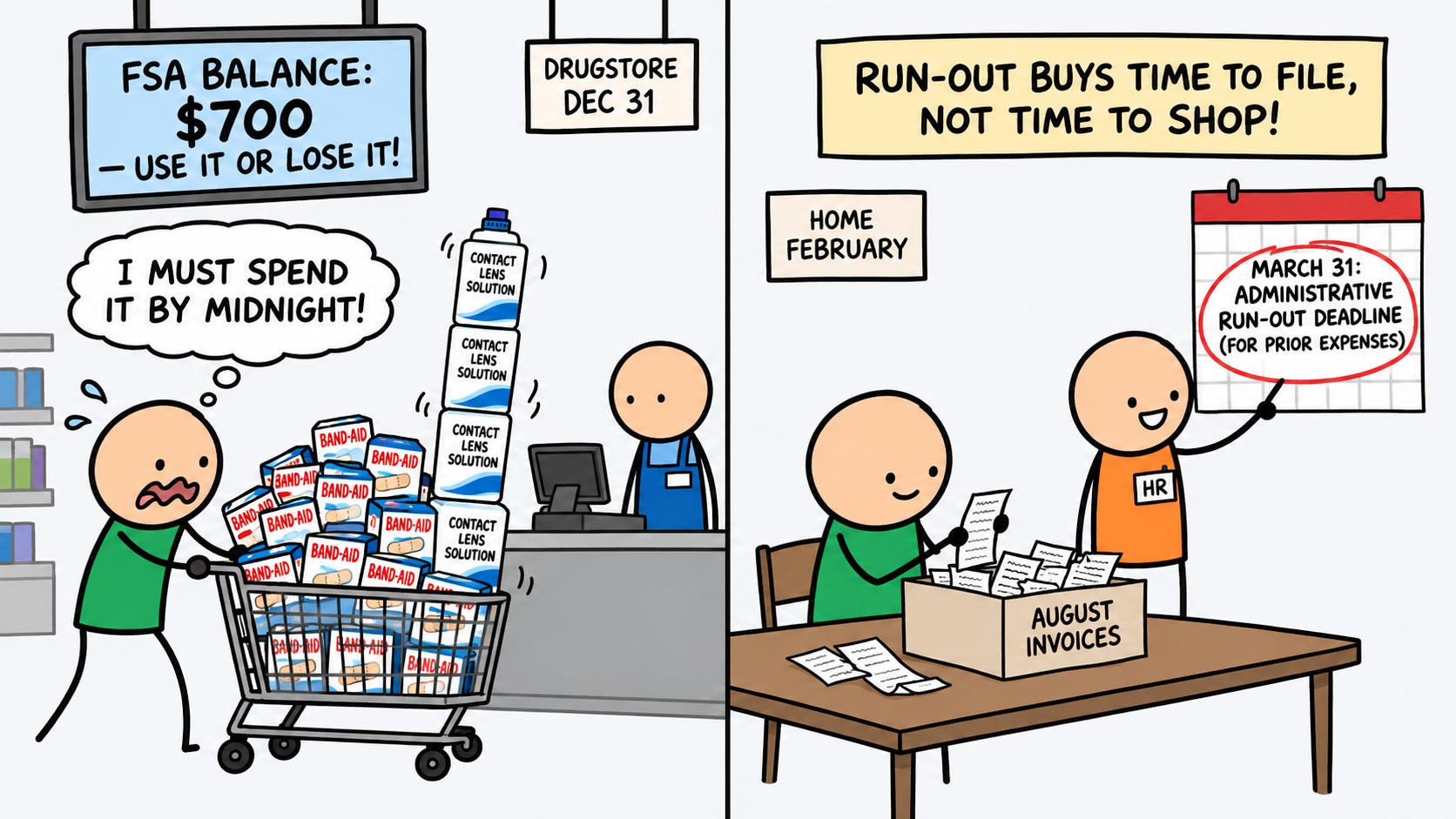
Every December a particular kind of panic sets in. Somebody logs into their benefits portal, sees a health flexible spending account balance they forgot about, and starts hunting for something to spend it on. Glasses they do not need. A year of contact lens solution. Anything with an expiration date further out than the deadline.
The panic is often justified and sometimes completely unnecessary, and which one depends on three separate deadlines that most plans explain badly. Two of them extend your time. One of them has nothing to do with spending at all. People routinely confuse the one that lets them buy things with the one that only lets them file paperwork, and the difference decides whether the money survives.
Start with the default rule, because everything else is an exception to it. Money you elect into a health FSA is available for eligible expenses incurred during the plan year. Amounts still unused after the plan’s grace period, carryover, and claim submission rules have all been applied are forfeited. The account is funded with your pretax dollars, and you cannot get the unused portion refunded to you.
That is the use-it-or-lose-it rule, and it is the reason an HSA behaves so differently. An HSA is an account you own. The balance rolls forward year after year with no deadline, it comes with you when you change jobs, and nobody takes it at year end. An FSA is a benefit your employer administers, and the forfeiture rule is structural to how the arrangement works.
Employers may soften the FSA rule in one of two ways, and the choice belongs to the plan.
The first is a grace period. It gives you up to two and a half months after the plan year ends to incur new expenses against last year’s balance. December money can buy a February dental visit.
The second is a carryover. It lets a capped amount of unused health FSA money move into the next plan year and stay usable. The cap is set annually and moves with inflation, so last year’s number is the wrong one to plan against, and anything above the cap is forfeited as usual. Carryover applies to health FSAs. Dependent care accounts do not get it, though a dependent care plan can still offer a grace period if it chooses to.
A plan may offer a grace period, or a carryover, or neither. It cannot offer both. That single sentence resolves most of the confusion people have about their own plan. The answer sits in your plan documents, because this is an employer election.
Now the third deadline, the one that causes the most avoidable losses.
The run-out period is the window after the plan year ends for submitting claims for expenses you already incurred during the year. It is administrative. It buys you time to file paperwork and buys you no time at all to spend money. A plan can have a run-out period alongside a grace period or a carryover, because they do different jobs.
So the December question has two halves. Do I have time to incur more expenses, which is the grace period or carryover question. And how long do I have to submit what I already spent, which is the run-out question. A person with a January 31 run-out deadline and no grace period has zero days left to buy anything and a month left to file.
One more mechanic that makes the whole arrangement less reckless than it sounds. Your full annual health FSA election is available to you from the first day of the plan year, even though your contributions come out of paychecks across the year. Somebody who elects a year’s worth and needs surgery in February has the whole amount available in February. That front-loading is part of the bargain the forfeiture rule pays for, and it applies to health FSAs. A dependent care account reimburses only what has actually been contributed so far.
And if you leave the job, health FSA participation generally ends with the employment, and expenses incurred afterward are usually not eligible. A run-out period may still let you submit claims for expenses incurred while you were covered, and COBRA continuation rights can change the answer for some health FSAs. An HSA in the same situation simply leaves with you.
Say a woman elects $2,400 to a health FSA for a calendar plan year and has $700 left on December 31.
Her plan offers a carryover and a March 31 run-out period.
She has until March 31 to submit claims for anything she incurred during the plan year and never filed, including the physical therapy receipts sitting in a drawer since August. Once those claims are accounted for, the carryover preserves up to the plan’s permitted cap for use in the new year, and any remaining amount above that cap is forfeited. The order matters: the receipts get reimbursed first, and only what is left over faces the cap.
Change one fact. Her plan has a grace period instead of the carryover, again with a March 31 run-out. Now the entire $700 stays available, and she has until March 15 to incur new expenses against it. The March 31 run-out gives her until then to submit claims for anything incurred through March 15.
Change it again. Her plan offers neither a grace period nor a carryover, with the same March 31 run-out. What March 31 gives her is the chance to dig out old receipts and get reimbursed for expenses she already had, which is frequently enough to recover a meaningful part of the balance.
Three plans, same balance, same date, and three different answers.
The useful move is to find two dates and one fact before December, and all three are in your plan documents or one call to the benefits administrator.
The two dates are the last day to incur expenses and the last day to submit claims. Those are frequently different, often by months, and confusing them is how people either panic early or miss the actual deadline.
The one fact is which softener your plan has, if any. Grace period, carryover, or neither. It determines whether December is a deadline or just a date.
If you are in December now with a balance, start by checking for unsubmitted receipts from earlier in the year before buying anything. Getting reimbursed for expenses you already had puts money back without spending any, and the run-out period is usually longer than people assume.
And when the next election comes around, the carryover or grace period is worth knowing about before you pick a number. A plan with neither one makes the size of your election matter more, because the downside of overshooting is total.
The forfeiture rule is old, unpopular, and still the law, and the whole game is knowing which of your three deadlines is the one actually approaching.
I write one of these every day, one retirement rule, explained in plain language and verified against the source. The daily email is free: subscribe here.
Full archive, worksheets, and search live at RetirementNewsRundown.com.
Disclaimer
This article is for educational and informational purposes only. It is not tax, legal, or financial advice and does not create an advisor-client relationship. Always consult appropriate professionals regarding your specific situation.