A retiree who has been in Medicare Advantage for six years reads the plan comparisons in November, picks a new plan with a lower premium, and starts it January 1. By the third week of January he learns that his cardiologist left the network in the switch and that one of his prescriptions now requires a prior authorization fight every refill.
He assumes he is stuck until next October, because the enrollment season everyone talks about closed on December 7. He actually has until March 31 to change his mind, once. What he does not know yet is that changing his mind toward a supplement comes with a condition nobody put in the November mailers.
Medicare runs a second enrollment window that gets a fraction of the attention of the autumn one. The Medicare Advantage Open Enrollment Period runs January 1 through March 31 every year, and it exists precisely for people who chose an Advantage plan and regret it.
It is only for people already enrolled in a Medicare Advantage plan. Inside it, you get one change for the year, and that change can go in one of two directions. You can switch to a different Advantage plan, with or without drug coverage. Or you can drop Advantage entirely, return to Original Medicare, and join a separate Medicare drug plan at the same time. The new coverage starts on the first day of the month after the plan receives your request.
The window has firm edges. It cannot move somebody from Original Medicare into an Advantage plan. It cannot be used to swap one standalone drug plan for another while you are in Original Medicare. And one change means one. Switch plans in January and discover a problem with the new one in February, and this window has nothing left to give you.
People new to Medicare get a similar one-time opportunity. If you join a Medicare Advantage plan when you first get Medicare, you can switch to another Advantage plan or return to Original Medicare during the first three months you have both Part A and Part B.
Miss March 31 and the plan you chose is generally the plan you keep until the autumn window reopens, with coverage changes taking effect the following January. That is nine more months, absent a special enrollment period, in a plan that did not work.
Now the condition that matters most, and it applies to anyone using this window to leave Advantage.
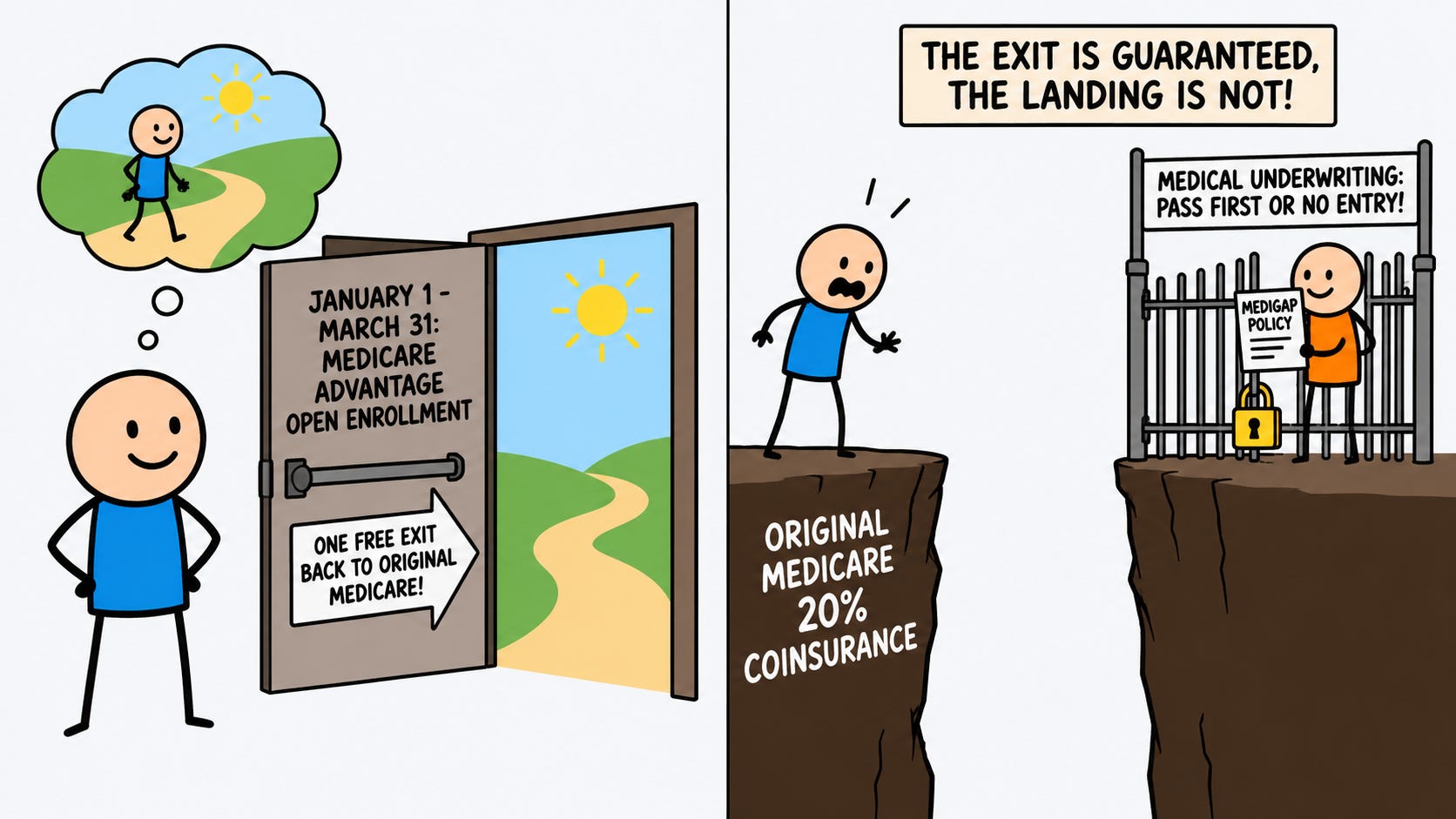
The exit is guaranteed. What happens at the other end depends on an insurance company. The January window lets you return to Original Medicare, but by itself it creates no right to buy a supplement without medical underwriting. Outside a Medigap open enrollment period or a guaranteed issue right, federal law may allow an insurer to underwrite, charge more, or decline the application. For somebody six years into Advantage, the health questions cover six years of diagnoses. Some states provide additional Medigap protections, so state law can change that answer.
There is an important exception, and it catches people in both directions. If you are still inside the first year of a trial right, which covers people who joined Advantage when first eligible at 65 and people who dropped a Medigap policy to try Advantage for the first time, the trial right carries its own Medigap protection. Use your exit while that trial is live and the supplement comes with guaranteed issue, subject to the specific Medigap plans that trial right allows. Use it a year later and the same exit comes without one.
So the window answers one question cleanly, which is whether you can leave. Whether you can get the coverage you are leaving for is a separate question with a separate answer.
Take the retiree from January. He is past any trial right, having been in Advantage for years, and he wants Original Medicare with a supplement.
He applies for a Medigap policy first, in early February, with the effective date set to begin after his Advantage coverage ends. Medicare permits a supplement to be sold in advance that way when someone is switching back to Original Medicare. Two companies ask their health questions. One declines. Once the other confirms it will issue a policy at a premium he can live with and a March 1 effective date, he uses the January window to drop the Advantage plan, returns to Original Medicare effective March 1, and joins a standalone drug plan at the same time. All three are coordinated to March 1 and he has no gap anywhere.
Run the order the other way. He drops the Advantage plan in February first, because that was the part he was sure about, and applies for Medigap afterward. Both companies decline. He is now in Original Medicare with a drug plan and no supplement, carrying the full share of costs that Original Medicare leaves to the patient, and his window has been used. The one change is spent.
Same person, same health, same window. The difference is which step he took first.
The useful way to hold this is that the January window guarantees the exit and says nothing about the landing. Treat those as two separate questions and the window becomes a genuinely useful tool.
If you are in an Advantage plan that is not working and you want to move to a different Advantage plan, this window handles it cleanly. Pick carefully, since you get one change.
If you want Original Medicare with a supplement, the order of operations decides the outcome. Before disenrolling, apply for the Medigap policy you want and confirm in writing whether the insurer will issue it, the premium, and the effective date. The policy cannot begin until your Advantage coverage ends, but it can be arranged in advance so that it starts the day the Advantage plan stops. Knowing those three answers turns the exit into a plan.
If you are inside a trial right, check the dates. The protection that makes the supplement safe runs on its own clock, and the January window will still be there in later years without it.
And whichever direction you go, drug coverage belongs in the same move. The window lets you join a standalone drug plan as part of dropping Advantage, which is the easiest moment to avoid a gap.
The autumn season gets the advertising because it is when plans compete for new members. The January window gets almost none, since its only purpose is letting existing members leave. That is a fair description of why so few people know it exists, and a good reason to know it well if you are about to choose a plan this autumn.
I write one of these every day, one retirement rule, explained in plain language and verified against the source. The daily email is free: subscribe here.
Full archive, worksheets, and search live at RetirementNewsRundown.com.
Disclaimer
This article is for educational and informational purposes only. It is not tax, legal, or financial advice and does not create an advisor-client relationship. Always consult appropriate professionals regarding your specific situation.