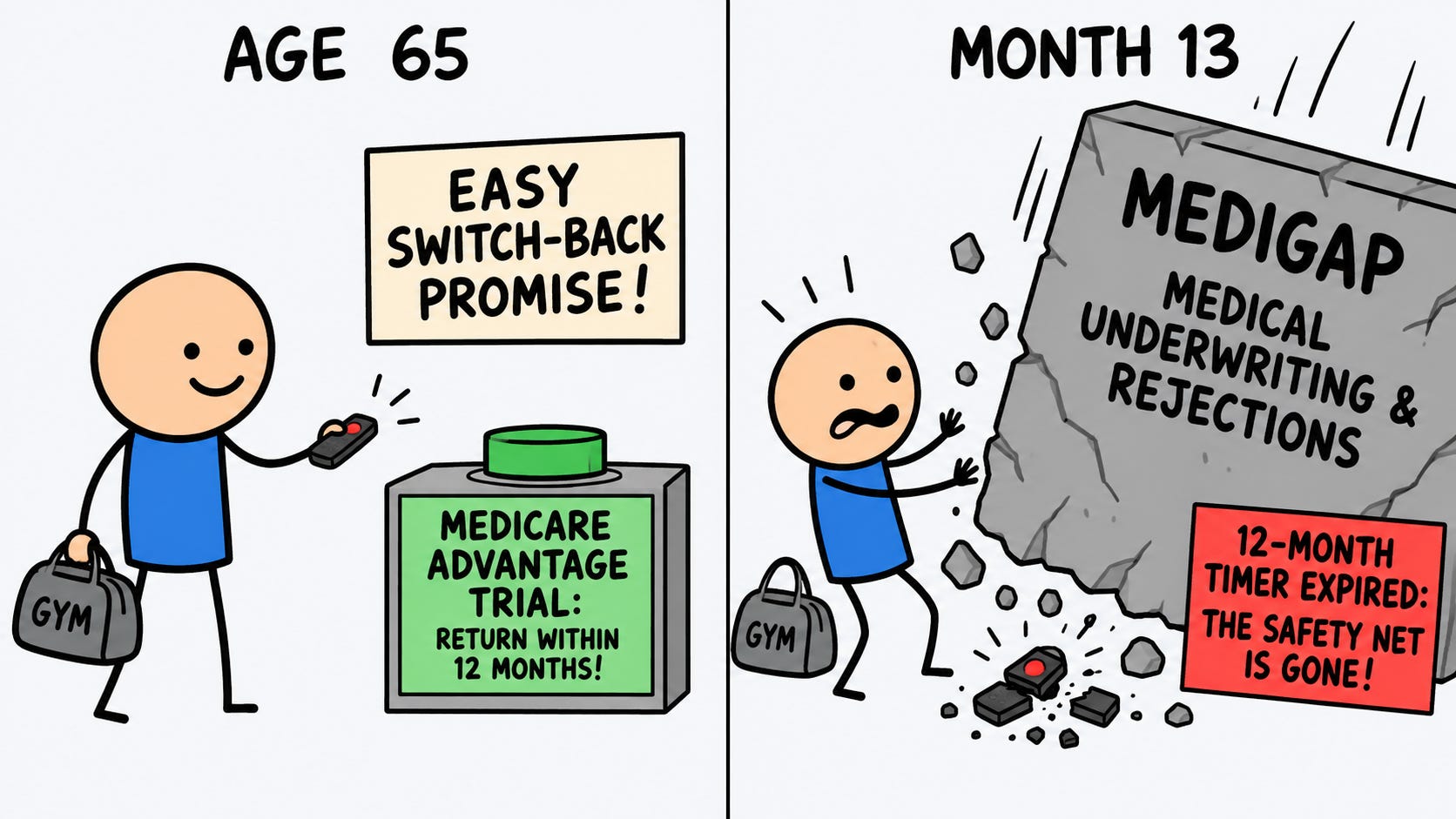
Somebody turning 65 hears the same reassurance from three different directions: try Medicare Advantage, and if you hate it you can always switch back. The premium is low, the ads are friendly, and the promise of an exit makes the choice feel reversible.
The promise is real for about a year. It comes with conditions nobody mentions in the ad, and it requires two separate pieces of paperwork that run on two separate clocks. Get both right inside the first year and the decision really is reversible. Miss either one and the exit still exists, but the protection that made it painless is gone.
There are two trial rights, and which one you have depends on where you started.
The first belongs to people who are new to Medicare. You joined a Medicare Advantage plan, or a PACE program, when you first became eligible at 65. If you decide within the first year that you want Original Medicare instead, you get a guaranteed issue right to buy any Medigap policy sold by any company in your state. Any plan letter, any insurer, no health questions, no charging you more for your health, and no waiting period on pre-existing conditions. That is the broadest version of this protection anywhere in Medicare.
The second belongs to people who already had a supplement. You dropped a Medigap policy to try a Medicare Advantage plan, or to switch to a Medicare SELECT policy, for the first time. If you have been in it less than a year and want out, you can repurchase the Medigap policy you gave up, provided the same company still sells it. If it does not, federal law lets you buy Plan A, B, C, D, F, or G from an insurer in your state, with Plans C and F limited to people who were eligible for Medicare before January 1, 2020.
Two words in that second right carry real weight. First time means you get one trial. Try Advantage, come back, try it again later, and the second attempt has no trial right attached. And the repurchase depends on your old company still offering your old policy, which is out of your control.
Now the part that trips people up. Using either right takes two separate actions.
The first action is leaving the Advantage plan. Medicare provides a special enrollment period for this under either trial right, and your chance to drop the plan lasts 12 months from the date your Advantage coverage began. Drop it and you return to Original Medicare automatically.
The second action is buying the Medigap policy. That runs on the guaranteed issue clock, which lets you apply as early as 60 days before your Advantage coverage ends and as late as 63 days after it ends.
Two clocks, measured from different starting points, and the second is useless if you blow the first. A Medigap right does you no good while you are still enrolled in the Advantage plan with no way out of it.
There is a third thing to arrange if your Advantage plan included drug coverage, as most do. Leaving the plan ends that drug coverage too. Medicare provides a coordinating window to join a standalone drug plan when you use either trial right, so the replacement needs lining up alongside the return to Original Medicare. A gap of 63 consecutive days or more without creditable drug coverage can trigger a late enrollment penalty once you do enroll, and that penalty generally lasts as long as you have Medicare drug coverage. Somebody busy getting the supplement right can walk straight into that one.
There is one unusual extension. If your plan is involuntarily terminated during that first trial year and you move directly into another qualifying plan, federal rules can carry the trial protection into the second enrollment. It cannot be stretched past two years from the date you first joined the original plan. States can add protections of their own on top.
Act later than the first year and the trial is over. You can still leave an Advantage plan through the ordinary annual enrollment windows, but returning to Medigap at that point generally means medical underwriting, and a company can decline you or price you on your health. The exit survives. The protection does not.
Say a woman turns 65 and her Medicare Advantage coverage begins March 1, which means her 12-month trial period runs through the end of the following February. She chose the plan for the low premium and the gym membership.
By November the network has become a problem. Her preferred specialist is out of network, and a referral fight has taken six weeks.
She is still inside her first year, so both rights are live. She uses the special enrollment period to drop the plan effective December 1, which puts her back in Original Medicare. She applies for a Medigap policy in October, inside the 60-days-before window, and because she joined Advantage when first eligible at 65, she can buy any policy from any company in her state. She picks the plan she wanted all along. The two conditions she developed during the year never come up. She lines up a standalone drug plan starting December 1 so there is no gap in drug coverage.
Run it the way it usually goes. She means to deal with it, the holidays arrive, and she gets around to it the following May. Her first year ended in February. She can leave the plan during the next enrollment window, but every Medigap application now includes health questions, and the conditions she developed during that first year are exactly what the underwriter reads.
Same plan, same frustration, same person. The difference is whether she acted while the first year was still running.
The useful way to hold this is that Medicare Advantage at 65 is reversible on a timer. The trial right is a real safety net and a genuinely generous one, especially the first version with its any-policy-any-company protection. It just has an expiration date that nobody sends you a reminder about.
If you are inside your first year of Advantage now, the date that matters is twelve months from when you joined. That is the deadline for leaving through the trial period, and the Medigap application has to line up with it. Starting both before the final month gives you room to fix a problem with either one.
If you are weighing Advantage at 65 and the exit is part of why it feels safe, it is worth knowing that the exit is shaped like this. One year, two actions, drug coverage to replace, and one trial per lifetime for the second version.
And if your first year has already passed, the situation has changed and some routes remain open. Some states have their own protections, including annual switching windows, and those are worth checking before assuming underwriting is the only route back.
The promise was always “you can switch back.” The fine print is that during the trial period, switching back comes with federal Medigap protections. After it, you may still be able to return to Original Medicare, but getting a Medigap policy can depend on underwriting, state law, and whether some other guaranteed issue right applies.
I write one of these every day, one retirement rule, explained in plain language and verified against the source. The daily email is free: subscribe here.
Full archive, worksheets, and search live at RetirementNewsRundown.com.
Disclaimer
This article is for educational and informational purposes only. It is not tax, legal, or financial advice and does not create an advisor-client relationship. Always consult appropriate professionals regarding your specific situation.