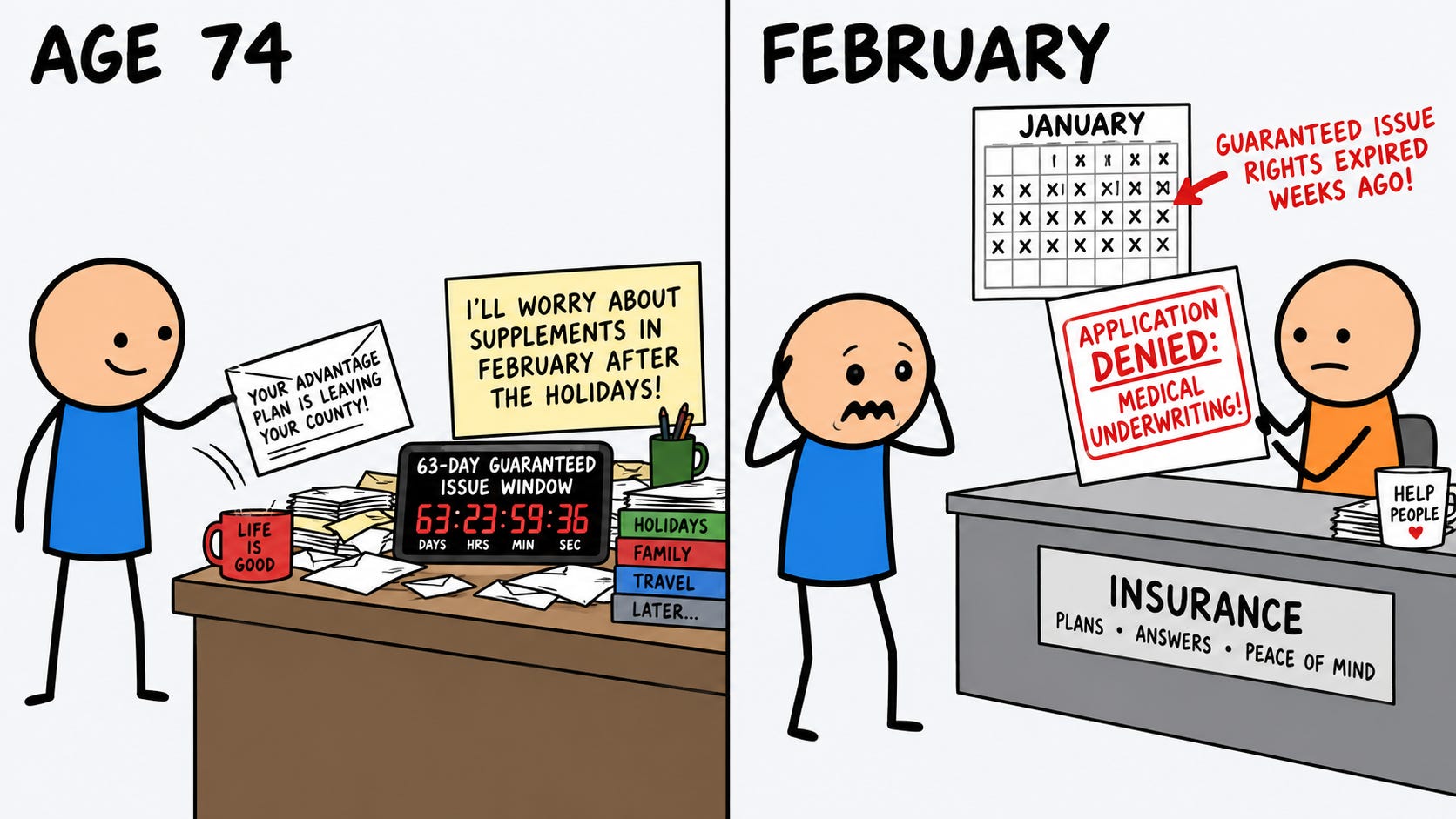
A man gets a letter in October saying his Medicare Advantage plan is leaving his county at the end of the year. He has been in it since 65, he is now 74, and he decides this is the moment to go back to Original Medicare with a supplement.
He calls in April, after the dust settles and he has had time to compare options, and gets asked about his health. Two companies decline him.
What he had, and spent, was a guaranteed issue right. For a defined stretch of days he could have bought a supplement with no health questions at all, and the letter announcing his plan’s departure was the thing that created it.
A “guaranteed issue right” is a period when an insurance company has to sell you certain Medigap policies. It cannot refuse you, it cannot charge you more because of past or present health problems, and it must cover your pre-existing conditions with no waiting period. That last part makes it stronger in one respect than the six-month window at 65, where a waiting period for a pre-existing condition can apply unless prior creditable coverage removes it. This is a separate federal protection, and it can arrive long after that original window has closed.
Medicare’s current guide describes seven common federal situations, and states can add protections of their own. The seven sort into two groups.
The first group covers coverage disappearing on you. Your Medicare Advantage plan leaves Medicare, stops serving your area, or significantly changes its network, or you move out of its service area. Your employer or union coverage that pays after Medicare is ending, which includes retiree coverage and COBRA. You have a Medicare SELECT policy and you move out of its service area. Your Medigap insurer goes bankrupt, or your policy ends through no fault of your own. Or you leave a plan because the company broke the rules or misled you.
The second group is the trial rights, which exist for people testing Medicare Advantage. You joined an Advantage plan or PACE when you first became eligible at 65 and want to switch to Original Medicare within the first year. Or you dropped a Medigap policy to try an Advantage plan or Medicare SELECT for the first time, have been in it under a year, and want your supplement back. That right principally lets you repurchase the policy you gave up, provided the same company still sells it, with a defined set of plan letters available when it does not.
Which policies you can buy depends on which right you have. Most of these rights entitle you to a defined set of plan letters. The first-year trial right at 65 is broader: it lets you buy any Medigap policy sold by any company in your state. Plans C and F are generally unavailable to people who became newly eligible for Medicare on or after January 1, 2020. People who were eligible before that date may still be able to buy them, so whether those letters appear on your list depends on when you became eligible.
Now the timing, where a single tidy rule would be convenient and would also be wrong.
The clocks differ by which right you hold. Many of them run up to 63 days after the old coverage ends, and several let you apply as early as 60 days before it ends, which stretches the practical window toward four months. The Medicare Advantage situations, a Medicare SELECT move, and both trial rights generally work that way. A Medigap policy lost to insolvency, or ending through no fault of your own, generally gives you 63 days after that policy ends.
One category runs on a different trigger, and it runs in your favor. When employer, retiree, COBRA, or union coverage that pays after Medicare is ending, the 63 days run from the latest of three dates: the day the coverage ends, the date on the termination notice, or the date of a claim denial if that is how you learned about it. A notice that arrives late, or a termination you discover only when a pharmacy claim bounces, can move the start of that window.
Whichever right you hold, acting after it expires is the same outcome. You are back to ordinary underwriting, where the company asks about your health and decides. Nothing about your circumstances changed. The calendar did.
One more thing the insurance company will want: proof. Keep the letter announcing the plan’s departure, the notice that employer coverage is ending, or whatever document established the event. You are claiming a right, and rights get documented.
Say a woman has retiree coverage that pays after Medicare, and the employer announces it ends June 30. The notice arrives March 15.
Her window runs 63 days from the latest of the three dates, which here is the June 30 coverage end, so she has until roughly September 1. Inside it, any company selling the eligible plan letters in her state has to take her, without charging her more because of her health, with her existing conditions covered from day one.
She applies in July. Done, and her health never comes up.
Run it the way it usually goes. She gets busy, and in October decides to sort out a supplement before year end. The window closed weeks earlier. Every application now includes health questions, and the two conditions she has developed since 65 are on the table.
Now suppose the employer was slow and the notice reached her in August, after the June 30 termination. Her 63 days would run from that August notice date, buying her into October. The same application that failed above now succeeds, because this category measures from the latest of the three dates.
The useful thing to hold onto is that an event creates these rights. Something happens to your coverage, and that event starts a short clock running.
So the moment to act is when the letter arrives, which is usually months before anything actually changes. People wait for the coverage to end because that feels like the real deadline, and the waiting is what burns the window.
If you are in the middle of one of these situations now, the questions worth answering are which event applies to you, what date the window runs from, and which plan letters your particular right entitles you to buy. Those three answers determine everything and none of them are obvious from the letter itself.
If you think your window has closed, it is still worth checking the three dates before accepting that. A notice that arrived after the coverage ended, or a termination you learned about from a denied claim, can put you inside a window you assumed was gone.
And if active employer coverage based on current employment is ending, that event may also affect your Part B special enrollment period. Retiree coverage and COBRA run on different Part B rules, even though losing either can create a Medigap guaranteed issue right. Our Medicare special enrollment period checklist covers the timing and documents that enrollment requires.
These rights are among the few places in Medicare where the rules run clearly in your favor. They are also among the easiest to miss, because they arrive inside a letter about something else and expire while you are still deciding what to do about the news.
I write one of these every day, one retirement rule, explained in plain language and verified against the source. The daily email is free: subscribe here.
Full archive, worksheets, and search live at RetirementNewsRundown.com.
Disclaimer
This article is for educational and informational purposes only. It is not tax, legal, or financial advice and does not create an advisor-client relationship. Always consult appropriate professionals regarding your specific situation.