The renewal notice arrives every year and the number on it is always a little larger. At 66 that reads as ordinary. At 78, after a dozen of them, the premium has become one of the larger line items in a fixed budget, and somebody who bought carefully at 65 starts wondering what happened.
So she calls a company advertising the same lettered plan for considerably less. The conversation goes well until the health questions start. Have you been treated for these conditions. What medications are you taking. When was the last time you saw a specialist. A week later the answer comes back as a decline, and the premium she was trying to escape renews on schedule.
Both companies are behaving normally. Medigap simply has no annual shopping season. In most states, the benefits in each lettered plan are fixed, so Plan G from one company provides the same standardized benefits as Plan G from another.
Start with the thing that makes Medigap pricing strange. The benefits in each lettered plan are fixed by law, so Plan G from one company covers exactly what Plan G from another company covers. Identical coverage, identical rules, different price tags. Shopping is therefore a pure price exercise, which is precisely why losing the ability to shop costs real money.
Premiums typically increase each year for everybody. Underneath that, insurers use one of three pricing methods, and which one you bought determines how steep your particular climb is.
Community-rated policies charge generally the same premium to everyone holding that plan, regardless of age. The price still moves with inflation and claims experience. Your age stops being a factor once you are in.
Issue-age-rated policies set the premium from your age at purchase. Buy younger, pay less, and that starting point does not rise merely because you are getting older. Other increases still apply.
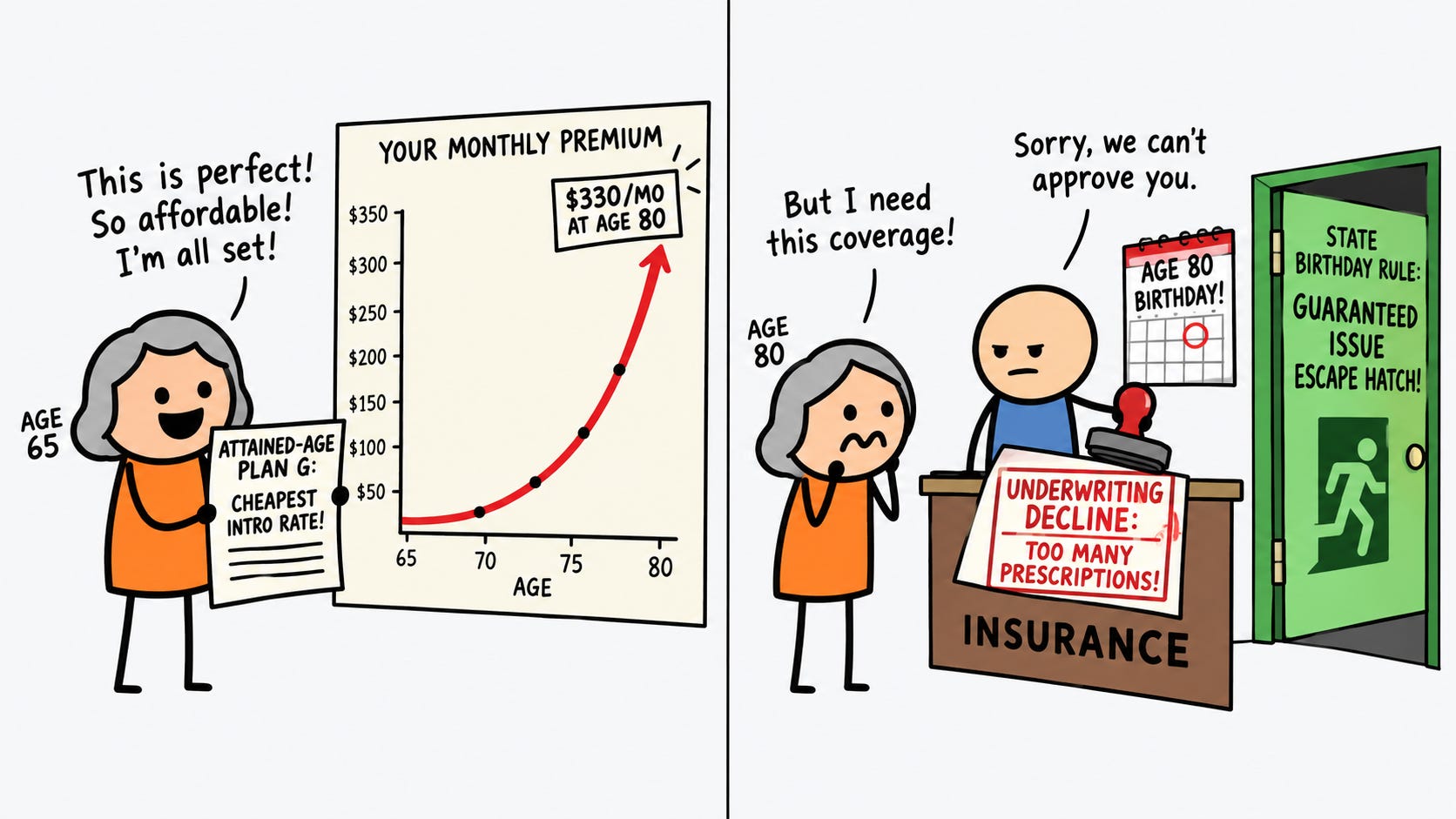
Attained-age-rated policies price on your current age, so the premium goes up as you get older on top of everything else. Attained-age-rated policies are often inexpensive at younger ages because the premium is based on your current age. As you get older, age-related increases stack on top of inflation and other increases, so a policy that looked inexpensive at 65 can become considerably more expensive later.
Nothing on the renewal notice announces which one you have. It was decided when you signed.
Now the second half, which turns a pricing question into a trap.
Federal rules give you a six-month open enrollment window when you first have Part B at 65 or older, plus specific guaranteed issue rights in defined situations. Outside those, an insurance company may run medical underwriting when you apply, and it may decline you. There is no federal annual window for Medigap that works the way the autumn enrollment season works for drug plans and Advantage plans.
So the person most motivated to shop, somebody who has held a policy long enough to watch the premium climb, is usually the person least able to. Thirteen more years of medical history sit between them and a new application.
Acting later makes both halves worse at once. Each year older raises the premium on an attained-age policy, and each year of accumulated diagnoses and prescriptions makes underwriting harder. Every additional year makes the application harder, which is a slower version of a deadline and considerably easier to ignore.
There are ways through it. Some states have adopted a birthday rule or a similar annual window letting existing Medigap policyholders change plans without underwriting. These are state laws, and they vary in almost every detail: how long the window runs, whether it starts on your birthday or the first of that month, whether you can move to any insurer or only within your current one, and whether you can switch only to equal or lesser benefits. A growing number of states have one, some have anniversary or year-round versions instead, and the list changes. Your state insurance department is the authority on whether yours does.
One more mechanic worth knowing before any switch. When you do buy a new policy, you get 30 days to decide whether to keep it. That free look period is the reason the old policy stays in force until the new one is genuinely in hand.
Say a woman buys Plan G at 65 for $140 a month, the lowest quote she found.
It was attained-age-rated, which is why it was the lowest quote. By 72 she is paying around $210. By 80, with age increases stacked on top of ordinary annual increases, she is near $330.
A neighbor with identical Plan G coverage pays less, having bought an issue-age-rated policy at 65 for $165. It looked worse on day one by $25 a month. Fifteen years later it looks considerably better, because her price never rose for the single reason of her getting older.
At 80 the first woman applies elsewhere. She has developed two conditions that are entirely ordinary for 80 and entirely disqualifying for underwriting purposes. She is declined by two companies and stays where she is.
Run the version where her state has a birthday rule. Each year a window opens around her birthday in which she can move to another company’s Plan G, or in some states to a plan with equal or lesser benefits, without answering a single health question. The same conditions that got her declined at 80 are irrelevant inside that window. She switches and her premium drops.
Same person, same health, same plan letter. The difference is which state she lives in and whether she knew the window existed.
The practical starting point is finding out which pricing method your policy uses, which means calling the company and asking directly. That single fact tells you whether your premium will keep climbing for reasons of age alone or only for the reasons everybody faces.
Then find out whether your state offers a birthday rule, anniversary rule, or any continuous guaranteed issue protection. This is the item most likely to save somebody real money, and it is also the one almost nobody knows to ask about, because it exists in state law and Medicare’s mailings cover federal rules.
If you are shopping for a policy now, the quote is only part of the comparison. Two policies with identical coverage and a $25 monthly difference can trade places entirely within a decade depending on how each is rated.
If you already hold a policy and the premium has become a problem, the honest position is that your options depend on your state and your health, and both are worth checking before assuming there are none. An application that gets declined costs you nothing but time, and your existing coverage continues while you find out.
The system does not announce any of this. The renewal notice shows a number and a due date, the pricing method that produced it goes unmentioned, and the state protection that might let you leave is never in the envelope.
I write one of these every day, one retirement rule, explained in plain language and verified against the source. The daily email is free: subscribe here.
Full archive, worksheets, and search live at RetirementNewsRundown.com.
Disclaimer
This article is for educational and informational purposes only. It is not tax, legal, or financial advice and does not create an advisor-client relationship. Always consult appropriate professionals regarding your specific situation.